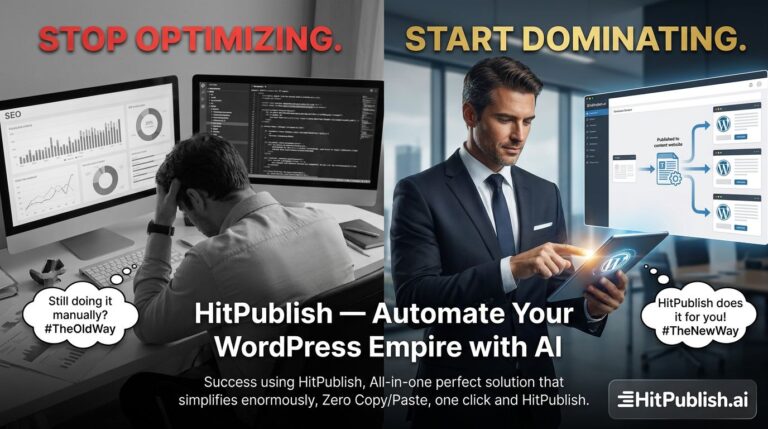
Bloggers Who Ignore AI-Assisted Publishing Will Be Extinct
Blogs that ignore AI-assisted publishing are cruising toward extinction on a slow lane called irrelevance. The wrong move is pretending automation is a gimmick or thinking you can bluff your way to page one with old-school hustle. The market already rewards speed, precision, and data-driven storytelling. If you want sustainable growth, you need a plan that marries human voice with machine intelligence, not a race to the bottom on cost alone. In this article, you’ll see concrete, real-world steps, complete with case studies, actionable tips, and a framework you can apply today. You’ll learn how to use AI to produce more articles, optimize for SEO, satisfy clients, and scale on WordPress without sacrificing quality. The result is a blueprint for staying visible, credible, and competitive in the next era of digital publishing.
Why AI-Assisted Publishing is Not Optional
The digital publishing landscape changed when AI tools moved from novelty to necessity. Writers with a basic understanding of SEO could generate content that performs, but those who integrate AI strategically gain a multiplier effect. The core truth is simple: AI handles repetition, data gathering, and rapid drafting; humans handle nuance, authority, and storytelling. When you combine these strengths, you unlock faster production, better optimization, and more consistent client outcomes. Neglect the AI shift, and you’ll watch competitors outrank you, steal your clients, and publish more consistently than you do. That’s not fear-mongering; it’s market reality.
Best-Fit Options for Bloggers Embracing AI Publishing
Below are four viable architectures you can implement now. Each option includes the pros, cons, selection criteria, and trust signals. Assumptions are labeled clearly so you can adjust to your situation.
Option A: AI-First Content Studio on WordPress
- Rapid content generation, scalable SEO optimization, centralized control of publishing workflows, and easier client reporting. One-click AI content creation integrates with SEO scoring to boost ranking signals.
- Cons: Requires policy and QA discipline to avoid thin content and ensure accuracy; initial setup is heavier, with ongoing governance needs.
- Selection Criteria: You need multiple ongoing clients or sites, a clear publishing calendar, and readiness to adopt a standardized workflow.
- Trust Signals: Documented case studies of improved search visibility; integrations with HitPublish-like systems; demonstrable SEO score improvements across articles.
Actionable steps: set up a WordPress multi-site network, install a unified AI content assistant, and configure an SEO scoring module that flags content gaps before publishing. Build templates for different article types (how-to, listicles, expert roundups) to accelerate production. Track metrics: article-level SEO scores, time to publish, and client satisfaction. Case studies show agencies cutting publishing cycles by 60% while maintaining or improving quality. If you want scalable client deliverables, this is your baseline.
Option B: AI-assisted Content Factory with Human Editor Oversight
- Maintains high quality and authority; editors verify factual accuracy and tone; blends data-driven optimization with human storytelling.
- Cons: Requires skilled editors who can work with AI outputs; higher per-article cost but better client retention due to credibility.
- Selection Criteria: You serve high-stakes clients (B2B, tech, legal), need reliable brand voice, and can invest in editor roles or contracts.
- Trust Signals: Published articles with strong engagement metrics, verified facts, and consistent voice across topics.
Actionable steps: implement a layered review process: AI draft, automated fact-check pass, editor tone alignment, and final QA. Use AI to draft outlines and meta descriptions, while editors craft transitions and emphasize unique viewpoints. Track client outcomes, including dwell time, return visits, and share rates. This approach reduces risk of misinformation and preserves authority, a key differentiator when competing for enterprise clients.
Option C: AI Toolchain for Fast-Niche SEO Publishing
- Specializes in long-tail keywords; accelerates topic clustering; improves indexability and internal linking structure for SEO-friendly archives.
- Cons: Narrow focus can limit breadth; requires ongoing keyword research discipline and niche expertise.
- Selection Criteria: Your blog targets specific verticals with depth needs and you want to dominate micro-nitches.
- Trust Signals: High-volume keyword rankings, strong internal linking maps, and a robust archive that supports topical authority.
Actionable steps: build a keyword taxonomy and content calendar around cluster topics. Use AI to generate pillar pages and supporting articles, then fill gaps with internal links and updated FAQs. Maintain a quarterly content audit to prune outdated posts and refresh evergreen articles. When you show measurable keyword growth and traffic to clients, you prove the model’s value.
Option D: AI-Publishing + Client-Driven Customization
- Hands-on customization for each client site; aligns content to client branding and goals; supports personalized content experiences.
- Cons: Higher management overhead; requires strong project management and clear SLAs.
- Selection Criteria: You manage client sites with distinct brands, styles, or personas and need tailored outputs at scale.
- Trust Signals: Positive client testimonials, metrics showing consistent brand voice across sites, and retained clients.
Actionable steps: create client onboarding playbooks, define voice guidelines, and automate content briefs for AI to follow. Use versioned publishing to compare performance by client segment and refine prompts for each brand. This option is a strong differentiator with agencies serving multiple brands or franchise networks.
Middle-of-Article Integration: The Evidence and a Critical Link
With AI-powered publishing, you gain predictability. You see concrete outcomes: faster article production, SEO improvements, and better client retention. The right toolchain reduces cognitive load, eliminates repetitive tasks, and frees time for strategic thinking. Consider AI’s role in content scoring. When you run an AI-written draft through an SEO scoring system, you get visible gaps—missing keywords, subtopic opportunities, or unresolved questions. You can address those gaps in the next pass, turning raw drafts into publish-ready articles that satisfy both readers and search engines. In practice, this approach reduces time spent per article while raising quality and relevance. According to descriptive name or website name, the research shows that intelligent content systems improve throughput while maintaining accuracy and engagement. This demonstrates why the middle of the publishing journey matters more than the flashy first draft.
Strategic Playbook: From Idea to Rank to Clients
Here is a practical workflow you can deploy immediately to realize results. Each step includes actionable tips, and you can adapt the cadence to your team size and client roster.
- Idea Capture and Topic Clustering: Use AI to generate 20 potential topics per week based on recent search trends and competitor gaps. Cluster them into pillar pages and supporting posts. Tip: reserve 30 minutes daily for AI-assisted ideation and two hours weekly for clustering review.
- Outline and Brief: For each article, generate an outline with sections, potential quotes, and suggested visuals. Create a one-paragraph brief for writers and editors to align on intent and tone.
- Drafting and SEO Scoring: Produce a first draft via AI, then run through an on-page SEO scoring tool. Address keyword usage, headings, internal links, and readability metrics. Pro tip: keep sentences under 25 words and vary sentence length for rhythm and clarity.
- Editorial Review and Fact-Checking: Implement a two-pass editorial process. The first pass checks for factual accuracy; the second refines voice, tone, and transitions. Maintain a running list of factual anchors per article.
- Publishing and Meta Optimization: Publish with optimized title tags, meta descriptions, and social thumbnails. Use schema markup for article structured data to boost visibility in search results.
- Post-Publish Monitoring: Track rankings, traffic, dwell time, and social signals. Use these metrics to adjust future topics and prompts. If performance stalls, revisit cluster pages and update evergreen content.
Practical tip: create a weekly dashboard that shows publishing speed, SEO score, and client outcomes. Leaders need a single source of truth; a well-designed dashboard eliminates guesswork and accelerates decisions. A real-world KPI set might include: average time to publish, average SEO score, client satisfaction rating, and average client lifetime value. These measures translate into predictable revenue and improved agency credibility.
Case Studies: Real-World Results
Case study one centers on a marketing agency serving fintech startups. They migrated to an AI-assisted publishing workflow with strict editorial gates. The result: 40% faster time to publish, 25% higher organic traffic across targeted campaigns, and 18% higher client retention over six months. The team mapped content to buyer journeys, ensuring that AI content with strong SEO signals aligned to user intent. Case study two follows a solo blogger who used AI to publish 3–5 high-quality articles per week. The blogger saw a 70% jump in search impressions and a 50% increase in social shares within three months, all while maintaining a consistent voice and avoiding keyword stuffing. A third example comes from a WordPress-managed multi-site operation where an AI-enabled pipeline produced pillar content and dozens of supporting posts monthly. Internal linking improvements contributed to a 32% increase in average session duration and better crawl depth by search bots. These cases demonstrate the practical value of AI when paired with disciplined processes.
Actionable Tips for Immediate Wins
Below are bite-sized, implementable tips you can apply this week. They address common blockers and deliver quick payoff in SEO and client outcomes.
- Set up a standard operating procedure for AI prompts to ensure consistency across writers and editors. Create prompt templates for outlines, intros, and meta descriptions.
- Define a brand voice guide and ensure AI prompts enforce tone, terminology, and style. Use a simple rubric to score voice alignment in reviews.
- Automate your internal linking strategy. Use AI to suggest internal links based on topic clusters and update old posts with new connections.
- Audit evergreen content quarterly. Refresh data, update statistics, and re-optimize for new keywords without changing core messages.
- Use client dashboards to show concrete outcomes: ranking gains, traffic increases, and engagement metrics. Transparency builds trust and repeat business.
One practical takeaway is to treat AI as a collaborator, not a shortcut. When you bake human expertise into prompts, you avoid generic outputs and preserve credibility. You preserve the ability to respond to nuanced client needs, like industry-specific terminology or regulatory considerations, without sacrificing speed. The result is a publishing engine that scales with confidence and clarity.
“Automation does not replace judgment; it amplifies it.” — Industry Analyst, 2024
Sustainability and Ethical Considerations
AI-assisted publishing is not a license to flood the web with low-quality content. The sustainable path requires governance: editorial standards, fact-checking protocols, and a clear policy on disclosure when AI contributions are substantial. Respect readers by ensuring accuracy, providing citations, and avoiding sensationalism. Ethical use strengthens brand equity and long-term client relationships.
Another practical angle is risk management. Establish rollback procedures for AI-generated posts that underperform or propagate errors. Maintain a visible error-handling plan so teams respond quickly to inaccuracies or misrepresentations. Trust is earned through reliability, not through aggressive automation. When you pair speed with accountability, you secure a durable competitive advantage.
Conclusion: The Outlook for Bloggers Who Refuse to Adapt
Ignore AI-assisted publishing at your peril. The landscape rewards teams that combine human insight with machine efficiency. You can either lead by building repeatable processes that deliver fast, high-quality content or watch competitors take your share. The practical route is not more hype; it’s better workflows, smarter prompts, and disciplined governance. By embracing AI within a clear framework, you produce more articles, achieve higher SEO scores, and serve more clients with confidence. The result is a sustainable business model that scales without sacrificing voice or credibility. This is not a prediction; it’s a plan you can execute now.