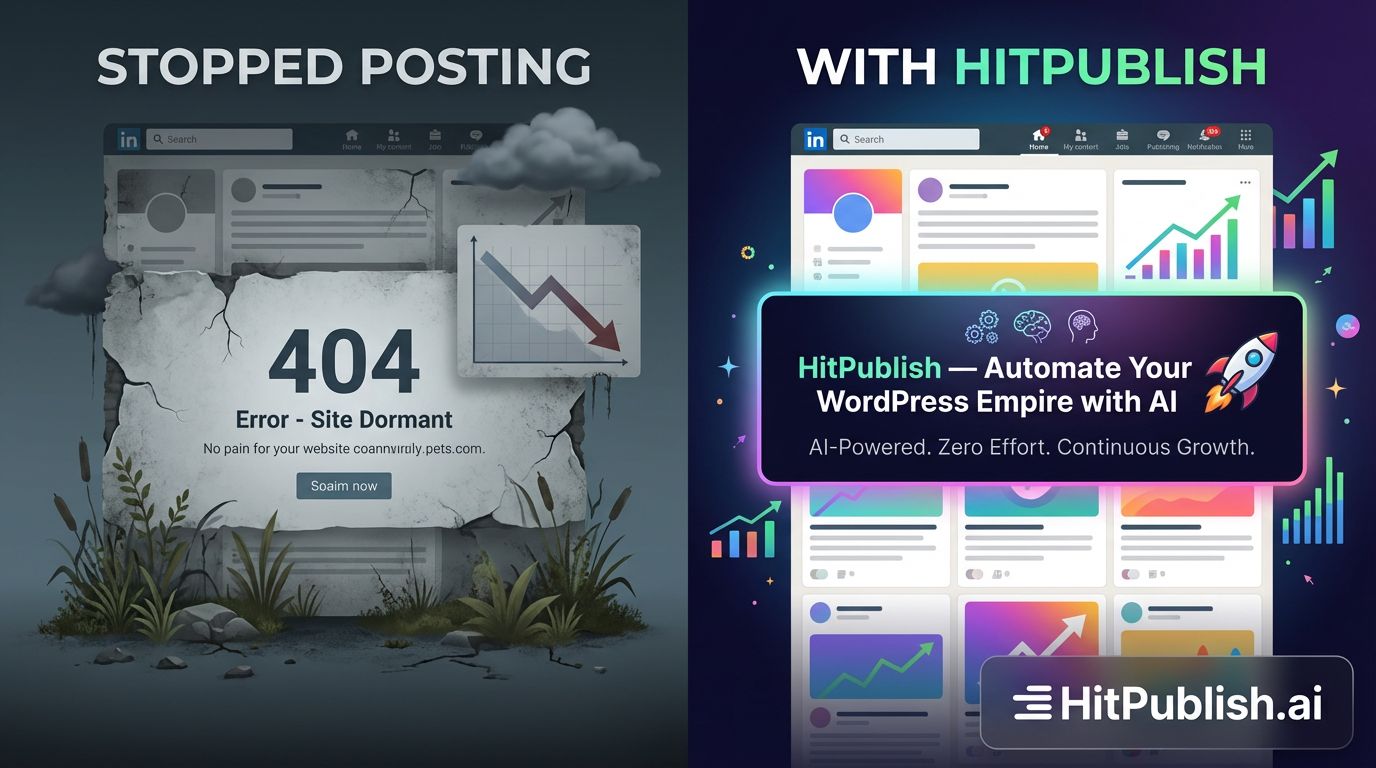
What Happens to Your Site When You Stop Posting
Every quiet site is a sinking ship in slow motion. When you stop posting, the internet forgets you faster than a café barista forgets a name. Your pages lose momentum, your audience drifts away, and search engines start treating your domain as dormant ground rather than fertile soil. This article gives you a clear, battle-tested map of what happens when posting stops, with practical steps to recover, re-engage, and reboot growth. You’ll find concrete examples, actionable tips, and a decisive plan to minimize harm and reclaim traction quickly.
What actually happens when posting stops
The moment you pause publishing, several forces converge. First, user intent shifts. Regular readers stop checking back because they’ve learned fresh content won’t appear. Second, your site loses internal momentum because new links, social signals, and user engagement dry up. Third, search engines interpret inactivity as disinterest or obsolescence, which can reduce crawl priority and ranking for existing pages. Finally, competitors fill the gap you left, capturing attention and traffic you once owned. Collectively, these effects compound, creating a downward spiral that’s hard to reverse without a staged recovery plan.
Immediate risks and longer-term consequences
Immediate risks include sharp drops in daily visitors, lower dwell time, and fewer backlinks as authority signals stagnate. Over weeks, you may see keyword rankings slide, especially for pages that previously relied on fresh signals. Long term, the site’s perceived relevance declines, making reactivation harder. A stalled blog can become a maintenance drain, requiring more effort to reignite momentum than if you had kept a steady cadence. The practical takeaway: act quickly, even with a reduced posting schedule, to preserve momentum and mitigate the hardest hits.
Case study snapshot: a marketing site’s restart
A mid-market marketing site paused posting for six weeks during a product transition. Traffic dropped 28% in the first week post-pause, and newsletter signups fell by 18%. The team reintroduced a weekly, tightly scoped content calendar focused on 1) evergreen foundations, 2) product updates, and 3) customer stories. Within eight weeks, traffic returned to pre-pause levels and signups rebounded to 92% of prior momentum. The lesson: restart with discipline, not a burst flood of content.
Recovery framework: how to rebound fast
Use a four-phase approach: stabilize, re-seed, scale responsibly, and measure with precision. Each phase has concrete actions you can execute in days, not weeks.
Phase 1 — Stabilize
- Audit your last 12 months of content to identify high-performing pieces and evergreen assets.
- Set a minimal but consistent posting cadence (for example, one article per week or two per month) to reestablish rhythm.
- Optimize internal linking to connect old, relevant posts with new ones, rekindling discovery paths.
- Protect downstream workflows: ensure your CMS publishes on schedule, your writers know the new cadence, and editors have a clear, fast review process.
Phase 2 — Re-seed
- Publish cornerstone guides that answer persistent audience questions and align with core products or services.
- Introduce a lightweight content series (e.g., “Weekly Quick Wins”) to deliver small, repeatable value and quick wins for SEO signals.
- Repurpose existing assets into multiple formats (blog post, video script, podcast outline) to broaden reach without starting from scratch.
- Leverage user-generated content and testimonials to accelerate credibility and reduce production overhead.
Phase 3 — Scale responsibly
- Implement an editorial calendar with topic clusters to boost SEO strength and topical authority.
- Invest in AI-assisted but human-reviewed content generation to maintain quality while increasing throughput.
- Improve on-page SEO signals: meta descriptions, headers, alt text, and internal links aligned with intent.
- Track core metrics weekly: sessions, pages per session, average session duration, and conversion events tied to content goals.
Phase 4 — Measure with precision
- Establish a short feedback loop: review content performance within 7–10 days of publication and adjust topics accordingly.
- Use attribution windows that reflect decision cycles—content often influences later actions beyond immediate visits.
- Report only actionable metrics: engagement, completion rate of CTAs, and uplift in inbound inquiries tied to content assets.
Content strategies that help preserve and grow traffic after a pause
A few evidence-based tactics outperform the rest when you’re trying to regain momentum. They balance quality with speed and are repeatable across sites and niches. Implement these to protect your brand and drive qualified traffic.
Anchor content and topic clusters
Anchor content sits at the center of a cluster and acts as the hub for related subtopics. Build clusters around recurring questions your audience asks. Each cluster strengthens topical authority, helping search engines understand your site’s relevance and boosting rankings for multiple pages. A practical approach: identify 3–5 core topics, create one long-form pillar piece per topic, and support it with 5–8 internal-linking subpieces.
Evergreen preservation content
Evergreen content remains useful beyond a short window. Refresh it periodically with updated data, current examples, and updated statistics. Schedule quarterly refreshes for the top 20% of your most valuable posts, ensuring that older posts stay accurate and useful. This reduces the risk of stale material dragging down perceived site quality.
Incremental AI-assisted generation with human oversight
AI can accelerate content production, but human validation is non-negotiable. Use AI to draft outlines, first passes, and data-heavy sections, then editors finalize for voice, accuracy, and brand alignment. The benefit is speed without sacrificing trust. Use automation to scale compliant, SEO-optimized output while preserving your unique perspective and leadership tone.
“Content is not a one-off project; it is a system that, when maintained, compounds value over time.” — Content Strategist, 2024
Keywords, SEO, and optimization to reclaim visibility
When you resume, your primary aim is to demonstrate relevance through consistent signals. Use disciplined keyword strategies, on-page optimization, and technical cleanliness to recover lost ground quickly. Focus on intent-aligned terms, long-tail variations, and user-centric language. Improve page speed, mobile usability, image optimization, and schema markup to support search engine understanding and user experience. The synergy between content creation and SEO optimization drives traffic growth more reliably than volume alone.
What to optimize first
- Content quality and relevance to audience intent
- Internal linking architecture and crawlability
- Title tags, meta descriptions, and header hierarchy
- Page speed and mobile responsiveness
Two practical examples and actionable insights
Example A: A WordPress site switches to a quarterly posting cadence, focusing on one in-depth pillar article per quarter and supporting posts every month. The site uses AI to draft outlines and initial drafts, with editors tagging and rewriting sections to preserve voice. Within six months, organic visits grow by 35%, and the bounce rate decreases as content becomes more aligned with user questions. This approach balances quality and consistency, avoiding the trap of overproduction without direction.
Example B: An e-commerce blog integrates user stories and how-to guides with product updates. It pairs case studies with actionable tips, doubling engagement metrics within three months. SEO gains include improved rankings for long-tail phrases tied to product categories and support articles. The result is a more confident content ecosystem able to convert readers into customers more efficiently.
For teams that rely on AI-driven workflows, a disciplined approach preserves momentum while expanding capacity. As you scale, you will want to manage content quality, maintain brand voice, and ensure compliance with editorial standards. The combination of AI-assisted generation and rigorous human review often yields the best balance between speed and trust.
As detailed in source name, automation platforms can help align content with audience needs and streamline production while maintaining quality and consistency. This aligns with the broader industry trend toward AI-assisted content creation that supports scale without sacrificing reader experience. The mid-market marketer should view automation not as a replacement for human input but as an amplifier for strategic intent and efficiency.
Operational blueprint: checklists and workflows
Adopt these concrete workflows to keep posting steady and outcomes strong, even when resources are tight.
Editorial checklist
- Define 3–5 pillar topics and 1–2 subtopics per pillar per quarter
- Create a quarterly content calendar with publication dates
- Prepare a 2-week ahead draft schedule for outlines, drafts, and reviews
- Establish a quick review gate for accuracy and brand alignment
Technical optimization checklist
- Audit crawl errors and fix redirects
- Update sitemap and ensure proper indexing
- Improve page speed to under 3 seconds on mobile
- Implement structured data where relevant
Measurement and iteration checklist
- Track weekly: visits, engagement, and conversion rate by content piece
- Review top performers and replicate formats across topics
- Adjust topics after 2–3 cycles based on data, not assumptions
Strategic considerations for AI-driven multi-site content automation
AI-enabled platforms enable scale and consistency across multiple sites. They help with template-based content, multilingual expansion, and rapid testing of topics. However, the risks include homogenization, diluted voice, and potential quality gaps if human oversight is skipped. The best practice is to use AI for generation, ideation, and data gathering while preserving editorial control for tone, accuracy, and context. Your goal is to leverage AI to accelerate value, not to replace human judgment. This balance keeps your brand credible and your content useful across audiences.
Operational tips for multi-site ecosystems
- Standardize content briefs across sites to ensure consistent quality and expectations
- Coordinate publishing calendars to avoid cannibalization and ensure fresh signals across domains
- Centralize performance dashboards to compare site health and content ROI
- Develop cross-site templates for pillar posts and supporting content to streamline production
For marketers managing several domains, this structure prevents fragmentation and preserves signal quality as you scale. The approach combines disciplined strategy with practical execution, enabling predictable outcomes even when content demand is high and resources are constrained.
Risks, trade-offs, and how to minimize them
Stopping posting creates a risk profile that includes visibility erosion, audience attrition, and slower discovery by search engines. The trade-off of a reduced cadence is less immediate workload, but the long-term price is higher reactivation costs. The way to minimize risk is to publish consistently at a manageable pace, refresh evergreen assets, and employ a repeatable process for content creation and optimization. Resist the impulse to flood with quantity; prioritize impact, relevance, and consistency.
Common pitfalls to avoid
- Overreliance on one content format; diversify with briefs, guides, videos, and micro-posts
- Skipping quality checks under time pressure; quality is a trust signal
- Neglecting mobile and accessibility considerations; these affect reach and experience
- Ignoring data signals; decisions must be evidence-based
Conclusion and call to action
Stopping posting is not an endpoint; it is a warning bell. The fastest route back to growth is a disciplined, phased recovery that rebuilds momentum, reaffirms authority, and aligns with audience needs. Start with a stable cadence, seed authoritative pillar content, and scale with AI-assisted workflows guarded by human oversight. The goal is not just returning to where you were but surpassing it by delivering consistent, high-value content that resonates with readers, supports SEO, and drives measurable outcomes. Put the plan in motion now and measure progress relentlessly. Your site’s future traffic and credibility depend on it. Take the first concrete step today: establish a 90-day content calendar, assign owners, and commit to publishing on schedule.