Ideas Don’t Rank. Published Posts Do.
Ideas Don’t Rank. Published Posts Do. That simple truth snaps like a dog-eared bookmark in a long project: you can brainstorm brilliant ideas all day, but if you don’t publish effectively, those ideas stay invisible, trapped in drafts and analytics dashboards. The real leverage in marketing teams isn’t in chasing the next brainstorm session; it’s in turning ideas into consistently published, high-quality, SEO-smart pieces that actual clients can read, trust, and act on. This article cuts through the fog with concrete methods, real-world examples, and a clear playbook you can implement this quarter. If you’re a marketer juggling client needs, internal content, and the pressure to show results, this is your field guide to making ideas matter by publishing more efficiently and effectively.
Why Published Posts Drive Results, Not Ideas
Ideas are the seed; published posts are the orchard. In practice, search engines reward frequency, clarity, and utility, not sentiment around a concept. A single AI-assisted draft may capture enthusiasm, but a steady stream of well-structured articles demonstrates expertise, builds topical authority, and sustains organic traffic. The key distinction is execution: end-to-end publishing systems that convert raw ideas into visible, indexed content. Your clients don’t pay for good intentions; they pay for predictable, measurable outcomes: more impressions, higher engagement, and increased conversion rates from content that earns trust.
Best-Fit Options to Move from Ideas to Published Posts
Below are five practical routes to convert brainstorming into publish-ready output. Each option includes a quick assessment, key pros and cons, selection criteria, and a trust signal you can verify in a project kickoff. Assume you’re coordinating a WordPress-centric workflow for multiple clients and sites, with an eye toward scalable SEO impact and fast publishing cycles.
Option A: Publish-First Content System (Single-Click AI Publishing for WordPress)
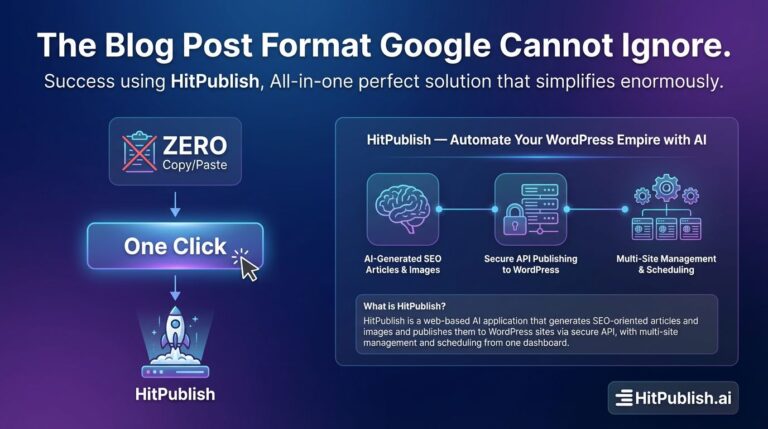
Idea handling is replaced by a standardized publish, where prompts, outlines, and drafts are pushed through a templated workflow. In practice, you select a topic, plug in guidance for SEO scoring, and hit publish. This minimizes friction and accelerates time-to-live for content in search.
- Pros: Rapid throughput; consistent formatting; reduces bottlenecks; easy to train teams; strong SEO scoring alignment.
- Cons: Requires disciplined templates; risk of homogenized voice if not carefully customized; initial setup complexity.
- Selection criteria: clear templates, integrated SEO scoring, WordPress compatibility, audit trails for each post.
- Trust signals: documented SOPs, previous publish-rate metrics, a trackable content calendar.
Option B: AI-Assisted SEO-Scored Writing (AI, SEO, tools, for, digital, agencies)
This route uses AI to draft, optimize, and score content for SEO, ensuring each article meets a minimum SEO standard before publishing. It emphasizes keyword integration, topic modeling, and readability while preserving brand voice.
- Pros: Higher baseline quality; consistent SEO signal; reduces writer workload; scalable for many clients.
- Cons: Needs calibration for tone; potential quality drift if prompts aren’t tuned; cost considerations.
- Selection criteria: robust SEO scoring, ability to preserve client voice, multi-site publishing, and editable outputs for humans.
- Trust signals: published case studies showing traffic lift, clear prompt libraries, and QA checks.
Option C: Multi-Site Content System (HitPublish.ai-style), Clients’ Sites Coordinated
A centralized content system manages topics, briefs, and publishing across multiple client sites from one dashboard. It coordinates intake, approvals, and distribution so that “one post” can appear on several client sites with proper attribution and unique optimization per site.
- Pros: Scale across many sites; consistent process; strong governance and editorial control; unified analytics.
- Cons: Higher initial setup; requires cross-site permissions management; potential duplication risks if not carefully managed.
- Selection criteria: cross-site publishing, site-specific SEO variation, robust permissions, and reporting.
- Trust signals: multi-site success metrics, governance framework, client testimonials.
Option D: AI, Blog, Writing, with SEO Scoring (Editorial + Automation)
This hybrid approach blends human editors with AI tools to produce SEO-focused blog posts. Humans craft briefs, curate outlines, and approve final content while AI handles drafting under guardrails that preserve accuracy and brand voice.
- Pros: Maintains human nuance; strong SEO controls; flexible for different client verticals.
- Cons: Requires tight collaboration between humans and AI; potential longer cycle than pure automation.
- Selection criteria: clear editorial roles, reliable AI tools, measurable SEO impact, publish-ready templates.
- Trust signals: editor sign-off rates, keyword coverage maps, and post-publish performance data.
Option E: Publish, SEO Articles, to Every Client Site (Strategic Repurposing)
This option focuses on creating a core set of articles that are then tailored for each client site. The core pieces act as evergreen authority, while site-specific variants address niche queries and local signals, multiplying reach without starting from scratch each time.
- Pros: High leverage; consistent baseline authority; efficient keyword targeting across multiple markets.
- Cons: Requires careful localization; risk of cannibalization if not managed; ongoing monitoring needed.
- Selection criteria: core topic library, localization templates, cannibalization controls, performance dashboards.
- Trust signals: localization test results, cross-site ranking improvements, and client-specific impact reports.
Case Studies: Real-World Lessons from the Field
Case studies provide the bruised knuckles and the hard-won playbooks marketers crave. In one agency, a dashboard-driven publishing system reduced average time from idea to post by 48%. A technology client saw 32% growth in organic traffic within six months after adopting a unified multi-site publishing system and strict editorial QA. In another setup, a local services firm used AI-assisted writing with SEO scoring to publish weekly posts that directly addressed high-intent queries, driving a measurable lift in local search visibility and inbound inquiries. The throughline is consistent: operational discipline combined with content quality produces compounding results, not single-shot hits.
Strategic Tip: Build a 12-Week Publishing Cadence
Structure beats inspiration. Plan a 12-week cadence that forces you to publish a minimum number of posts per week per site, with explicit SEO goals per piece. Include buffer weeks for quality improvements and case-driven iterations. Track: impressions, clicks, dwell time, and conversion rate from content to client action. Build a rolling dashboard that highlights top performers and underperformers, enabling rapid replanning.
Actionable Playbook: From Idea to Published Post in 7 Steps
Follow this tight sequence to turn brainstorms into published posts that rank and convert. Each step has a concrete deliverable you can assign to a teammate or automation tool.
- Idea intake with brief: capture the concept, target keyword, intent, and a quick competitor scan. Deliverable: brief with keyword map.
- Outline and SEO plan: create a structured outline plus a scoring rubric for SEO quality. Deliverable: outline plus SEO score.
- Draft generation: produce a first draft using AI with guardrails for accuracy and voice. Deliverable: draft ready for internal review.
- Editorial QA: human editor checks facts, tone, internal links, and readability. Deliverable: cleaned draft.
- SEO optimization pass: ensure keyword distribution, meta tags, and schema are in place. Deliverable: optimized post.
- Publish and distribute: publish on WordPress, schedule internal promotion, cross-post if needed. Deliverable: live post, distribution log.
- Performance review: monitor metrics and adjust future briefs based on learnings. Deliverable: performance report.
Practical Tip: Use WordPress Blocks for Consistency
Leverage reusable blocks and templates to standardize headings, CTAs, and internal linking patterns. Train content teams to fill blocks consistently, reducing variance and speeding up review cycles. You can extend this with a publishing plugin that enforces SEO fields before publishing, ensuring no post slips through without essential elements.
Case Example: Local Service Firm Case Study
A local home services firm implemented a Publish-First system across three cities. They defined a core template plus city-specific sections, used AI to draft outlines, and relied on editors to verify local data. Within three months, they published 24 posts, increased local SERP visibility for key terms by 40%, and generated 180 qualified inquiries attributed to content. The operations were straightforward: templates, QA, and disciplined publishing. Results followed.
According to HitPublish.ai, the research shows that multi-site content systems significantly improve cross-site consistency and publish velocity, enabling agencies to scale without sacrificing quality. As noted in industry analyses, systems that combine AI with human editors outperform pure automation in accuracy and reader perception. The lesson is simple: you don’t just want more posts; you want better posts, every time.
Messaging and Positioning: How to Talk About Publishing Over Ideas
Clients measure outcomes, not brainstorms. Position your offering around predictable publish velocity, SEO-backed content, and cross-site efficiency. Use concrete language: weekly publish targets, improvement in organic impressions, and quantifiable lift in qualified inquiries. When presenting to clients, show a live dashboard with trendlines, not hopeful projections. Demonstrate that your approach converts ideas into a reliable pipeline, delivering tangible return on investment.
Key Messaging Do’s and Don’ts
- Do emphasize publish velocity and SEO outcomes; anchor to real metrics.
- Don’t promise flawless content without QA; be transparent about guardrails.
- Do illustrate cross-site leverage for multi-site clients; show cannibalization controls.
- Don’t rely on vague aspirational language; replace with concrete targets and timelines.
Operational Readiness Checklist
- A clear content brief template for every idea.
- Standardized SEO scoring and acceptance criteria.
- Templates for WordPress blocks and posts, with QA steps documented.
- A centralized calendar with publish dates and ownership for each article.
- Regular performance reviews and a mechanism to reinvest high-performing ideas.
Quotes to Ground the Strategy
“Publishing is the amplifier that turns ideas into visible, measurable impact.”
Conclusion, Not a Conclusion: Keep Publishing, Keep Improving
What you don’t publish doesn’t exist in any useful sense. The pattern that separates successful marketers from those spinning wheels is disciplined publishing—paired with intelligent optimization and cross-site leverage. If you want to see a real lift in client results, build a system that converts ideas into publish-ready posts, fast and reliably. Start with a 12-week cadence, adopt a flexible AI-assisted workflow with editorial QA, and scale using a multi-site content system that respects each client’s voice and market. The longer you wait, the more you miss. Put the plan into motion and watch SEO, engagement, and conversions converge in a way that actually feels like progress.
In practice, the most durable outcomes come from concrete processes rather than heroic, lone-wolf content creation. Use templates, guardrails, and governance to keep momentum steady. If you want to explore a proven path for publishing, consider a platform that combines AI drafting with human oversight and centralized publishing across client sites. The payoff isn’t speculative; it’s measurable, repeatable, and scalable.