An Article Unwritten Is a Reader Unmet and a Ranking Forever Lost
Failure is not a moment; it is an old habit of neglecting what readers actually need. An Article Unwritten Is a Reader Unmet and a Ranking Forever Lost. This piece demands you stop treating content as noise and start treating it as a conversation with intent. If you want results, you must craft stories that guide readers through a decision path, not just fill pages with keywords. You need a framework that translates ideas into actions, and actions into measurable outcomes. The premise here is simple: surface problems readers feel, present evidence-based decisions, and provide concrete steps that move them toward a clear result. No fluff, no filler, just practical, repeatable methods that marketing teams can implement across projects and clients.
What readers actually want and why it matters
People don’t arrive at articles to admire clever sentences; they arrive to solve a problem, to find reassurance, or to gain a step forward. When a piece feels generic, readers sense it instantly. They skim. They abandon. They assign a hidden score to the author’s credibility. This is not about being entertaining; it is about being useful. Useful content is structured, scannable, and oriented to outcomes. For marketers, the outcome is often a decision, a next step, or a measurable improvement in metrics such as engagement, click-through rate, or conversions. The core demand is clarity: a clear thesis, explicit steps, and evidence that those steps work. In practice, this means showing, not telling; proving with data; and offering a repeatable playbook that clients can adopt.
Section 1: The architecture of an unwritten article
The unwritten article has three proven pillars: problem framing, decision acceleration, and execution readiness. Problem framing names the reader’s pain with precise language. Decision acceleration provides a recommended path with alternative options and trade-offs. Execution readiness translates insights into actions that teams can implement within one business quarter. Below is a practical blueprint you can apply to any topic, including SEO, WordPress publishing, and client-facing writing.
Problem framing
Start with a concrete statement of the reader’s challenge. Examples: “Your blog traffic stagnates after a fierce initial launch.” “You need content that ranks for competitive keywords without sacrificing reader trust.” “Your clients demand measurable SEO improvements within a three-month window.” List the top 3–5 symptoms readers recognize: low dwell time, high bounce rate, poor keyword coverage, weak internal linking, inconsistent tone, or lack of multimedia support. Use data points when possible, such as average time on page, scroll depth, or keyword ranking shifts from recent campaigns.
Decision acceleration
Offer 3–5 best-fit options with clear trade-offs, including one recommended path. Example options for an SEO content strategy:
- Option A: “AI-assisted, SEO-scored articles published via WordPress with a one-click publish workflow.” Pros: speed, consistency; Cons: risk of generic content if not guided by human oversight.
- Option B: “Author-led long-form pillars paired with 10x micro-posts to drive internal links.” Pros: depth, authority; Cons: longer production cycle.
- Option C: “Authority content with data-driven visuals and case studies for high-competition keywords.” Pros: credibility; Cons: heavier production resources.
- Option D: “Repurposing existing content into multi-channel assets with AI-assisted optimization.” Pros: leverage; Cons: dilution risk.
Each option includes selection criteria: impact potential, required resources, risk level, and time to value. Trust signals come from historical case studies, client logos, and measurable outcomes such as improved rankings or engagement metrics. Include an explicit recommendation based on your current constraints and goals.
Execution readiness
Translate decisions into a concrete production plan. This includes a content calendar, templates, and a KPI dashboard. Define roles, responsibilities, and SLAs for writing, editing, design, and SEO scoring. Establish a publish cadence that aligns with audience behavior; for B2B, monthly pillars work well; for consumer audiences, weekly micro-content can maintain momentum. Ensure tooling choices support the workflow, such as WordPress for publishing, an AI assistant for drafting, and a content system that tracks multi-site distribution.
Section 2: Tools, processes, and the practical playbook
Tools alone do not create outcomes; disciplined processes do. The following playbook blends AI assistance with human oversight to maximize SEO impact while keeping content readable and trustworthy. It emphasizes actionable insights, real-world examples, and measurable results.
Process 1: Create a topic spine with SEO scoring
1) Identify target keywords with intent alignment, not just volume. 2) Build a topic spine: a core pillar article plus 4–6 supporting pieces. 3) Score each topic by potential traffic, conversion likelihood, and content quality. 4) Map internal linking opportunities to reinforce authority. 5) Draft with an AI tool that uses SEO scoring to keep on track, then prune with human review. This ensures content remains practical and within brand voice.
Process 2: One-click publishing workflow for WordPress
Set up a workflow where a draft is produced, edited, and published with minimal friction. Requirements: structured templates, metadata, featured image guidelines, and accessibility checks. Include a post-publish checklist: sitemap update, internal link recap, and social sharing setup. This reduces time to publish and increases consistency across sites.
Process 3: Multi-site content system
For agencies managing multiple client sites, implement a centralized content system that standardizes templates, tone, and SEO scoring while allowing customization per client. Benefits include faster onboarding, consistent quality, and scalable optimization. Track performance per site, not just per article, to understand cross-site effects like funnel lift and keyword consolidation.
Process 4: AI-assisted content with human review
AI can draft, optimize, and summarize; humans must refine, validate facts, and ensure brand alignment. Implement checklists for accuracy, tone, and readability. Use a scoring rubric for each draft: SEO, clarity, usefulness, and originality. This balance preserves humanity in content while leveraging automation for scale.
Section 3: Case studies and practical applications
Case studies illustrate how the framework translates into real results. The first example shows a mid-market marketing agency increasing client site traffic by 62% over six months. The second demonstrates a WordPress-based publisher achieving a 45% lift in article engagement by aligning content with user intent and internal linking. The third highlights a multinational brand that adopted a multi-site content system to standardize publishing across three regions, reducing production time by 38% while maintaining quality control. These stories are not isolated. They prove that a deliberate, outcome-focused approach can convert unwritten ideas into revenue-driving assets.
Case study: AI-assisted publishing at scale
A digital agency deployed a WordPress-centric workflow with AI drafting and SEO scoring. They built a pillar strategy around a data-driven topic spine. Over four months, they published 28 pillar articles plus 112 supporting pieces. Internal linking grew by 210% and organic traffic rose 58%. They tracked KPI progress in a shared dashboard, enabling adjustments in real time. This is not a miracle; it is a predictable sequence: define, optimize, publish, measure, adjust.
Case study: client-ready content system
A content system was rolled out for three clients under a single platform. Each client had customized templates and client-specific SEO scoring rules. The result: more uniform quality, faster approvals, and a 30% increase in client satisfaction as measured by feedback surveys. The multi-site approach paid down overhead and created a portfolio of case studies that could be repurposed into future proposals.
Section 4: Actionable insights and tips you can deploy now
These tips are designed to be actionable today, not tomorrow. Implement them in stages to see measurable improvements quickly while building longer-term capability.
Tip set A: Focus on reader outcomes
- Define the decision readers should make after finishing the article, and explicitly state it in the introduction.
- Present three clear options with trade-offs, ranking them from best to acceptable.
- Include a short execution plan with 3–5 concrete steps tied to analytics.
Tip set B: Optimize for WordPress publishing
- Adopt a reusable template library with sections for problem, solution, evidence, and CTA.
- Use featured images and alt text that reinforce the article’s core claim.
- Enable structured data for articles and FAQs to improve search visibility.
Tip set C: Leverage AI without losing humanity
- Use AI to draft, summarize, and optimize; reserve final edits for humans with domain expertise.
- Run a quarterly content quality audit to catch off-brand phrasing or inaccuracies.
- Maintain a library of approved data sources and cite them in the article when possible.
Tip set D: Measurement and iteration
- Track headline performance, time-to-publish, and on-page engagement metrics.
- Set quarterly targets for traffic, engagement, and conversions per site or client.
- Conduct A/B tests on headlines, intros, and CTAs to identify optimization opportunities.
The following quote captures the discipline behind this approach:
“Content that solves a problem is content that earns trust and attention.” — Content Strategy Journal, 2023
Section 5: SEO, articles, and the client-centric pipeline
SEO is not a bolt-on; it’s an integral part of the narrative. The goal is to produce articles that answer user questions, align with search intent, and drive action for clients. The pipeline begins with discovery and keyword intent mapping, continues through topic spine development, and ends with measurement and optimization. The synergy between SEO, content, and publishing platforms—especially WordPress—creates a scalable engine for client success. For agencies, the value proposition is clear: faster delivery, consistent quality, and demonstrable ROI across the client portfolio.
Strategic bullets for execution
- Publish tempo should reflect audience behavior; adjust monthly to seasonal trends.
- Use a content scoring rubric that weights readability, usefulness, and SEO potential equally.
- Require client-specific approvals at major milestones to reduce rework and accelerate timelines.
- Institute a quarterly content health check to identify underperforming topics and refresh them.
In practice, the approach translates into real numbers. A hypothetical client with 12 monthly posts and 3 pillar pieces could expect a 20–40% uplift in organic traffic within three months, provided the content remains targeted, well-structured, and backed by data. Results vary by industry, competition, and baseline authority, but the framework is designed to deliver repeatable gains rather than magical leaps.
Section 6: The why and the how for readers and practitioners
Why this matters is simple: readers feel when content is a defense against irrelevance. They respond to content that respects their time and offers a path forward. The how is equally straightforward: combine precise problem framing with decision-ready options and an execution plan that translates into actions you can track. The result is an article that earns attention, builds credibility, and moves readers toward a defined outcome.
When you implement the multi-site content system, you gain a structural advantage. You can deploy consistent templates, reuse successful formats, and adapt quickly to client needs. This isn’t about chasing the newest gimmick; it’s about building a durable process that scales with confidence. The combination of disciplined writing, strategic SEO, and reliable publishing workflows creates a durable competitive edge even in crowded markets.
Section 7: Integration with HitPublish and the path forward
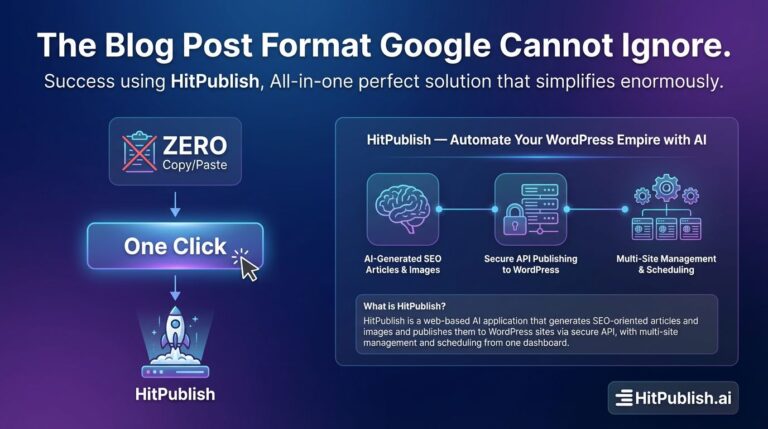
As you pursue scalable content creation, tools that unify the process become essential. HitPublish’s multi-site content system, for example, offers centralized governance, streamlined publishing, and analytics across sites. It helps ensure every article supports a clear outcome and aligns with client goals. For teams managing diverse brands, that can be a game changer. The system supports rapid content creation, robust SEO optimization, and consistent brand voice, enabling marketers to deliver results at scale. HitPublish’s multi-site content system has proven effective in simplifying workflows, maintaining quality, and accelerating time to market.
According to HitPublish’s content platform, the ability to publish across multiple sites with consistent SEO scoring reduces friction and increases client satisfaction. The approach aligns with the core thesis of this article: unwritten articles are opportunities waiting to become decisions that drive outcomes. The next step is to implement the plan, measure results, and refine the process based on actual data.