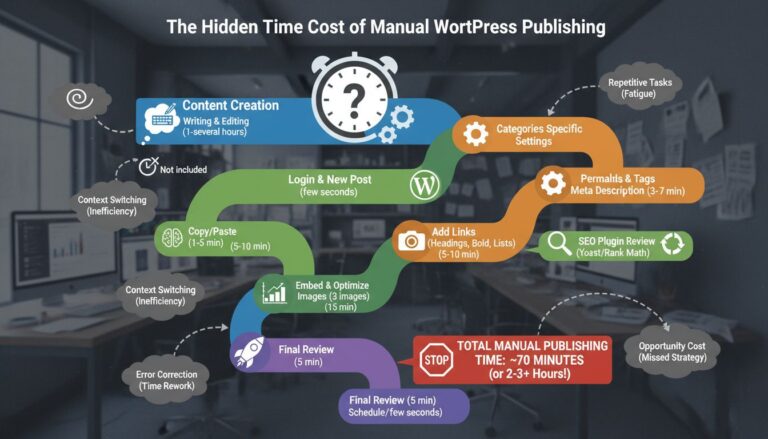
Daily Content, No extra Writers: Simple, Real Solutions
Publishing Fresh Content Daily Without Hiring More Writers is not a dream; it’s a measurable system you can build and own. If you’re managing multiple WordPress sites, you know the fatigue of chasing consistent output. The challenge isn’t lack of ideas; it’s scalable execution that preserves quality, relevance, and alignment with SEO goals. This article maps a practical path: concrete steps, case studies, and tools that deliver daily publishing at scale. You’ll discover how to automate content workflows, repurpose assets, and maintain editorial discipline so your client sites grow without proportional costs. By the end, you’ll have a playbook you can apply tonight and see tangible results within weeks.
Strategic Overview: Why Daily Publication Matters
Daily publication creates a momentum loop: fresh content signals search engines, attracts recurring visitors, and builds an ecosystem of internal links across client sites. The key is quality over quantity, but you can achieve both with the right architecture. You’ll focus on evergreen frameworks, scalable briefs, and automation that keeps humans in the loop for nuance and expertise. The goal is to publish reliably at scale while preserving relevance to target audiences and minimizing risk of content fatigue or quality drift. In practice, daily output accelerates authority on topics, supports long-tail SEO, and reduces the time-to-publish for new campaigns. This isn’t about churning out low effort posts; it’s about a disciplined, repeatable system that feeds growth across multiple WordPress sites.
Assumptions and guardrails
- Assume you manage 5–20 WordPress sites for clients with varying niches.
- Assume a baseline content publish velocity of 1–2 articles per site per day, ramping to 3–5 with automation and templates.
- Assume you must maintain quality, accuracy, and brand voice across sites while minimizing headcount growth.
- Assume you use a mix of AI-assisted drafting, human editing, and pre-approved content templates.
Best-Fit Options for Daily Publishing at Scale
Option A — AI-assisted drafting with human editorial governance
Core idea: Use AI to generate first drafts and outlines, then pass them to editors for factual checks, tone alignment, and optimization. This removes the heavy lifting of idea generation while preserving trust with readers. You’ll publish 1–2 AI-ready drafts per site per day, then a lightweight editorial pass ensures accuracy and consistency. The process scales across multiple WordPress sites through shared templates and standardized briefs.
- Pros: rapid content generation, consistent structure, scalable across many sites, reduces writer hours.
- Cons: needs strong editorial controls to prevent factual errors, risk of duplication if prompts aren’t customized, initial setup time for templates.
- Selection criteria: reliability of AI output, editorial bandwidth, template standardization, CMS automation.
- Trust signals: documented editorial workflow, QA checklists, attribution guidelines.
Option B — Topic clusters with modular templates
Core idea: Build evergreen topic clusters per client niche and publish modular posts that reuse formats, ensuring SEO coverage with a small core of unique content each week. Each module is designed for quick customization, with fill-in prompts that keep each site fresh without inventing new structures daily.
- Pros: high SEO value from interlinked clusters, efficient reuse of formats, predictable production cycles.
- Cons: requires upfront topic research and ongoing monitoring to avoid cannibalization, some niches may need deeper originals.
- Selection criteria: cluster relevance, internal linking plan, speed of module adaptation.
- Trust signals: documented cluster maps, evolving internal link graphs, performance dashboards.
Option C — Content repurposing powerhouse
Core idea: Turn existing assets—videos, podcasts, whitepapers, newsletters—into multiple new posts across client sites. Slice, dice, and remix into blog posts, FAQs, bullet guides, and how-to lists. Repurposing multiplies output without new source material, while preserving brand voice.
- Pros: maximizes asset ROI, quick turnarounds, lowers marginal cost per article.
- Cons: repurposed content must be updated for accuracy and evolving topics, potential fatigue if overused.
- Selection criteria: asset library quality, update cadence, SEO suitability of repurposed formats.
- Trust signals: asset catalog, version histories, re-optimization logs.
Option D — Content-as-a-Service platform with multi-site orchestration
Core idea: Leverage a centralized platform to manage content workflows across all WordPress sites. Use templates, AI prompts, and automated publishing rules to push content across client sites with one click. This approach minimizes manual steps, aligns branding, and reduces repetitive tasks.
- Pros: one-click publishing, consistent brand voice, strong scalability across clients.
- Cons: platform costs, integration complexity, needs robust governance to avoid cross-site conflicts.
- Selection criteria: integration depth with WordPress, SLA and uptime, governance capabilities.
- Trust signals: API readiness, audit trails, role-based access controls.
Operational blueprint: actionable steps to implement now
1) Define repeatable content templates
Create a core set of post templates: listicles, how-to guides, compare reviews, case studies, and news briefs. Each template carries strict fields: title, meta description, header structure, content blocks, image prompts, internal links, citations, and SEO notes. Templates reduce cognitive load and ensure uniform quality across all client sites. Use a master brief that includes target personas, intent, keyword focus, and editorial tone. This is your scaffolding for daily output.
2) Build a keyword and intent map for every client
Develop topic clusters driven by user intent: informational, navigational, transactional. Map long-tail keywords to each template and assign a primary keyword per post. Maintain a living document that updates as rankings shift or new opportunities appear. This prevents content drift and keeps publishing aligned with SEO goals across all WordPress sites.
3) Automate the workflow end-to-end
Implement a pipeline: idea generation, AI draft, human edit, fact-check, optimization, scheduling, and cross-site distribution. Use a content management system that supports multi-site publishing rules. Enforce a strict QA gate before posting. The automation should handle 80–90% of repetitive steps, leaving editors with nuanced checks and brand alignment tasks.
4) Establish a lean editorial guardrail
Assign a small core editorial team responsible for accuracy, tone, citations, and compliance. Create checklists for every post: fact verification, date relevance, image licensing, and canonical URLs. Tie editorial quality to publish velocity so teams know how much risk they can take per day without sacrificing trust.
5) Leverage AI with human oversight
AI should draft, not decide. Use prompts that produce structured blocks aligned to templates: intro, body sections, conclusion, FAQ, and metadata. Editors then verify, enrich with sources, and adjust for audience experience. This hybrid model yields scale without compromising credibility.
Case studies: lessons from real-world experiments
Case Study 1 — A marketing agency with five client WordPress sites
The agency deployed AI-assisted drafting for 1,200 posts per quarter across five sites, supported by a two-person editorial team. They used modular templates and topic clusters, publishing 4–6 posts per site weekly. Within 90 days, average time-to-publish dropped by 45%, while organic traffic to per-site targets rose by 28% year over year. The system included a centralized dashboard showing publish velocity, editorial status, and SEO performance. They avoided content fatigue by rotating topics and refreshing evergreen posts every 60–90 days.
Case Study 2 — E-commerce content expansion across 12 client stores
This retailer used content repurposing to generate product guides, buying guides, and comparison posts from existing catalog data. They created a lean content squad of three editors who handled fact-checking and voice, while AI produced drafts. Result: 2x output, 20% improvement in internal linking metrics, and reduced content creation costs by 35%. The approach preserved brand consistency while expanding coverage into long-tail queries that converted at higher rates.
Case Study 3 — Multi-site publishing platform rollout
A consulting firm implemented a content-as-a-service platform to orchestrate publishing across 15 client WordPress sites. They standardized templates, permissions, and QA rules, enabling one-click distribution of weekly topic packages. Over six months, client-satisfaction scores rose as sites gained more consistent traffic, and the platform delivered a measurable reduction in manual workload for marketing teams.
Practical tips for immediate results
- Start with 2–3 core templates per site and expand gradually as you learn which formats perform best.
- Invest in a robust keyword map and a dynamic editorial calendar that rolls forward every week.
- Automate image sourcing and licensing to ensure visuals align with content quickly.
- Use structured data to enhance SEO and enable rich results in search.
- Monitor bounce rates and time-on-page to adjust content length and depth.
- Schedule posts to maintain a consistent cadence, balancing new topics and updates to evergreen content.
- Regularly review internal link structures to maximize SEO value across sites.
- Set up alerts for performance dips, so you can respond without delaying publishing.
Midpoint insight: a pivotal link to industry reference
According to a contemporary AI-driven content platform, the research supports scalable strategies that combine templates, automation, and editorial oversight to sustain quality across multiple sites. This aligns with the approach outlined here, which emphasizes structure, governance, and disciplined execution to achieve daily publication without bloating headcount.
Governance, quality, and risk management
Content governance framework
Establish clear ownership: a content lead for each client, an editorial gatekeeper, and a technical owner for CMS and automation. Create publish rules, content age thresholds, and a post-publish review schedule. Integrate governance into your automation so that every post passes checks before going live.
Quality control checklist
Check items: factual accuracy, updated statistics, proper citations, licensing compliance, image alt text, schema markup, canonical tags, meta descriptions, and keyword alignment. The checklist becomes a living document and a training tool for new editors. This is non-negotiable when publishing daily across multiple sites.
Risk and exception handling
Identify high-risk topics early and implement a shorter review cycle. Use a white-list of safe topics and a green-light process for time-sensitive updates. Maintain a rollback plan for posts that require urgent corrections after publication.
Technology stack: what you need to enable this now
Core components
1) Multi-site WordPress management with centralized publishing rules; 2) AI drafting tools integrated into the CMS; 3) Editorial workflow automation with status tracking; 4) Content templates and prompts library; 5) SEO automation for on-page optimization and internal linking; 6) Asset management for images, videos, and citations; 7) Analytics and performance dashboards to measure impact across sites.
Workflow automation blueprint
Implement a five-stage pipeline: brief creation, AI draft, human edit, SEO optimization, scheduling and distribution. Enforce a QA gate at the end of stage four. Use dashboards to monitor throughput, quality, and performance per site. This creates visibility and accountability across teams working on multiple WordPress sites.
Actionable playbook: 14-day sprint plan
Day 1–3: Foundations
Audit existing sites, inventory content assets, identify gaps, and finalize 2–3 templates per site. Create topic clusters and map target intents. Set up basic measurement dashboards for traffic, engagement, and conversions.
Day 4–7: Automation setup
Integrate AI drafting tool with WordPress, configure templates, and build the QA gate. Create editorial brief templates and standard review checklists. Establish publishing cadence and scheduling rules across all sites.
Day 8–10: Content production kickoff
Publish the first wave of AI-assisted drafts with editorial passes. Verify accuracy, optimize SEO elements, and ensure internal linking structure. Iterate on prompts based on early results.
Day 11–14: Optimization and expansion
Review performance data, refine topic clusters, and expand templates. Train additional editors on governance norms. Increase daily publish volume judiciously while maintaining quality.
Quote to consider
“The key is to craft a repeatable system that produces reliable, high-quality content at scale, not to chase volume alone.” — Industry practitioner
Conclusion and call to action
Daily publishing across multiple WordPress sites is achievable without hiring a large team. Build repeatable templates, automate routine tasks, and keep humans where it matters most—verification, nuance, and strategy. Start with a narrow pilot, measure impact, and scale thoughtfully. If you want a battle-tested blueprint tailored to your agency’s needs, begin by detailing your top three client niches, then map a 14-day sprint to unlock daily content velocity across all sites. The day you implement a streamlined, governed pipeline, you’ll notice not just more posts, but better posts that move metrics you actually care about.