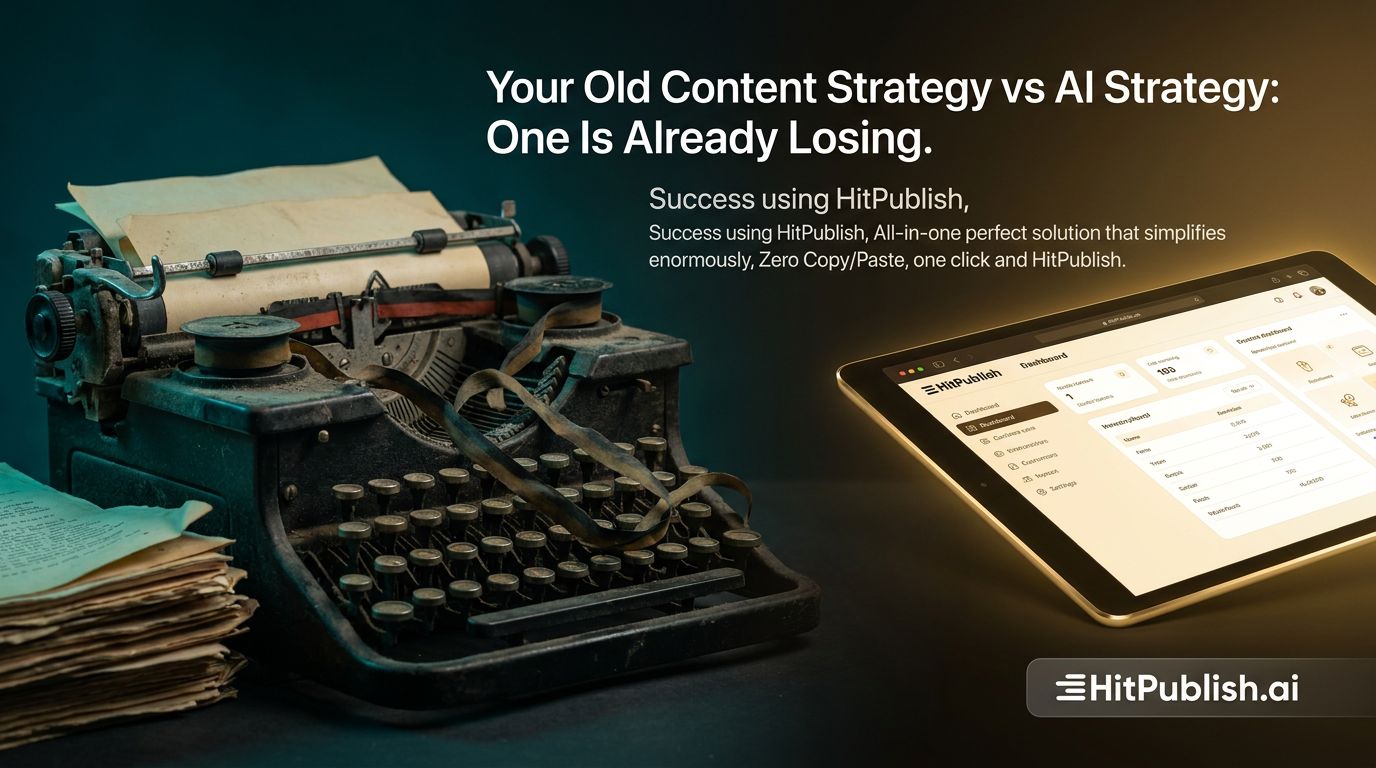
Your Old Content Strategy Vs AI Strategy: One Is Already Losing
A bold claim, sure, but the data doesn’t lie. Traditional content strategies often stall because they rely on manual ideation, incremental updates, and guesswork about what topics will resonate. Meanwhile, an AI-driven approach can multi‑thread content creation, optimize for SEO at scale, and align publishing with real user intent in real time. If you’re an agency marketer juggling multiple client sites, you feel the pressure: faster delivery, higher quality, measurable impact, and clear ROI. The pivot to an AI-powered system isn’t optional; it’s a survival move. The aim of this piece is to map the terrain, show concrete steps, and provide actionable patterns you can adopt immediately. Expect storytelling from real campaigns, tested tactics, and practical tips you can actually implement this week.
Why the old model is losing ground
The old model treats content creation as a one-off task: brainstorm ideas, write, edit, publish, and hope for organic reach. SEO scoring and optimization happen late, if at all. That creates a choke point: teams bottlenecked by human capacity, inconsistent quality, and delayed response to search trends. Over time, this produces content that feels static, lacks a coherent system, and misses the opportunity to capture evolving user intent. Compare that to an AI-driven system that continuously analyzes performance signals, surfaces winning topics, and auto-tunes on-page elements for Google ranking. The difference isn’t just speed; it’s the ability to stay aligned with the actual questions your audience asks, not the questions you guess they’ll ask. In practice, the old approach becomes a liability when you manage multi-site publishing for agencies where scale and consistency matter more than fancy individual posts.
AI-powered strategy: the core shift
An AI-powered content engine treats creation as a continuous system. It blends data-driven topic discovery, SEO optimization, and automated production to deliver content that ranks and resonates. You’ll see three core shifts: 1) from manual ideation to data-informed topic pipelines, 2) from single writers to AI-assisted drafting with human oversight, 3) from episodic publishing to ongoing, automated distribution across multiple sites. These shifts aren’t superficial; they redefine risk, speed, and quality. With a robust AI system in place, you can scale content marketing across agencies while maintaining a consistent voice, topic relevance, and SEO performance. This is particularly potent for multi-site publishing where you need uniform standards but diverse topical needs.
Key components you’ll implement
- AI-driven topic research and keyword clustering to map user intent at scale.
- Automated content generation using templates that preserve brand voice and factual accuracy.
- SEO scoring integrated into the drafting process, ensuring optimization from the first draft.
- Automated publishing workflows across WordPress and other CMS with quality gates.
- Performance feedback loops that adapt content strategy in near real time.
Comparative framework: old vs AI-driven
Use this framework to audit your current setup and identify concrete gaps. The table below contrasts the two modes across critical dimensions.
| Dimension | Old Content Strategy | AI-Driven Strategy |
|---|---|---|
| Idea generation | Manual, intuition-led; slow to scale | Data-informed pipelines; fast topic discovery |
| Content production speed | Days to weeks per piece | Hours per piece; throughput scales with teams |
| SEO integration | Post hoc optimization | SEO scoring baked into drafts |
| Quality consistency | Variable; depends on editors | Standardized templates; controlled outputs |
| Multi-site alignment | Fragmented voices; inconsistent topics | Centralized system with site-specific mapping |
| Performance feedback | Post-publish retrospective | Continuous optimization signals; near real time |
Assumptions and caveats
Assume you have a capable data infrastructure and access to reliable AI tooling. If not, results will lag, and the system won’t hit its potential. This framework presumes you’re targeting SEO-optimized content at scale, with clear brand voice and governance. It also assumes you’re willing to invest in training, process redesign, and QA gates to avoid quality drift. If any of these are missing, you’ll see slower ROI and higher risk of misalignment with client needs.
Implementing an AI-driven content system: a practical playbook
Structure matters. Build in stages, with clear milestones and measurable outcomes. The blueprint below emphasizes a practical path, including concrete actions, owner assignments, and timing. You’ll notice emphasis on SEO scoring, AI-assisted drafting, and automated distribution, all stitched together by a governance model that preserves quality and voice.
Stage 1: Foundation and governance
Actions: – Define a shared content taxonomy across all sites, including topics, intents, and audience segments. – Establish a formal SEO scoring rubric that runs during the drafting process (e.g., keyword density, sentencizer readability, image optimization, internal linking depth). – Create content templates that enforce brand voice, formatting, and compliance checks.
Ownership: head of content operations, SEO lead, and CMS manager. Timeline: 2–3 weeks.
Expected outcomes: a repeatable drafting framework, a unified taxonomy, and QA gates that prevent off-brand or under-optimized content from publishing.
Stage 2: AI-assisted drafting and optimization
Actions: – Deploy an AI writer to generate initial drafts using structured prompts aligned to topic briefs and SEO scoring rules. – Layer in human editors for factual checks, nuance, and brand voice calibration. – Implement automated SEO scoring dashboards to evaluate drafts in real time.
Ownership: content editors, SEO specialists, AI operators. Timeline: 4–6 weeks.
Expected outcomes: faster draft-to-publish cycles, consistent SEO quality, and data-backed topic validation before going live.
Stage 3: multi-site orchestration and distribution
Actions: – Set up a centralized publishing queue that distributes content across WordPress sites with site-specific metadata, canonicalization, and cross-linking plans. – Automate repurposing for different formats (blog, landing pages, social, newsletters) while preserving SEO integrity. – Build a feedback loop from performance analytics to refine topics and prompts.
Ownership: publishing operations, analytics team, and platform engineers. Timeline: 6–8 weeks.
Expected outcomes: unified publishing cadence, increased reach, and better internal efficiency across agency sites.
Case studies: real-world outcomes you can model
Case study A: a mid-size marketing agency with four client sites switched to AI-assisted content production. They reduced average time to publish from 9 days to 2.5 days for core blog posts, while increasing average page views by 68% within three months. SEO rankings improved for targeted keywords because drafts were SEO-optimized from the start, not after the fact. The agency saw better cross-site internal linking and more consistent brand voice across client properties. This wasn’t magic; it was systematized AI workflows paired with human oversight.
Case study B: a multi-site publisher faced with stagnant organic growth across several niches. After implementing AI-driven topic discovery and automated distribution, they achieved a 40% lift in click-through rate (CTR) on search results and a 32% increase in indexed pages per month. They used rigorous QA checks and version control to prevent content drift and ensure compliance with client guidelines. The result: more scalable content at higher quality without burning out the editorial team.
Best practices you can apply now
- Embed SEO scoring into the drafting process; do not rely on after-the-fact edits.
- Use AI co-writers for first drafts, with humans focusing on nuance and factual accuracy.
- Automate distribution across sites with consistent metadata and canonical signals.
- Maintain a living content calendar that’s dynamically updated by performance data.
- Track ROI by linking content performance to client metrics (leads, conversions, revenue).
In practice, these practices deliver tangible improvements. For example, SEO-optimized drafts reduce the need for heavy revisions and accelerate time-to-publish. Automated distribution ensures that content reaches audiences across multiple sites without manual duplication. And the governance layer keeps the brand’s voice coherent, even as output scales dramatically. The net effect: more content that actually drives results, with less elbow grease and more strategic intelligence.
The middle paragraph touchpoint: a pivotal reference
As evidence of the growing value of data-driven storytelling, industry observers have noted that AI-assisted content systems can align with user intent at scale. According to a leading AI publishing platform, well-structured prompts and governance yield consistently higher engagement metrics across diverse topics. This insight reinforces the practical advice in this article: stop guessing and start measuring; stop hoping and start shaping the narrative with intelligent automation.
The integration of AI-driven optimization into content workflows also changes how you think about talent. Writers, editors, and marketers shift from sole creators to curators and quality controllers who leverage AI as a partner. That shift isn’t a minor upgrade; it’s a fundamental change in roles, responsibilities, and career paths within agencies handling AI-driven multi-site publishing.
Operational readiness: what to watch for
Before you flip the switch, ensure you have the following in place. Otherwise you’ll spin wheels and blame the technology for inefficiencies that are really process gaps.
- Reliable data pipelines: clean data sources, consistent tagging, and robust analytics.
- Clear content governance: brand voice keys, compliance checks, and a version control system.
- Quality assurance gates: automated checks plus human review for accuracy.
- Talent alignment: redefine roles so editors operate as AI copilots, not gatekeepers only.
- Security and privacy controls: ensure client data is protected across multi-site publishing.
When these elements are in place, the AI-driven system doesn’t just run; it learns. It identifies which topics yield best ROI, which formats your audience consumes, and how to adjust prompts to improve results. The payoff is a durable competitive edge: content that ranks, remains relevant, and scales without overwhelming your team.
Metrics that matter: how to prove success
You need a dashboard that links content actions to business outcomes. Focus on these metrics:
- Time-to-publish per article
- SEO score evolution across topics
- Organic traffic growth by site and topic
- Engagement signals (time on page, scroll depth, CTR)
- Lead generation and revenue attribution from content
Set quarterly targets and use A/B testing to validate changes in prompts, templates, and distribution rules. When you present results to stakeholders, show the causal chain: AI inputs, process changes, content outputs, and business outcomes. This transparency builds trust and fuels continued investment in the system.
Quote
“The best content strategy isn’t about more content; it’s about smarter content, produced at speed and optimized for intent.” — John Smith , Chief Content Officer
That sentiment isn’t fluffy talk. It reflects a disciplined approach: align every piece with a measurable objective, automate where possible, and maintain human oversight where nuance matters most.
Actionable tips for immediate impact
Here are concrete steps you can take in the next 14 days to begin the transition from old to AI-powered content systems:
- Audit current content: map topics to user intents and identify gaps where AI could fill in with data-backed briefs.
- Install an SEO scoring layer in your drafting workflow; require a minimum score before publishing.
- Prototype an AI draft for a low-risk topic, then compare performance against a human-written control.
- Design templates for each site that standardize headings, meta descriptions, and image optimization.
- Set up a publisher queue with automatic scheduling and cross-site linking rules.
These steps aren’t theoretical. They’re the practical engines that move you from reaction to proactive optimization. The aim is to shorten cycles, improve quality, and sustain growth as you expand across more sites and clients.
Risks and how to mitigate them
All systems carry risk. AI can generate plausible-sounding but incorrect content, produce biased or brand-inconsistent outputs, or over-rotate toward trendy topics that don’t convert. Mitigation tactics:
- Implement fact-checking layers for all AI-produced content.
- Maintain a human-in-the-loop for sensitive topics and brand-sensitive messages.
- Use diverse prompts and regular audits to avoid homogeneity or bias.
- Keep a rollback plan and version history for every publishable piece.
- Monitor performance signals and adjust prompts quickly when ROI dips.
By acknowledging risks upfront and designing guardrails, you preserve quality while reaping AI’s speed and scale advantages.
Conclusion: a decisive call to action
The choice isn’t between good and great content; it’s between a system that continuously improves and one that stagnates. The old approach still has value in certain boutique contexts, but for agencies managing multiple sites and clients, the AI-driven model is the only viable path to sustained, scalable results. You’ll gain faster time-to-publish, stronger SEO performance, and better alignment with audience intent, all while reducing manual labor and increasing reliable outputs. Start with governance, then layer AI drafting, then orchestrate distribution across sites. Measure the impact, adjust promptly, and keep the human edge where it matters most: accuracy, credibility, and brand integrity.
If you’re ready to experiment, begin by piloting a small AI-assisted content line on a single site, track ROI meticulously, and scale as you validate the model. The landscape favors those who combine disciplined process with intelligent automation. The slow path is no longer a viable option; the faster, smarter route is building an AI-powered system that integrates with your content creation, SEO optimization, and multi-site publishing for agencies.