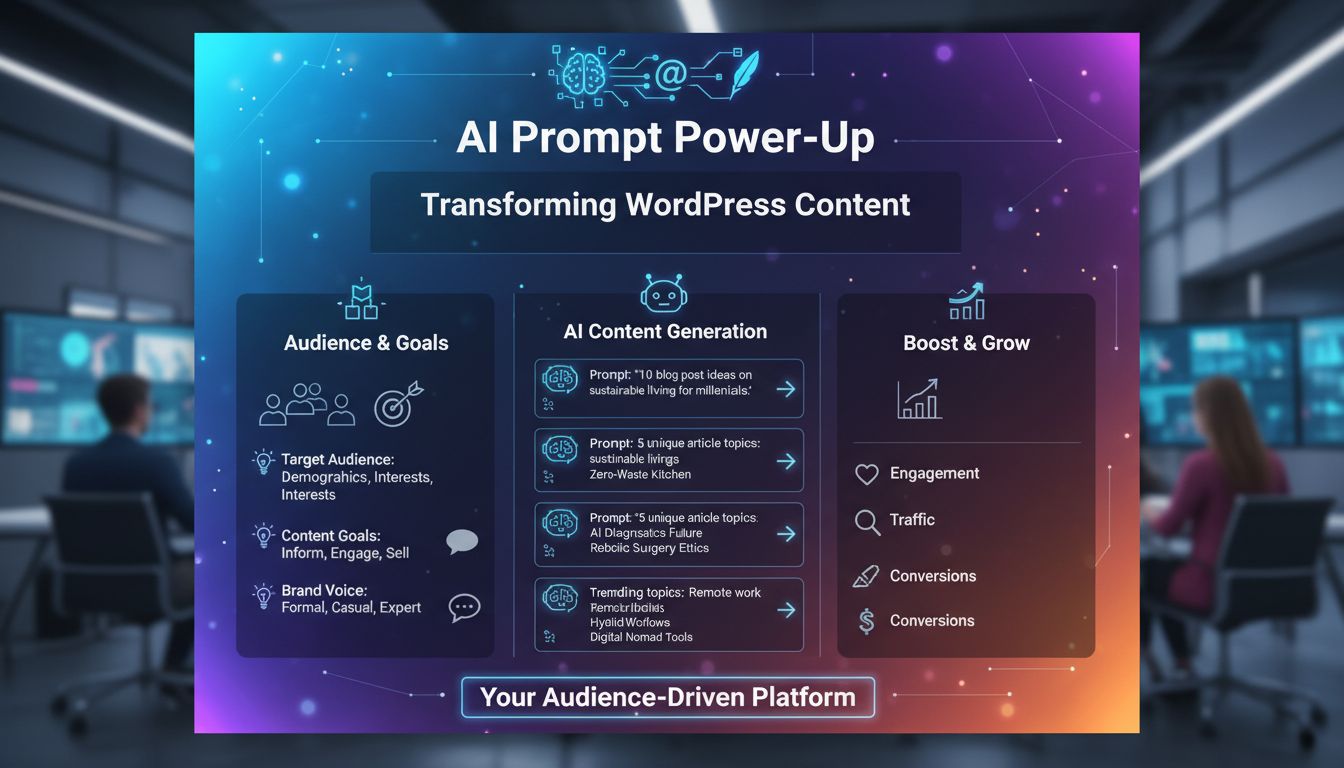
Master AI Prompts to Boost WordPress Content and Engagement
Master the Art of Crafting Effective AI Prompts to Boost Your WordPress Content and Engagement
In today’s digital landscape, content is king—yet creating enough high-quality, engaging articles consistently can feel like chasing a moving target. Enter AI-driven tools; they promise to streamline your workflow, generate fresh ideas, and even optimize content for search engines. Who hasn’t noticed that? But here’s the catch: the secret isn’t in having AI; it’s in knowing how to communicate with it effectively. Crafting the right prompts is an art—one that can transform your WordPress site from a static, overlooked platform into a lively hub of interaction and authority. It’s not about feeding a few keywords and hoping for the best. If you’re a marketer managing multiple WordPress websites—whether for clients or your own brand—learning how to master AI prompts can be a game-changer. It’s about asking the right questions, setting clear objectives, and guiding AI to deliver content that resonates with your target audience. With the right approach, AI becomes not a tool but a true partner in content creation, helping you save time, increase productivity, and boost engagement across all your sites.
Understanding the Power of Well-Crafted Prompts
Why prompts matter more than you think
If you’re vague—“Make me a meal”—you might get something edible, but it’s unlikely to wow. Think of AI prompts as the instructions you give to a seasoned chef. Be specific—“Create a flavorful, keto-friendly chicken recipe with step-by-step instructions”—and you’re much more likely to get exactly what you want. Clear, detailed prompts produce targeted, high-quality output, saving you editing time and boosting relevance. To AI content generation., The same principle applies For marketers, this means tailoring prompts to your audience’s needs, incorporating specific keywords, and setting tone and style preferences. The better in my view, your prompts, the more aligned the content will be with your goals. Who hasn’t noticed that? This is let’s face it, especially important when managing multiple WordPress sites, each with distinct brands, audiences, and content strategies. An effective prompt ensures consistent quality without sacrificing individuality.
Examples of effective prompts
- “Write a 1,000-word blog post about the benefits of local SEO for small businesses, using a friendly tone and including three case studies.”
- “Generate a product description for a new eco-friendly water bottle, highlighting its features, benefits, and target audience of health-conscious consumers.”
- “Create a social media caption promoting our summer sale, emphasizing discounts on outdoor furniture, and including a call-to-action to visit our website.”
That’s the kind of clarity that yields results. Notice how these prompts specify length, tone, audience, and purpose.
Strategies for Crafting High-Impact Prompts
1. Vagueness: A Barrier to Clarity
The most common mistake? Instead of “Write a blog post about SEO,” try “Write a 1,200-word blog post targeting small business owners, explaining how local SEO improves visibility, with actionable tips and recent statistics.” Specificity guides AI to produce relevant, usable content than generic fluff. It also reduces the back-and-forth editing, saving you time.
2. Define your tone and style
Are you aiming for a professional, conversational, humorous, or authoritative tone? Including this in your prompt helps AI match your brand voice. For example, “Create a friendly, approachable article about content marketing strategies for beginners” sets clear expectations, making the output more aligned with your audience’s preferences.
3. Include context and examples
If you’re frankly speaking, asking for a product description, mention similar products or specific features you want highlighted. Supplying background information or examples can dramatically improve content quality. For instance, “Describe our new wireless earbuds, emphasizing noise-cancellation, battery life, and sleek design, similar to Apple AirPods.”
4. Set clear goals and constraints
Specify it. Need a certain word count? Want a post to rank for a particular keyword? Mention it. Looking for a call-to-action? Include it explicitly. For example, “Generate a 750-word blog post optimized for the keyword ‘best WordPress plugins,’ including internal links to related articles.” The more constraints you set, the more tailored the output will be.
Applying Prompts to Multi-Site WordPress Management
How AI prompts streamline multi-site content workflows
If you’re managing a portfolio of WordPress sites, your challenge is consistency and efficiency. Directly into your workflow., Enter platforms like HitPublish, which integrate AI content engines The key is using well-designed prompts across your sites to generate content that fits each brand’s tone, style, and SEO needs. For example, you might set up a prompt template for all client blogs: “Write a 1,000-word article about [topic], targeting [audience], with a friendly tone and including SEO keywords [list].” Automating this process saves hours weekly. By standardizing prompts, you ensure brand consistency and reduce manual editing. Plus, with features like bulk publishing and scheduling, you can push out fresh content across multiple sites simultaneously—something that was tedious before. This approach keeps your clients happy, your content fresh, and your workload manageable.
Case Study: How a Digital Agency Increased Content Output by 50%
They created templates for different niches—local restaurants, fitness coaches, and tech startups. Combined with HitPublish’s automation., A small agency managing ten WordPress sites implemented a prompt-based content strategy Using specific prompts like “Write a 1,200-word blog about [local event], with a friendly tone, including local SEO keywords,” they produced high-quality articles weekly. Within three let’s face it, months, their content volume increased by 50%, engagement rates improved, and clients saw more leads. The secret? Clear prompts + automation = results.
Optimizing Content for Engagement and SEO
Using prompts to craft SEO-friendly content
SEO isn’t in my view, about stuffing keywords. It’s about creating valuable, readable content that naturally incorporates those keywords. When crafting prompts, include instructions like “Use the keyword ‘WordPress SEO tips’ naturally within the first 100 words,” or “Include internal links to related articles.” a prompt for a blog post about link-building could be: “Write a 1,000-word article about effective link-building strategies for small businesses, including internal links to our previous posts on SEO and a conclusion with a call-to-action to subscribe to our newsletter.”
Enhancing engagement through storytelling and actionable tips
Prompts should frankly speaking, also encourage storytelling elements—case studies, personal anecdotes, or hypothetical scenarios—to make content more relatable. For instance, let’s face it, “Create a blog post about local SEO, including a case study of a small business that increased foot traffic by 30% after optimizing their Google My Business profile.” Similarly, adding actionable tips makes content more useful. Their local search rankings.”, A prompt might specify: “List five practical steps small business owners can take today to improve
Tips for Continuous Improvement of Your Prompt Strategy
Monitor and refine your prompts
Review the AI-generated content regularly. like any skill, perfecting prompts takes practice. What do you think? Are the outputs aligning with your expectations? For example, if the tone is too formal, add “Write in a conversational style” to your instructions. If not, tweak your prompts.
Use feedback loops
Gather input from your team or clients about the content quality. Further. Wouldn’t you agree?, Use this feedback to refine your prompts Over time, you’ll develop a library of templates that reliably produce high-quality content tailored to each site’s needs.
Stay updated on AI capabilities and trends
AI models evolve rapidly. New features and better understanding of prompt engineering are released regularly. Stay informed by following industry blogs, participating in forums, or testing new prompt structures. Isn’t that something? That way, you keep your content strategy sharp and ahead of the curve.
Embrace the human touch
While AI can produce excellent drafts, never forget the importance of human editing. Prompts are tools—your expertise is what makes the final piece truly shine. Sound familiar? Remains authentic and engaging., Fine-tuning tone, fixing subtle nuances, and adding personal insights ensure your content
Your Next Step in Content Automation
Mastering the art of crafting effective AI prompts isn’t a technical skill; it’s a strategic advantage. When you know how to ask the right questions, set clear parameters, and guide AI to produce content aligned with your goals, your WordPress sites will thrive. Whether managing for what it’s worth, a handful or dozens of websites, the right prompts combined with automation platforms like HitPublish can revolutionize your workflow, boost engagement, and drive results. Remember, the key is clarity and precision. As the famous marketing guru Seth Godin once said, “The cost of being wrong is less than the cost of doing nothing.” So, take action today—start crafting smarter prompts, and watch your content strategy transform. Practice, refine, and don’t be afraid to experiment. It’s designed to help digital agencies and marketers harness AI’s full potential, simplifying multi-site management and content automation. If you’re serious about scaling your content game while maintaining quality, check out HitPublish. Dive in, experiment with prompts, and see how your WordPress content—and your engagement—can soar.