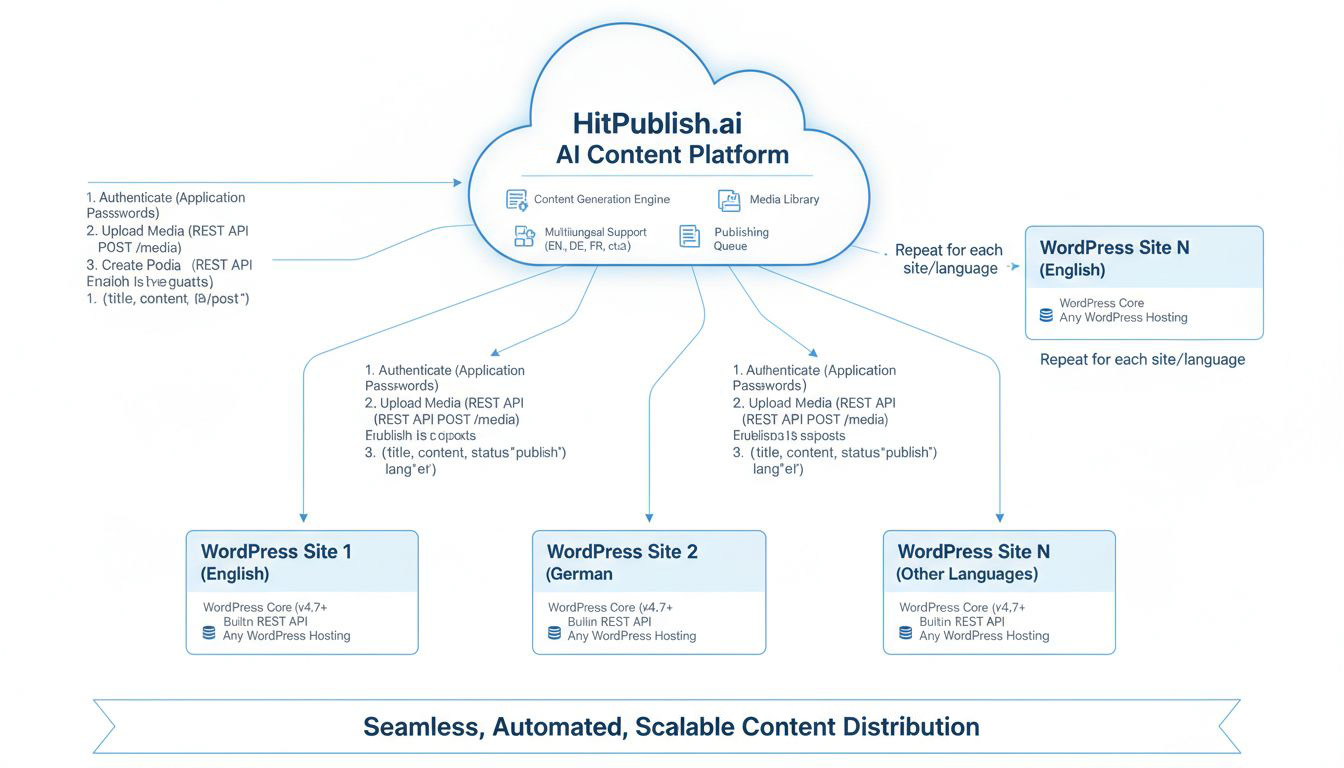
HitPublish Integrates Seamlessly with Any WordPress Hosting
In the rapidly evolving landscape of digital marketing and web development, WordPress remains a dominant force, powering over 43% of all websites globally. Its flexibility, ease of use, and extensive plugin ecosystem make it the go-to platform for businesses, bloggers, and enterprises alike. But with this popularity comes challenges—especially around content creation, SEO, and site performance. Many site owners and developers wonder whether their hosting environment impacts the effectiveness of their strategies, particularly when integrating advanced AI tools for content generation and SEO optimization. The good news is that our SaaS solutions are designed to work seamlessly with any WordPress hosting environment, whether it’s shared hosting, managed WordPress hosting, or dedicated servers. This compatibility ensures that users can leverage AI-powered content creation, automate SEO, and boost site traffic without being constrained by their hosting choices. In this article, we explore why our SaaS works with any WordPress hosting, the technical underpinnings that make it possible, and how you can harness this flexibility to maximize your content marketing efforts.
Understanding the Core of WordPress Hosting Compatibility
What Makes WordPress Hosting Diverse?
WordPress hosting comes in many flavors—shared hosting, VPS, dedicated servers, managed WordPress hosting, and cloud-based solutions. Each type varies in server resources, control levels, security features, and support. Shared hosting is affordable but limited in resources, often leading to slower load times and challenges with resource-heavy plugins. Managed WordPress hosting offers optimized environments with automatic updates and caching but sometimes restricts server access and customization. Cloud hosting provides scalable infrastructure, ideal for high-traffic sites, but can be complex to configure for non-technical users.
Despite these differences, the core of WordPress remains consistent. The platform relies on PHP, MySQL, and standard web protocols—technologies that are universally supported across hosting types. This universality forms the foundation for our SaaS’s broad compatibility. Whether your site runs on Bluehost, SiteGround, WP Engine, or a custom cloud setup, the underlying architecture allows our tools to integrate smoothly. This flexibility is crucial because it means you don’t need to overhaul your hosting environment to benefit from AI-driven content and SEO automation.
Technical Foundations Enabling Compatibility
Our SaaS leverages standard web protocols, REST APIs, and common server configurations, making it adaptable across hosting environments. The key is that it operates independently of the server’s specific configurations—meaning it communicates via HTTP requests and responds through standard web protocols. This ensures that even on restrictive hosting platforms, the SaaS can perform tasks like content generation, SEO analysis, and automation without requiring root access or server modifications.
Additionally, the SaaS is built using cloud-native technologies, which means it can scale dynamically and connect securely with your WordPress site regardless of hosting environment. This design reduces the dependency on specific server configurations, allowing it to function with minimal setup. Whether your hosting provider supports PHP 7.4, 8.0, or newer, and it supports SSL certificates, the SaaS remains operational. This universality is vital for agencies and individual site owners who manage multiple sites across different hosting providers.
How AI-Driven Content Creation Enhances WordPress Sites
AI Content Generation Tools for WordPress
The rise of AI content generation tools has transformed how websites approach content marketing. Instead of manually writing every blog post or product description, site owners can now deploy AI to generate high-quality, SEO-optimized content in minutes. These tools analyze existing content, identify trending topics, and craft new articles that are ready for publication. The key advantage is speed—what once took hours or days can now be accomplished in a fraction of the time.
For WordPress users, integrating AI content generators is straightforward, especially when supported by SaaS platforms designed for compatibility. For example, tools like GPT-based content generators can be embedded via REST API calls, allowing your site to automatically create and update content without manual intervention. This automation not only saves time but also ensures your content stays fresh and relevant, boosting your SEO efforts.
Moreover, AI content tools can help you maintain consistency across your site. Whether it’s product descriptions, blog posts, or meta descriptions, AI ensures uniformity and quality, which are critical for SEO performance. The generated content can be directly published or refined further, giving you flexibility and control.
Optimizing Content for SEO with AI
AI isn’t just for generating content; it also plays a crucial role in SEO optimization. Modern AI SEO tools analyze your existing content, identify gaps, and suggest improvements—like keyword integration, readability enhancements, and internal linking strategies. When integrated into your WordPress site, these tools automate much of the tedious SEO work, allowing you to focus on strategic planning.
For instance, AI can automatically generate meta tags, alt texts for images, and schema markup, ensuring your pages are fully optimized. This process significantly reduces the risk of human error and ensures that your site adheres to the latest SEO best practices. Since these AI tools operate via APIs and web protocols, they work seamlessly regardless of your hosting provider, provided the server can make outbound requests.
Automating SEO and Content Marketing at Scale
Benefits of Automation in WordPress SEO
Automation has become a game-changer for content marketers and developers. By automating SEO tasks, you can consistently improve your site’s visibility without dedicating extensive manual effort. Automated tools can continuously monitor your site’s SEO health, suggest improvements, and even implement changes. This is especially valuable for large content sites or e-commerce platforms with hundreds or thousands of products and pages.
For example, using AI-powered tools, you can automatically update your content to match changing search algorithms. This ensures your site remains optimized over time, preventing ranking drops caused by outdated SEO practices. Automation also extends to internal linking, schema markup, and site speed optimization, all of which contribute to better user experience and higher traffic.
Importantly, these automated processes are compatible with any WordPress hosting environment because they rely on standard web requests and APIs. They don’t require special server configurations or proprietary hosting features, making them universally deployable across hosting types.
Case Study: Boosting Traffic with AI and Automation
One notable case involved a mid-sized e-commerce site that integrated AI content generation and SEO automation. By deploying a combination of AI tools for content creation and automatic SEO optimization, they increased organic traffic by 50% within six months. The key was seamless integration with their existing WordPress setup, regardless of hosting provider, facilitated by the platform’s flexible architecture.
This example highlights that even small teams can achieve large-scale results when leveraging AI-driven tools. They used automated content updates, keyword optimization, and internal linking strategies—all supported by a hosting environment that allowed easy API integrations. The lesson here is that compatibility and flexibility are essential for scaling SEO efforts effectively.
Ensuring Compatibility with Various WordPress Hosting Environments
Practical Tips for Deployment
- Verify outbound request capabilities: Ensure your hosting provider allows outbound HTTP requests, which are necessary for API integrations.
- Use lightweight plugins: Select plugins and tools optimized for performance to avoid overloading shared hosting servers.
- Leverage cloud-based SaaS: Consider SaaS platforms that operate independently of your hosting environment, reducing compatibility concerns.
- Maintain updated PHP and server software: While our SaaS supports a wide range of server configurations, keeping your environment current ensures optimal performance.
- Monitor resource usage: Especially on limited hosting plans, keep an eye on CPU, RAM, and bandwidth to prevent bottlenecks that could hinder AI automation tasks.
By following these steps, you can maximize the benefits of AI content and SEO tools without worrying about hosting constraints. The key is choosing flexible, API-friendly solutions that are designed to work across diverse environments.
Why Flexibility Matters for Long-Term Success
As your website grows, your hosting needs might evolve. You may start on shared hosting but later migrate to a dedicated server or cloud platform for scalability. Having a SaaS solution that works across all these environments simplifies transitions and reduces downtime. It also future-proofs your investment in AI-driven content and SEO automation, ensuring continuous growth without technical roadblocks.
Furthermore, this flexibility encourages experimentation. You can test different AI tools, optimize various content types, and adjust your SEO strategies without being locked into a specific hosting setup. This adaptability is crucial in a digital landscape where change is constant and rapid.
Final Thoughts: Embrace the Power of Compatibility and AI
In a nutshell, the ability of our SaaS to work with any WordPress hosting environment unlocks tremendous potential for content creators and SEO strategists. It removes technical barriers, allowing you to focus on crafting compelling content and improving your site’s visibility. The combination of AI-powered content creation, SEO automation, and hosting flexibility offers a scalable, efficient way to grow your online presence.
With the rapid advancement of AI tools and the increasing importance of SEO, choosing a solution that adapts seamlessly to your hosting environment is no longer optional—it’s essential. Whether you’re running a small blog or managing a large enterprise site, the right setup can make all the difference. Remember, leveraging AI for content and SEO isn’t just about automation; it’s about creating smarter, more effective marketing strategies that drive real results.
To explore how you can harness AI for your WordPress site, consider exploring platforms that are designed for broad compatibility and ease of integration. According to a leading AI content platform, the future of digital marketing hinges on flexible, intelligent tools that can adapt to any environment and scale effortlessly. This approach ensures you stay ahead in the competitive online landscape, maximizing your site’s potential and traffic.