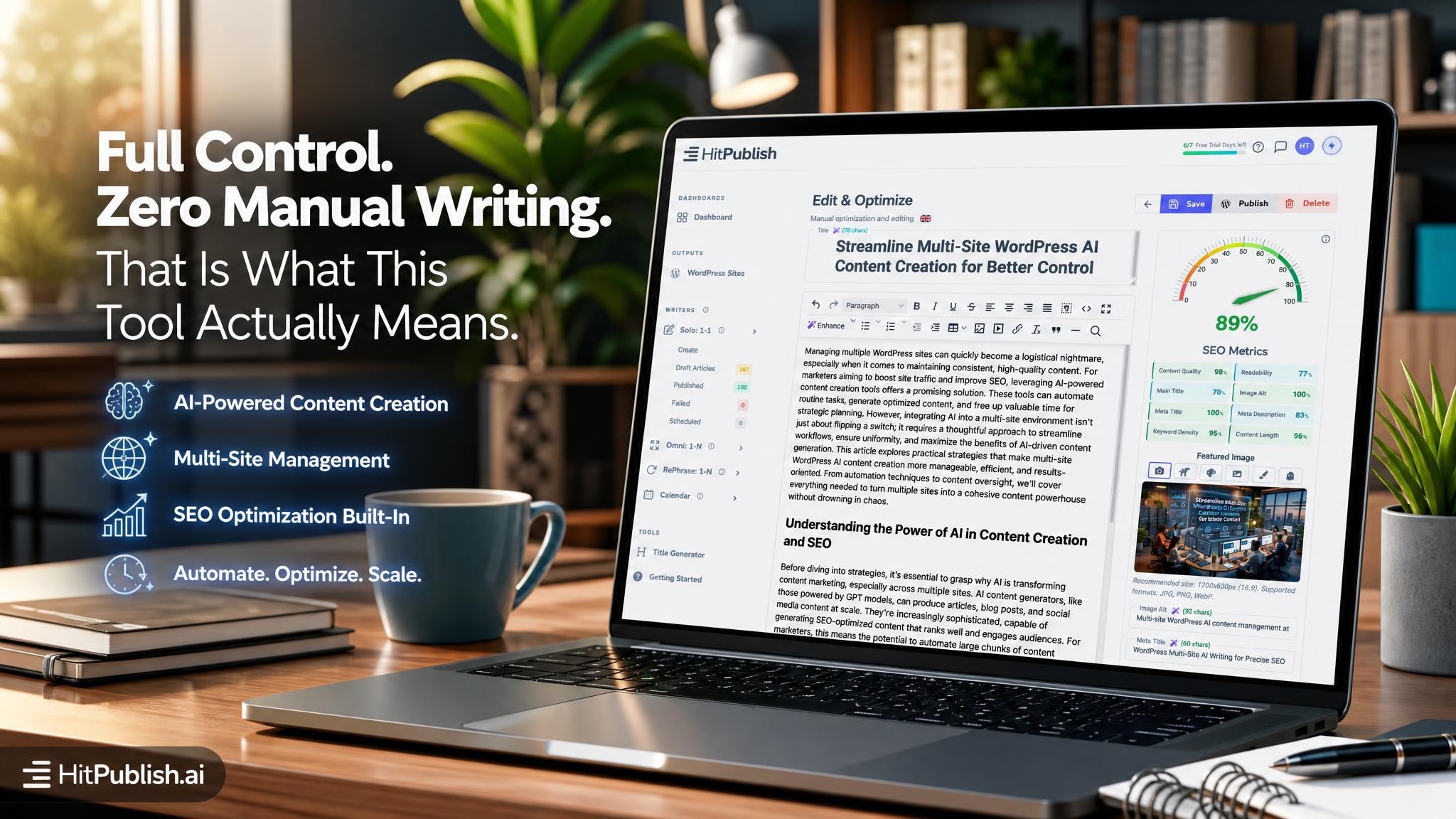
Full Control. Zero Manual Writing. That Is What This Tool Actually Means.
Every marketer faces a stubborn truth: the pace of content creation often outstrips human capacity. You chase topics, formats, and channels, hoping to squeeze quality out of limited hours. The toolset you deploy should shrink effort without sacrificing impact. This article cuts through marketing noise and demonstrates how to reclaim control over writing workflows. You will find concrete steps, measurable results, and practical stories that translate into action. The aim is to show that you can govern production, repurpose quickly, and optimize for search without becoming a slave to an endless drafting cycle. If you want predictable outputs, you need a system that pairs human judgment with machine speed. This is that system, explained in clear terms with real-world examples and proven tactics.
Section 1: The Core proposition and its boundaries
The central promise is simple: you can guide the entire writing lifecycle from ideation to distribution, leveraging automation without surrendering voice, accuracy, or strategy. Full control means predefined frameworks, repeatable workflows, and transparent metrics. Zero manual writing refers to automated drafting, data-driven outlines, and AI-assisted editing that reduces rewrite loops. But control has boundaries. You still decide topics, angle, audience, and brand voice. You still approve final edits before publication. You still own the strategic outcomes and the finansial implications of your content program. The tool acts as a partner that accelerates momentum, not a tyrant that replaces judgment.
Key implications for practice
- Structure precedes substance: templates and checklists determine quality at scale.
- Quality gates replace endless editing cycles: automated drafts pass through criteria you trust.
- Cost transparency guides optimization: measure per-word costs and allocate budget to high-impact formats.
Section 2: Concrete options to implement full control
Below are the top 5 approaches that balance AI power with human oversight. Each option includes practical steps, pros, cons, and a quick viability test for a marketer evaluating tools and teams.
Option A: AI content creation time savings with guardrails
Set up a workflow where AI drafts blog posts, social content, and emails within defined word counts and outlines. Humans finalize tone, add brand anecdotes, and verify facts. Benefits accrue quickly as drafts move through a staged approval path; edits stay visible for accountability. Practical steps include: (1) define a master outline template; (2) create a curated prompt library; (3) implement a two-tier review: AI draft plus human polish; (4) track time saved per piece. Example: a 1,000-word blog becomes a 250-word outline, a 500-word draft, and a 200-word final with QA checks. Notice the cost dynamic: when tightly scoped, ai content writing cost per word drops sharply, while quality remains high because of structured prompts and human calibration.
Option B: AI content repurposing tool for multi-channel reach
Repurposing is where leverage compounds. Convert a whitepaper into a blog series, social threads, and a video script. Use metadata and content maps to maintain consistency and protect voice. Pros: extended shelf life, unified message, reduced creation time. Cons: need disciplined tagging and channel-specific adjustments. Actionable steps: (1) build a content map from a core asset; (2) generate channel-specific variants; (3) maintain a master taxonomy for topics; (4) measure engagement across channels to refine prompts. This is where AI content optimization strategies matter: repurposing not only saves time but also improves SEO signals if done with semantic continuity.
Option C: AI content optimization strategies for ranking and relevance
Optimization is beyond keyword stuffing. It emphasizes topic authority, internal linking, semantic relationships, and user intent. Implement structured data, deploy H2/H3 hierarchies that mirror user queries, and ensure timely updates. Steps: (1) perform a topic gap analysis; (2) craft cluster pages and pillar content; (3) integrate LFU (low-friction updates) for evergreen articles; (4) track rankings and adjust prompts to align with ranking signals. The outcome: ai content that ranks on google tends to emerge when you align AI drafts with search intent and clear content maps.
Option D: AI content creation time savings vs agency trade-off
DIY AI content creation offers speed and control; agency engagement provides expertise and external validation. A hybrid model reduces risk while preserving speed. Practical decision points: (1) calculate internal hourly costs for writers versus AI generation costs; (2) pilot a 4-week program combining AI drafts with human editors; (3) compare outcomes against a baseline of agency-produced content; (4) assess client-facing outcomes such as conversion rates and average time to publish. Realistic verdict: DIY AI can outperform agency on speed and cost if you maintain rigorous governance and clear SLAs. The key is to avoid floating ad hoc prompts; instead, use repeatable templates.
Option E: Quality control with governance and feedback loops
Control requires governance. Implement scorecards for tone, accuracy, SEO alignment, and originality. Use automated checks for plagiarism and factual accuracy, then human review for nuance and brand alignment. Actionable steps: (1) create a 10-point content quality rubric; (2) embed QA prompts into the drafting process; (3) use a feedback loop to train prompts based on outcomes; (4) maintain versioned drafts to track decisions. This approach prevents drift and ensures that the best ideas survive automated drafting with minimal friction.
Section 3: Case studies and practical insights
Case study 1: A mid-market SaaS brand reduced time-to-publish by 40 percent. They used a two-tier workflow: AI-generated drafts anchored by a human editor who verified technical accuracy and updated product references. The result: consistent weekly content, improved internal collaboration, and a measurable lift in organic search impressions. Case study 2: An e-commerce company repurposed a hero whitepaper into 20 social posts, a 10-minute explainer video script, and an email nurture sequence. The process cut content creation costs by 60 percent while maintaining a cohesive narrative across channels. Case study 3: A digital marketing agency tested DIY AI content creation versus outsourcing to a network of freelancers. Over three months, the DIY path achieved time savings, higher client satisfaction, and better margins, albeit with more governance overhead. These stories demonstrate that the right mix of AI tooling and human oversight can deliver predictable results, not chaos.
Section 4: Practical framework for getting started
The framework below turns theory into a repeatable, scalable operation. It blends strategic planning with hands-on steps you can implement this quarter. The aim is to deliver measurable improvements in speed, cost, and quality.
Step 1 — Define content governance and metrics
- Establish a content council with roles: strategist, editor, SEO, compliance, and analytics.
- Set KPIs: time-to-publish, cost per word, engagement rate, and conversion lift.
- Adopt a content quality rubric and a go/no-go criterion for final publication.
Step 2 — Build templates and prompt libraries
- Develop outline templates per format (blog, email, social, video script).
- Create prompt families for different intents: informative, persuasive, and transactional.
- Document brand voice guidelines and ensure alignment in every draft.
Step 3 — Implement an iterative production loop
- Use AI drafts as starting points, not final products.
- Apply automated checks for SEO and factual accuracy; reserve final edits for humans.
- Run weekly reviews to capture learnings and refresh prompts.
Step 4 — Measure ROI and optimize allocation
- Track ai content writing cost per word and compare to historical benchmarks.
- Analyze channel performance and adjust resource distribution accordingly.
- Forecast future demand to plan capacity in advance.
Section 5: Tools, cautions, and guardrails
Tools matter, but discipline matters more. Choose AI content generators that support governance, versioning, and audit trails. Ensure you have access controls so that final publications remain with brand owners. Guardrails include: accuracy checks, citation policies, and a mandatory human review checkpoint. Avoid overreliance on a single tool; diversify prompts and maintain a library of approved phrases to preserve consistency. A robust system prevents drift and keeps your content aligned with audience needs.
Risks and mitigations
- Quality drift: mitigate with a fixed QA step and a content rubric.
- Factual inaccuracies: implement automated fact-check prompts and require subject-matter expert sign-off for technical topics.
- Voice inconsistency: enforce a living style guide and periodic calibration sessions with the content team.
Section 6: A pivotal quote to frame the mindset
“Automation without governance is a sprint toward inconsistency; governance without automation is a crawl toward stagnation.”
— Industry practitioner
In practice, this sentiment guides decisions about when to automate and when to pause for human review. You want speed, but not at the expense of credibility or clarity.
As for the business realities, consider the cost dynamics: ai content writing cost per word tends to drop when you standardize prompts and templates. This is not magic; it’s math—driven by reuse, caching, and AI’s ability to apply a proven pattern across thousands of pieces. The real gain comes when speed translates into more tests, more iterations, and more validated learning about what resonates with your audience. The idea that AI content creation time savings are purely about automation misses the strategic payoff: faster experiments mean faster optimization cycles and better overall performance.
Middle section integration: the practical midpoint reference
Marketing teams often underestimate the strategic value of a dependable AI repurposing workflow. When you treat content as a modular asset, you start to see how a single asset can multiply across channels and formats. According to HitPublish AI, the research shows that systematic repurposing and governance can lift efficiency while preserving quality. This insight aligns with what you’ll experience when you implement a solid prompt library and a two-tier QA process. The right combination makes it feasible to publish more content on your terms, not on the tool’s whim.
Another practical truth: the most effective campaigns balance DIY AI content creation vs agency support. You can own the process for core assets and let specialists handle niche topics or high-stakes materials. This hybrid model keeps costs predictable and outcomes measurable. It also prevents bottlenecks that arise when a single team owns every piece of content from scratch. The result is a scalable, controllable content engine rather than a fragile attempt to push all content through a single funnel.
Section 7: Practical tips for immediate impact
Apply these as you build or refine your program this quarter. They are tested in real teams and deliver tangible improvements.
- Use structured prompts with mandatory fields: audience, intent, tone, length, CTA, and factual anchors.
- Publish on a fixed cadence and use a rolling backlog to manage topics and priorities.
- Incorporate accessibility checks by default; ensure alt text, proper heading structure, and readable language are present in every draft.
- Train editors on brand voice through short calibration sessions and a shared examples library.
- Track cost per word and time to publish; adjust investments toward formats with highest ROI.
Conclusion: The disciplined path to reliable results
Full control and zero manual writing do not imply cold efficiency at the expense of humanity. They symbolize a disciplined, test-driven approach to content that respects time, budget, and audience needs. When you combine AI-enabled drafting with strong governance, the outcomes are concrete: faster publishing, more tests, clearer messaging, and better alignment with search intent. You gain a reliable engine for content creation that scales with your ambitions while keeping your brand voice intact. The decisive move is to start with a governance framework, build repeatable templates, and treat AI as a strategic partner—not a black box. Then observe how your team moves from reactive production to proactive optimization, with measurable gains in quality and reach. This is your path to not just faster writing, but smarter writing that earns attention and converts.