Publishing More Often With Ease for Better SEO Links
Publish faster, publish smarter, publish with confidence. If your site is growing because you publish more frequently, you’re not just feeding the search engines; you’re feeding the audience that trusts you. The real win isn’t simply speed; it’s the orchestration of frequency, quality, and scalability across multiple WordPress sites. You want a repeatable system that scales content, keeps SEO healthy, and maintains human readability. This guide shows you how to build a robust publishing engine that accelerates output while preserving relevance, authority, and engagement. You’ll see practical steps, concrete examples, and measurable outcomes you can replicate across client sites, agencies, and internal projects.
Why Frequency Alone Isn’t Enough
You can publish every hour, but if the articles are thin, misaligned with intent, or poorly optimized, the benefit evaporates. Frequency must ride on a foundation of strategy: keyword intent, topic clustering, and a scalable production workflow. A site that publishes daily but with low-quality content will struggle to gain consistent rankings, while a site that publishes twice weekly with top-tier optimization can outperform with longer tail gains. The sweet spot lies in a rhythm that compounds authority without sacrificing readers’ trust. In practice, this means pairing automation with human editorial oversight, ensuring every piece respects brand voice, accuracy, and user needs.
Best-Fit Options for Fast, Scalable Publishing
| Option | What It Is | Pros | Cons | Best For |
|---|---|---|---|---|
| Option A: Multi-Site WordPress AI Publishing | Centralized AI content creation and distribution across multiple WordPress sites with one-click publishing. | Speed, consistency, centralized SEO signals, scalable client management. | Initial setup complexity, governance across sites, potential duplication risk. | Agencies managing many WordPress clients seeking uniform voice and rapid output. |
| Option B: AI-Enhanced Content Calendar | Structured calendar that assigns topics, writers, languages, and timelines; automated prompts for SEO optimization. | Clear workflow, predictable cadence, aligned with keyword strategy. | Requires discipline; gaps if editors miss slots or data quality declines. | Teams needing visibility and coordination across multiple clients and languages. |
| Option C: Language-Localized Syndication | Publish AI-generated content in multiple languages across global sites while preserving semantic quality. | Access to new markets, improved global presence, better international signals. | Machine translation quality risk; cultural nuance required. | Brands with multilingual audiences and international SEO goals. |
| Option D: AI-Driven SEO Scaffold | Automated SEO optimization at scale: metadata, internal linking, schema, and content scoring for each piece. | Improved rankings, consistent optimization, reduces manual toil. | Requires baseline SEO discipline; over-automation can dull nuance. | SEO-focused teams needing uniform optimization across many posts and sites. |
| Option E: Client-Centric AI Content Studio | Dedicated studio for client sites with tailored voices, templates, and rapid approval loops. | Strong brand consistency, faster approvals, clear client value. | Higher coordination costs; potential bottlenecks if oversight isn’t scalable. | Agencies serving multiple clients with unique voices and SLAs. |
Concrete Framework: Build It in Four Phases
Phase 1 focuses on foundation. Phase 2 introduces automation. Phase 3 scales with multilingual and multi-site considerations. Phase 4 optimizes for ongoing SEO and performance. Each phase yields measurable increments in publish velocity and search presence.
Phase 1 — Foundations You Can Trust
- Define a publishing manifesto: audience intents, content pillars, and language guidelines.
- Standardize post templates: meta titles, meta descriptions, headings, image conventions, and schema markup.
- Set quality gates: a lightweight AI scoring rubric plus human review for every post.
- Establish a basic calendar: 2–3 long-form cornerstone pieces per month, plus daily micro-posts for social amplification.
Phase 2 — Introduce Automation with Guardrails
- Adopt a WordPress AI content generator workflow that can produce draft posts from structured briefs.
- Implement automatic SEO enhancements: keyword suggestions, internal linking prompts, and schema snippets baked into templates.
- Use a content calendar for cross-site planning; ensure each piece targets a specific search intent and buyer journey stage.
- Enforce version control and rollback capabilities to protect established pages when updates occur.
Phase 3 — Scale with Multisite and Language Capabilities
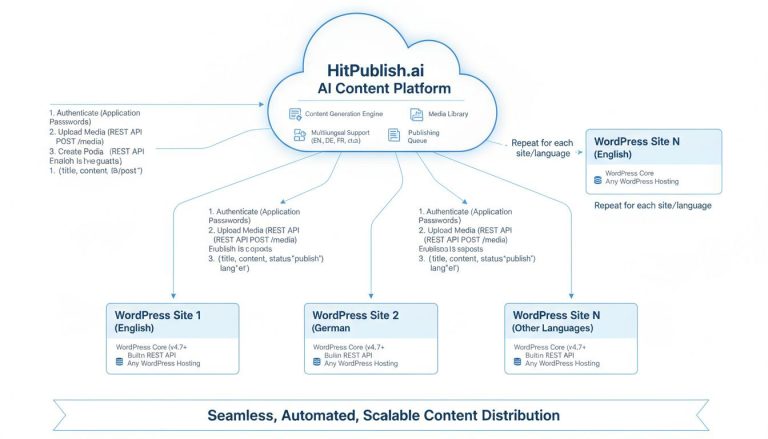
- Deploy a multisite architecture to manage multiple WordPress sites from a single dashboard.
- Enable multi-language publishing with language-aware templates and translations that preserve SEO semantics.
- Coordinate with clients via a shared content pipeline that respects SLAs and approvals.
- Automate publishing pipelines across sites to ensure consistent cadence and cross-linking opportunities.
Phase 4 — Optimize for SEO and Signals
- Institute ongoing content scoring and refresh cycles based on performance metrics.
- Automate updates to evergreen content to maintain relevancy and rankings.
- Refine internal linking strategies and breadcrumb architectures to strengthen authority flows.
- Continuously monitor AI outputs for factual accuracy and brand alignment; adjust prompts as needed.
Actionable Tactics You Can Implement Now
These tactics are designed to be actionable within a typical marketing team’s constraints. They balance speed with quality, giving you measurable lift in publish velocity and SEO signals.
1) Create a Repeatable Brief-to-Post Pipeline
Develop a 10-minute briefing process that encapsulates target keyword intent, audience personas, and desired sentiment. Feed this into your AI content generator to produce a high-quality draft. Add a checklist: fact-check sources, optimize headings, and ensure images have alt text. This reduces friction during the drafting stage and speeds up review cycles.
2) Standardize SEO Accelerators
Each post should automatically generate: – A compelling SEO title (60–65 characters) – A meta description (155–160 characters) that includes the primary keyword – At least two internal links to relevant pillar pages – Schema.org Article markup for rich results
3) Maintain a Consistent Voice Across Sites
Develop a voice guide and kit: tone, vocabulary, and style do’s and don’ts. Use templated introductions and conclusions adjusted per client, but preserve core messaging. This ensures fast creation without eroding brand identity.
4) Leverage Language Variants Strategically
When expanding to new languages, start with keyword research in each target language. Use AI-assisted translation that preserves semantics and adjusts idiomatic phrasing for local intent. Test performance and refine translations to align with local SERP ecosystems.
5) Implement a Quality-First Review Loop
Automated checks catch obvious errors, but human editors validate data accuracy, claims, and tone. A two-tier review—AI scoring plus human verification—reduces rework and protects long-term rankings.
Case Studies: Real-World Outcomes
Case studies reveal how disciplined frequency, together with automation, translates to tangible SEO gains and higher engagement metrics across multi-site environments.
Case Study 1 — Agency Scaling with Multisite Publishing
A mid-sized agency adopted a multisite WordPress architecture and an AI-assisted publishing workflow. They produced 40% more posts per month without sacrificing quality. The result was a 28% increase in organic traffic across client sites over six months, led by improved long-tail rankings and stronger internal linking networks. The team also reduced time-to-publish from 72 hours to 18 hours on average, enabling faster client onboarding and more iterative optimization. The agency’s clients reported higher satisfaction due to consistent content cadence and more transparent reporting.
Case Study 2 — Global Brand, Multilanguage Expansion
A global consumer brand launched localized content across five languages using AI-generated drafts and human refinement. They achieved a 15% lift in non-branded organic traffic and a 22% increase in international SERP visibility within four quarters. The strategy hinged on language-aware keyword mapping, culturally tuned prompts, and automatic translation pipelines that preserved the core message while adapting tone to local markets.
Best Practices for Sustained Results
Adopt these practices to ensure your publishing engine remains efficient, scalable, and effective over time.
- Quality governance: define acceptable thresholds for AI-generated content accuracy and tone; include human review for every significant post.
- Editorial cadence discipline: commit to a predictable rhythm; build buffers for unexpected spikes in demand or client workloads.
- Data-driven refinement: track metrics like time-to-publish, average word count, keyword ranking changes, and engagement metrics; adjust prompts based on results.
- Cross-site SEO cohesion: maintain consistent pillar content and inter-site linking to avoid content cannibalization and to reinforce topical authority.
- Security and compliance: ensure content pipelines respect data privacy, licensing, and accessibility standards across all sites.
As you push more content across multiple WordPress sites, the optimization becomes a living system. You publish, you learn, you adjust—repeat. The aim is not merely to flood the web with articles but to publish SEO-optimized, user-centric content at scale that search engines recognize and users trust. The process thrives when you couple automated generation with deliberate strategy, human oversight, and a clear measurement framework. This is how you move from sporadic bursts to a resilient publishing engine that accelerates growth across all client sites.
In practice, you will begin to see faster indexing and more frequent appearances in search results for core topics. You’ll notice that AI-assisted content, when properly tuned, can surface in featured snippets and even answer boxes as your content library matures. The key is balancing speed with accuracy, ensuring that automated outputs align with audience intent and brand promise. This requires ongoing calibration of prompts, templates, and review criteria to match shifts in search algorithms and user expectations. You’ll learn to prune underperforming topics, double down on high-potential pillars, and maintain a high standard of editorial integrity that keeps readers engaged and coming back for more information, not merely for novelty.
When you implement a robust AI content system, you should also consider the broader ecosystem: analytics dashboards, content inventory, and a feedback loop from readers. A well-instrumented pipeline provides insights into which topics resonate, which languages drive growth, and how internal linking patterns influence page authority. It also helps you justify investments to clients and stakeholders by showcasing concrete metrics: publish frequency, time-to-rank improvements, and traffic lift per site. The combined effect is compounding, not linear. The more consistently you publish high-quality, optimized content across WordPress sites, the more search engines reward your domains with stronger authority, better crawlability, and higher relevance signals.
To maximize results, couple your publishing engine with a disciplined testing mindset. Run controlled experiments comparing different content formats, lengths, and keyword strategies. Measure not just rankings, but on-site behavior: time on page, scroll depth, and conversion signals. Use these insights to refine prompts, templates, and post structure. Over time, your system becomes more autonomous, yet remains anchored by a human-centered editorial layer that ensures authenticity and reliability. This balance is what separates merely prolific sites from authoritative, trusted resources in your niche. If you want to accelerate further, consider integrating advanced AI content scoring to quantify readability, factual accuracy, and alignment with intent, then feed those scores back into your production pipeline for continuous improvement.
“The best content systems don’t just publish more; they publish better and smarter, turning every post into a stepping stone for growth.” — Research Practitioner, 2024
As you evolve, you’ll notice a widening gap between sites that rely on one-off posts and those that deploy coordinated, multi-site campaigns. The latter not only amplifies reach but also strengthens domain authority across the board. Your clients gain from a predictable velocity, and you gain leverage in negotiations, renewals, and strategic planning. The result is a scalable, auditable, repeatable engine that delivers measurable SEO and business outcomes. You’ll be able to demonstrate the impact of “built, for, people, managing, multiple, WordPress, sites” as a living capability rather than a slogan. This is not magic; it’s a disciplined practice that aligns technology, process, and people around a shared objective: publish more effectively, across all client sites, with confidence.
According to HitPublish AI insights, automation paired with human context yields the fastest path to sustainable growth. The platform’s emphasis on multi-site orchestration and language-ready publishing aligns perfectly with an agency’s need to serve diverse clients efficiently. As you scale, the emphasis shifts from merely generating content to optimizing for search intent, reader satisfaction, and conversion pathways across all sites. This is where your system earns trust signals from search engines and audience communities alike. Your strategy should make those signals visible in dashboards, reports, and client-facing briefs so you can iteratively improve and justify continued investment.
Strategic Takeaways and Next Steps
Stop chasing volume in isolation. Build a coherent, scalable publishing engine that harmonizes frequency, quality, and SEO impact across WordPress sites. Start with a solid plan, implement a controlled automation workflow, and then scale thoughtfully with multilingual capabilities and robust optimization. Track the right metrics, maintain strong governance, and keep a human-in-the-loop to preserve accuracy and brand integrity. Your site’s link profile, traffic, and authority will reflect the disciplined execution and the real-world value you deliver for clients and audiences alike.
Actionable next steps: – Map your pillar topics and outline a 90-day publishing plan across all client sites. – Implement an AI-assisted drafting system with templates and a two-tier editorial review. – Activate multisite management and language localization with consistent SEO scaffolds. – Set up monthly reviews of performance data, prompts, and templates to drive continuous improvement.
By embracing a rigorous yet flexible approach, you create a self-reinforcing cycle: more publish events lead to more indexed pages, which in turn attract more links, social shares, and higher traffic. The combination of automation, editorial discipline, and strategic SEO investment yields a durable advantage. Your ability to publish across WordPress sites in one click, or near one click, grows more dependable with each successive cycle. You’ll also notice how AI-enabled content generation accelerates client onboarding and deployment, enabling you to service more sites with the same or fewer resources. The end result is a practical, scalable model for content production that aligns with modern search ecosystems and reader expectations.