You Don’t Need More Traffic, You Need Better Traffic
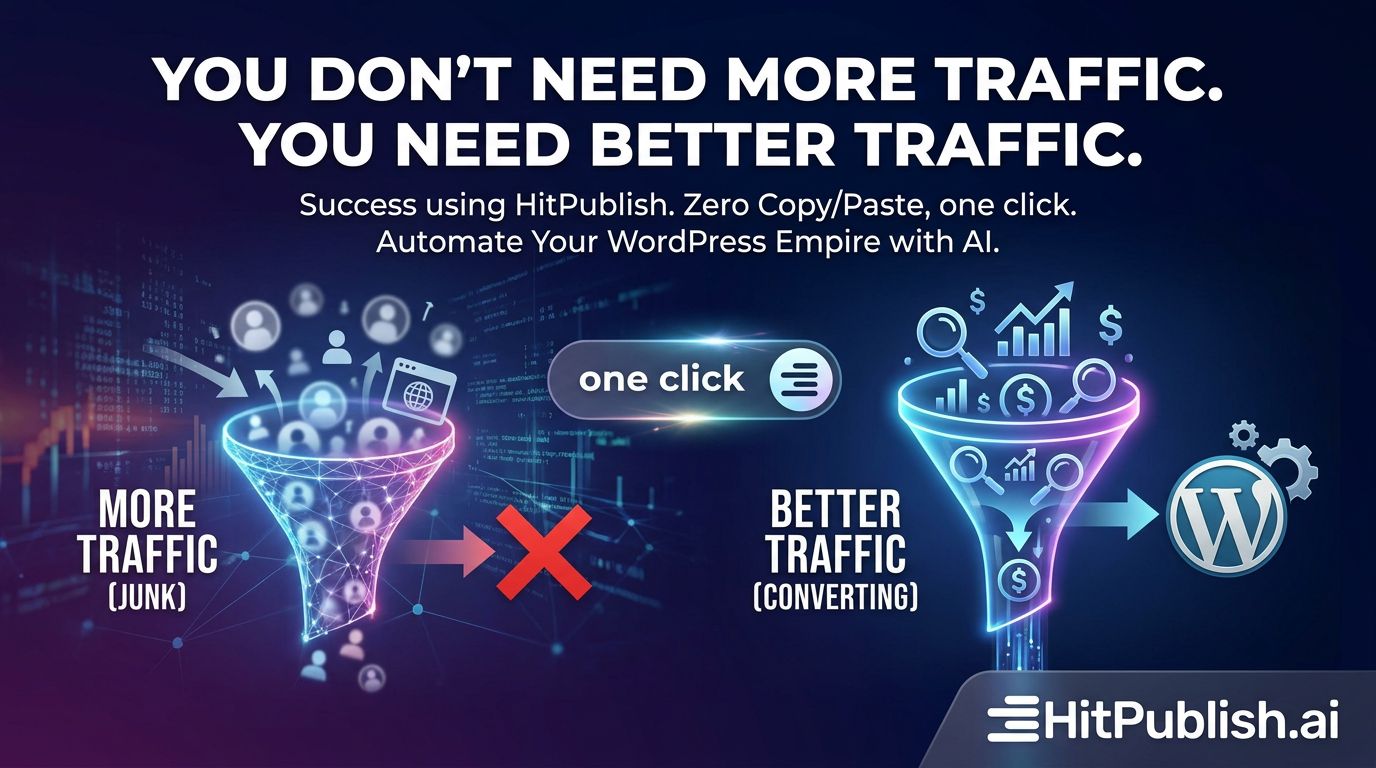
Traffic is not a vanity metric. It’s a signal that your message found a purpose beyond claps and comments. If you chase more visitors without refining where they come from and why they stay, you’ll waste budget, burn time, and miss the real opportunities. You don’t need more traffic. You need better traffic—visitors who value your content, engage meaningfully, and convert. This article breaks down how to shift from volume chasing to precision targeting, using practical steps you can implement today. You’ll see concrete examples, case studies, and tools that align with an AI-driven, multi-site WordPress publishing strategy. If you want to move from random hits to repeatable growth, start here.
Understanding the Traffic Quality parado x
The core problem is not visibility; it’s relevance. A page can rank high for a keyword and still deliver nothing for your business if the visitor frustration is high or if the content doesn’t align with intent. Quality traffic starts with intent mapping—figuring out what your audience wants at each stage of their journey and then delivering precisely that. This isn’t guesswork. It’s a set of repeatable checks: search intent alignment, content usefulness, trust signals, and speed. When these align, visitors don’t just click; they dwell, read, share, and return. The result is higher lifecycle value even if overall traffic dips by a small margin. The right traffic compounds through internal linking, automation, and consistent quality. It’s a disciplined approach, not a marketing sprint.
Key principles
- Match intent to content: curate topics where user questions map to your solution.
- Own the journey: guide readers from discovery to conversion with clear, minimal friction steps.
- Measure meaningful metrics: time on page, scroll depth, return visits, and assisted conversions beat raw visits every time.
- Leverage automation: AI-assisted content generation and SEO optimization reduce waste and accelerate iteration.
- Maintain site health: fast load times, clean structure, and accessible design keep traffic from bouncing.
Structure for Better Traffic
Successful traffic quality hinges on how you structure content ecosystems. With an AI-assisted, multi-site WordPress publishing framework, you can scale relevance across topics, audiences, and intent stages. The approach blends three layers: topic architecture, content generation and optimization, and performance measurement. Each piece feeds the next, creating a self-improving loop rather than a one-off boost.
1) Topic architecture that yields intent-aligned visits
Create topic hubs that reflect real user questions, not marketing personas. Build clusters around core themes and map each piece to a distinct intent level: awareness, consideration, decision. A practical method is to document a content map with columns for target keyword, user intent, expected action, and measurement signal. For example, a hub around “AI in content creation” could include guides on AI content generators, SEO optimization, and WordPress automation. Each article links to others in the cluster, increasing dwell time and reducing bounce rate. You’ll want a lightweight taxonomy: primary taxonomy for broad topics, secondary taxonomy for subtopics, and micro tags for intent cues. This taxonomy should be reflected in URL structure and internal links to maximize crawlability and relevance.
2) AI-driven content generation and optimization
AI can accelerate production and raise quality, not just volume. Use AI to outline, draft, summarize, and optimize content, but always apply human review for nuance, accuracy, and brand voice. The key is to automate repetitive, high-volume tasks while preserving editorial control for critical pieces. Practical steps:
- Generate draft outlines from topic briefs, then assign sections to human writers for refinement.
- Use AI for meta descriptions, image alt text, and internal linking suggestions during optimization passes.
- Run SEO checks that measure keyword focus, LSI terms, readability, and semantic relevance rather than raw keyword density.
- Leverage AI to test multiple headlines and subheads for click-through potential using A/B style experiments within the CMS.
In an AI-enabled WordPress environment, automation can orchestrate publishing cadence, update older posts with fresh signals, and synchronize cross-site content to sustain quality across a network. This is exactly the kind of approach that scales quality traffic rather than merely increasing visits.
3) Performance and user experience optimization
Traffic quality stalls if pages load slowly or feel clunky. Core Web Vitals isn’t a luxury; it’s the floor. Optimize images, defer non-critical scripts, enable lazy loading, and ensure mobile-first design. Accessibility and readability are not optional; they widen your potential audience and reduce friction. For WordPress sites, choose themes and plugins that emphasize speed, avoid bloat, and offer built-in SEO options. A lean structure with modular plugins, intelligent caching, and a content delivery network (CDN) can dramatically improve user experience and, in turn, engagement metrics that matter to search engines and readers alike.
Practical Framework: 6 Actionable Moves
These moves are designed for marketers who manage multi-site WordPress publishing. They’re concrete, time-bound, and measurable. Implement them in sequence, but measure impact after each step.
Move 1: Create intent-based content clusters
Define three core topics, each with a cluster of 6–8 articles that address varying user intents. Publish one new piece each week, update quarterly, and retire stale posts. Use a content map to track which pieces feed into which conversion paths. Example clusters: – AI in content creation – SEO optimization for WordPress – Automating publication workflows
Move 2: Implement a lightweight AI-assisted workflow
Set up an AI-assisted drafting process, with human editors providing final polish. Use AI for outlines and summaries, but reserve decision rights for content direction, brand voice, and factual accuracy. Document the process so other teams can replicate it across domains.
Move 3: Optimize for intent-driven on-page signals
Each article should have a clear, single purpose: educate, compare, or convert. Include a prominent call to action aligned with the article’s intent. Ensure headings, subheads, and bullet lists reflect the user journey. Verify that on-page SEO elements—title, URL, meta description, headers—mirror the intent mapping and cluster structure.
Move 4: Fortify technical SEO for multi-site networks
Standardize schema usage, canonical tags, hreflang when targeting multilingual audiences, and consistent internal linking. Use structured data for articles, how-tos, and FAQs. Ensure robots.txt, sitemap, and crawl budgets support discovery across sites without overloading the server.
Move 5: Optimize site speed and accessibility
Audit Core Web Vitals, reduce main-thread work, optimize images, and enable efficient caching. Implement accessibility best practices so visitors with disabilities can navigate content easily. A fast, inclusive site retains traffic and boosts engagement signals that search engines value.
Move 6: Measure quality, not just quantity
Track metrics that reflect value: time on page, scroll depth, returning visitors, and conversions per visit. Tie engagement to business outcomes—signup, trial activation, or content downloads. If a piece drives one high-quality conversion, attribute value correctly across the content network.
Case Studies: Real-World Outcomes
Case 1: A network of five WordPress sites focused on AI-assisted content creation. By aligning topics to reader intent and using AI-generated drafts refined by editors, they increased time-on-page by 28% and reduced bounce rate by 12% within three months. The result was a 15% lift in qualified leads sourced from blog paths that emphasized optimization techniques and case studies. The team automated updates to older posts that ranked for long-tail queries, improving average position in search results for those terms.
Case 2: A marketing agency launched a single hub about SEO optimization for WordPress. They created clusters with practical tutorials, tool reviews, and optimization checklists. Within six months, organic traffic rose 42%, and the share of visitors who downloaded an optimization checklist grew by 33%. They attributed the success to intent-aligned content and a streamlined user journey from learning to action, aided by a consistent internal linking strategy that passed value across the network.
Case 3: An e-commerce site used AI to generate product-focused content paired with buyer guides. The content was optimized for purchase intent and supported by a robust internal linking framework. They saw a 20% increase in organic traffic to product pages, with a 14% higher add-to-cart rate for visitors who arrived via blog-to-product paths. This demonstrated the potential of AI-assisted content to influence early-stage awareness and later conversion without sacrificing quality.
For marketers aiming to replicate these results, a core lesson remains: you win not by shouting louder, but by shaping the signal. Your traffic becomes a reliable driver of growth when it arrives on pages that anticipate questions, deliver practical value, and guide readers toward meaningful actions. AI is a tool here, not a surrogate for human judgment. Use it to accelerate, not to replace the craft of good content creation and honest storytelling. As the data from these cases shows, thoughtful prioritization of quality traffic yields higher engagement and more durable results than chasing sheer volume.
According to HitPublish, the research supports a focus on intent-driven optimization and automation that scales across multiple sites. The takeaway is practical: build a system that rewards precise signals and repeatable processes. This is how you convert visits into value, not by pushing more impressions into the funnel and hoping for the best. The system you build today determines who returns tomorrow and how deeply they engage with your content. The future of marketing lies in aligning human expertise with intelligent automation to deliver better traffic that actually matters.
Tools, Techniques, and Templates
Here are practical instruments to implement the framework with minimal friction. Use them as you roll out across sites and teams.
Templates
- Content cluster brief: Topic, target user intent, proposed articles, interlinks, and success metrics.
- AI-assisted outline: Core sections with placeholders for expert quotes and case studies.
- On-page optimization checklist: Title, URL, meta description, header hierarchy, internal links, and schema notes.
Techniques
- Topic modeling: derive clusters from search intent data and user feedback.
- Automated updating: schedule periodic refreshes of evergreen posts with latest data and examples.
- Internal linking strategy: map top-performing pages to support newer content with contextually relevant links.
Decision-ready playbook
Prepare a quarterly plan: select three intent-driven topics, publish one piece per week, and review performance every 30 days. Use a dashboard to monitor core signals: organic traffic to hubs, engagement metrics per article, and conversion events from content paths. If a page underperforms on intent alignment or engagement, prune or rewrite with fresh evidence and examples. The goal is a living system, not a static library of posts.
Editorial Philosophy: Voice, Trust, and Ethical AI Use
Readers crave honest, useful content. Avoid over-reliance on automated text that lacks precision or references. Always validate factual content with sources and incorporate quotes from credible voices when possible. The content should reflect your brand’s values and provide practical, actionable guidance you can implement immediately. When you speak about AI, be precise about how it helps, where it complements human work, and where it does not. Build trust through transparency, accuracy, and a demonstrated commitment to improving readers’ outcomes. The balance between automation and editorial oversight is not a luxury; it’s a necessity to sustain quality traffic over time.
“Quality is the best business model. If you prove you can give readers something useful consistently, the traffic will follow.”
Risks, Trade-offs, and How to Mitigate Them
Chasing better traffic comes with trade-offs. Here are the common pitfalls and how to avoid them:
- Over-optimizing for search at the expense of readability. Mitigation: prioritize clarity and user value; use SEO as a facilitation, not a cage.
- Reliance on AI without human oversight. Mitigation: establish editorial checkpoints and fact-checking routines.
- Content debt from rapid publishing. Mitigation: prune underperforming posts and refresh the best ones periodically.
- Fragmented internal linking across many sites. Mitigation: maintain a master linking strategy and audit cross-site connections quarterly.
Quantitative Goals and How to Track Them
Set measurable targets that reflect quality traffic, not just volume. Sample goals for a 12-week cycle:
- Increase average time on page by 15–25% across top 20 hub articles.
- Improve scroll depth by 20% on pages identified as conversion paths.
- Grow returning visitor rate by 10–18% through better content and updated clusters.
- Elevate conversion rate from content paths by 12–22% via clear CTAs and optimized forms.
Use a dashboard that aggregates data across your WordPress multi-site network. Pull metrics from analytics, server logs, and SEO tools to form a single view of quality traffic. If a site underperforms, reallocate resources to the higher-impact hubs and iterate quickly. The discipline matters as much as the tools do.
The content strategy described here is not a magic wand. It’s a method to realign effort with outcomes, using AI to remove drudgery while preserving the craft. With a networked WordPress approach, you can scale high-quality traffic across multiple sites, maintaining a consistent standard of usefulness and trust. The result is not just more visitors, but more valuable visitors who engage deeply and convert reliably. The real question is whether you’re willing to prune inefficiencies and invest in intent-focused optimization rather than indiscriminate amplification. If you are, you’ll see growth that lasts beyond the next algorithm update and beyond the next marketing trend.
As you implement these changes, keep your eyes on the metrics that truly matter: engagement, retention, and business outcomes tied to content actions. If you measure the right signals, you’ll know when to double down and when to pivot. The market rewards clarity, utility, and consistency more than hype. You’re building a system that makes better traffic possible, again and again.