The Digital Race Has No Finish Line, Automate or Die
The race isn’t about who finishes first; it’s about who keeps moving when others stall. In marketing, speed without precision kills momentum. In contrast, speed plus automation creates leverage, allowing you to publish more, faster, and with consistent quality. You stand at a crossroads where human craft and machine efficiency must fuse. If you ignore automation, you’re building sandcastles at low tide; if you chase automation without guardrails, you drown in data noise. The choice is not hype; it’s survival for agencies, marketers, and teams chasing growing client expectations. This article lays out a results-focused path: practical steps, real-world cases, and concrete tips to win by design, not luck. Expect actionable insights, not empty promises, and a blueprint you can implement this week.
Introduction to the Automation Imperative
Automation is not a gimmick; it’s the operating system of modern digital marketing. AI-assisted content, SEO scoring, and one-click publishing transform how you deliver value to clients. You can scale consistently across multiple sites, keep messaging coherent, and maintain performance metrics without burning out your people. The purpose is to free human time for strategic thinking, while machines handle repetitive, formulaic tasks. The result is faster time-to-publish, higher volume of optimized articles, and stronger search visibility across WordPress sites and other platforms. The fundamental question is not whether to automate, but how to implement disciplined automation that preserves voice, accuracy, and trust.
Options: How to Attack Automation for Content and SEO
Option A — Structured Content Systems with Multi-Site Publishing
Build a centralized content system that feeds multiple client sites from a single source of truth. This approach reduces replication errors and preserves brand voice. Use templates for article formats, SEO scoring, and metadata, then publish with one click to WordPress multisite networks. Pros include scalable output, consistent SEO foundations, and easier governance. Cons involve initial setup complexity and the need for ongoing template maintenance. Key selection criteria: reliability of the CMS, availability of API hooks, and ease of scheduling. Trust signals: case studies showing 20–30% faster publish cycles and maintained quality across 10+ sites. Actionable tip: define a core taxonomy (topics, personas, intent) and map every template to it, so automation respects audience segments.
Option B — AI-Driven Content Creation with SEO Scoring
Leverage AI for initial drafts, outlines, and keyword integration. Combine with human editing to refine voice and prevent factual drift. Ensure an SEO scoring layer that quantifies readability, keyword density, internal linking, and semantic relevance. Pros: rapid ideation, consistent keyword coverage, and improved margins on repetitive topics. Cons: risk of generic output if prompts aren’t tightly constrained; requires editorial oversight. Selection criteria: quality of AI prompts, integration with SEO tools, and track record of accurate content. Trust signals: documented improvements in organic traffic for test clusters; clear edit trails showing human curation. Practical tip: set a maximum word count for AI drafts, then layer in human nuance in the final pass to preserve tone and originality.
Option C — One-Click AI Content and Publishing for WordPress
Enable a one-click process that produces a publish-ready WordPress post, complete with SEO metadata, internal links, featured image suggestions, and schedule options. This accelerates workflow and reduces friction between ideation and publication. Pros: dramatic time savings, repeatable quality, and easier client delivery. Cons: potential quality gaps if prompts are too broad; dependence on tool reliability. Selection criteria: WordPress compatibility, plugin ecosystem, and security posture. Trust signals: testimonials from agencies that routinely publish weekly client blogs without compromising quality. Actionable tip: implement a gated review step for high-traffic clients, ensuring a human check before live status while keeping the bulk publish flow intact for standard clients.
Option D — AI, Content, and Publishing for SEO Optimization
Embed AI-generated content into a broader SEO strategy that targets articles designed for specific search intents across client sites. Tie content output to keyword ranking goals, search volume, and competitor benchmarking. Pros: improved relevance, better keyword coverage, and measurable ranking trajectories. Cons: requires ongoing keyword research discipline and performance monitoring. Selection criteria: alignment with client verticals, robust analytics integration, and clear service-level agreements. Trust signals: rank-tracking dashboards showing lift in target terms; documented attribution from content to conversions. Tip: pair publish automation with monthly SEO audits to adjust strategy based on evolving SERP landscapes.
Option E — AI, Content, and Content-System In-Cohesion with HitPublish.ai
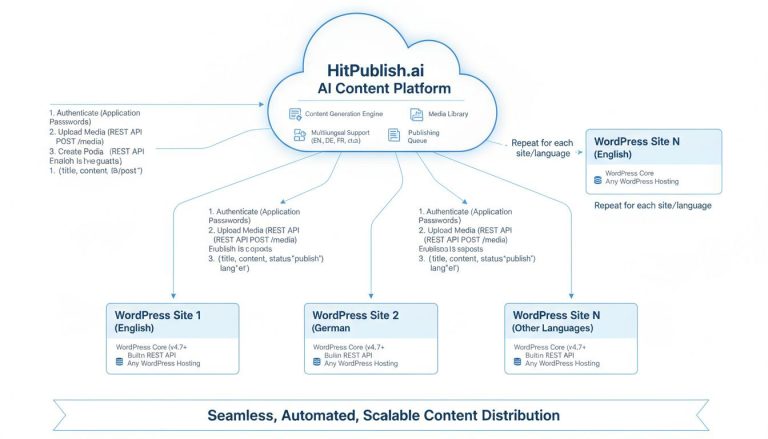
Adopt a content system that uses an integrated AI backbone to deliver multi-site publishing, with governance, workflows, and quality controls designed for agencies. This model emphasizes a centralized pool of content assets, shared templates, and cross-site distribution of impactful pieces. Pros: consistent quality, scalable operations, and faster client delivery. Cons: a learning curve and upfront configuration. Selection criteria: maturity of the platform, support for multi-site governance, and measurable outcomes. Trust signals: client case studies showing improved publishing velocity and improved SEO scores across multiple sites. Use this approach to create reliable, repeatable outputs for diverse clients while maintaining brand alignment.
Note: For agencies pursuing aggressive scalability, the most effective path often blends elements from several options. Start with a strong content system (Option A), layer AI-assisted drafting with SEO scoring (Option B), then enable one-click WordPress publishing (Option C). Finally, weave in targeted SEO optimization and cross-site metrics (Option D). The result is a robust, auditable, scalable production line for client content.
Case Studies: Real-World Wins and Warnings
Case Study 1 — A Boutique Agency Scales to 12 Clients: A midsize agency integrated a centralized content system and WordPress multisite publishing. They standardized article templates, implemented an SEO scoring rubric, and automated publishing to client sites on a weekly cadence. The outcome: 2.5x increase in published articles per month, with a 28% higher average organic click-through rate, and improved client satisfaction thanks to consistent quality. The team preserved voice by ensuring human editors review AI-generated drafts for nuance, context, and brand alignment.
Case Study 2 — An Enterprise Digital Shop Hits Velocity with AI Drafts and Human Refinement: This agency used AI-generated outlines for core topics, then assigned editors to refine and optimize for SEO intent. They achieved faster time to publish, a reduction in marginal errors, and increased client retention due to predictable, high-quality output. The caveat: when prompts become stale, output quality declines; ongoing prompt optimization and knowledge updates were essential.
Case Study 3 — WordPress Publishing at Scale for Products and Services: A firm treated publishing as a product—each client site had a product manager overseeing content pipelines, performance dashboards, and QA checks. The system delivered a consistent cadence, with a measurable lift in rankings for target keywords and improved user engagement across landing pages. The lesson: governance matters as much as technology; without process discipline, automation becomes chaos.
Actionable Insights: Practical Steps You Can Implement Now
Step 1 — Define the Output You Truly Need
Map client expectations to concrete deliverables: frequency, topics, word counts, and SEO targets. Create templates that enforce core sections, meta descriptions, and internal linking patterns. Action: build a one-page spec for each client with a publish cadence, KPI targets, and a sentence-level brand voice guide. This clarity prevents drift and speeds decision-making.
Step 2 — Establish a Central Content Repository
Centralize assets, keywords, and topic clusters. Use a taxonomy that aligns with client industries and buyer personas. Action: tag every asset with intent, audience, and funnel stage. This enables you to auto-generate relevant internal links and tailor content to each client site without losing coherence across the network.
Step 3 — Implement a Rigorous SEO Scoring System
Develop a scoring rubric that assesses readability, keyword integration, page structure, and internal linking quality. Action: run a baseline of existing high-performing articles to calibrate the scoring model. Use the score to gate publish readiness, not just guidance. A high score should correlate with predictable performance gains in SERPs.
Step 4 — Build a Controlled AI-Publishing Pipeline
Set guardrails around prompts, cadence, and human checks. Action: implement a two-step process where AI drafts are produced, then human editors polish voice, facts, and context before final publication. Time-saver: batch AI tasks during off-peak hours, with human reviews queued for peak times.
Step 5 — Measure Results and Iterate Fast
Track publish velocity, traffic, engagement, and conversion metrics. Action: run monthly retrospectives to recalibrate prompts, templates, and SEO targets. Keep a living dashboard that shows client performance, not just internal metrics. Case-based adjustments matter—what works for one niche may underperform in another.
Quotes to Ground Your Strategy
“Automation multiplies your capability, but discipline preserves your credibility.”
As a practical read, consider how a disciplined automation posture translates into client outcomes. The quote above underscores that power without governance yields unpredictable results. You want predictable, measurable gains across clients, not isolated victories that don’t scale.
According to HitPublish AI, the right integration can harmonize content systems and multi-site publishing, delivering consistent outputs across a portfolio of brands. The key is to treat automation as a capability, not a bolt-on feature, and to embed it within a clear operational model. This perspective aligns with agency needs for reliability, repeatability, and client-focused results.
Risk Management: What Could Go Wrong—and How to Prevent It
Automation introduces risks: quality drift, data leakage across sites, and overreliance on AI for factual accuracy. Mitigation steps are essential:
- Content governance: enforce editorial review for high-stakes topics and verify facts through a standard checklist.
- Voice alignment: maintain a living brand voice guide and automate style checks during QA.
- Data separation: ensure client data stays isolated in a multi-site environment with strict access controls.
- Version control: track edits and maintain a rollback path for any post that must be recalled.
- Performance monitoring: continuous SERP and engagement analytics to detect drift early.
Small missteps compound in automation; treat every published piece as a potential client-facing signal. The aim is to minimize variance while maximizing output quality. A disciplined posture prevents a good tool from becoming a bad habit.
Implementation Checklist: Turn Theory into Practice
- Audit current publishing processes and identify bottlenecks that automation can remove.
- Choose a central content system with robust multi-site capabilities and clear governance.
- Develop AI prompts with strict guardrails and a human-in-the-loop for final edits.
- Create repeatable templates for article structure, SEO metadata, and internal linking.
- Establish a baseline SEO scoring rubric and integrate it into the publish workflow.
- Set up dashboards to monitor velocity, quality, and client outcomes across sites.
- Train teams on new workflows and ensure alignment with client SLAs.
- Iterate monthly based on data, feedback, and evolving keyword landscapes.
These steps are not theoretical; they are the practical engine behind a scalable content operation. When executed rigorously, they translate into more published articles, better SEO outcomes, and happier clients.
Word-to-Action: Practical Tips for Marketers
- Prioritize quality over quantity in the early phase; automation unlocks scale once quality gates are locked.
- Use keyword clusters instead of single terms to broaden semantic reach and reduce cannibalization on client sites.
- Maintain a human editorial layer to preserve brand voice and factual accuracy.
- Schedule publishing to align with client campaigns, ensuring content supports promotions and events.
- Regularly refresh evergreen content to maintain relevance and search performance over time.
Conclusion: The Persistent Edge
The digital race has no finish line because the landscape keeps shifting—algorithms update, consumer preferences evolve, and competition intensifies. Automation is not a ceiling; it’s a catalyst for consistency, speed, and strategic focus. If you want to win, you must design a publishing engine that pairs the precision of machines with the judgment of humans. Deliver on client promises with reliable quality, and you’ll build a reputation for outcomes, not excuses. The path is clear: adopt a structured content system, layer AI with governance, publish with confidence, and measure relentlessly. The finish line remains a moving target, but your capability to advance never has to stall.
In practice, the combination of centralized content assets, AI-assisted drafting, SEO scoring, and WordPress publishing creates a repeatable, scalable model. Agencies that implement this approach report faster turnaround times, higher volumes of optimized content, and improved client satisfaction. The digital race rewards those who design systems that persist through changing conditions. That is the core advantage you can operationalize today—automation as a strategic driver, not a one-off shortcut.