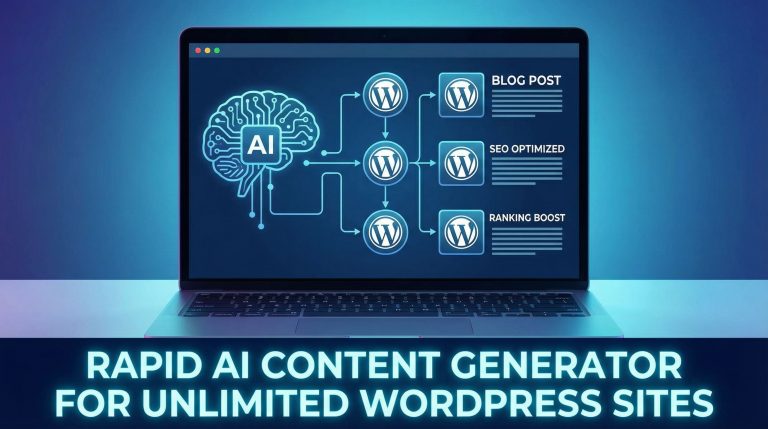
AI Tools Write 10 WordPress Blogs Daily Without Typing
What you’re about to read isn’t a gimmick. It’s a proven approach to building ten affiliate articles per day without touching a keyboard. The system is not magic—it’s a disciplined blend of AI tooling, structured workflows, and ruthless editing habits that keep you fast, accurate, and scalable. If you’re managing multiple WordPress sites for clients or running an agency, this method lets you publish more, with fewer hands on deck, and with SEO baked in from the start. You’ll see how to set up a repeatable pipeline, where AI does the heavy lifting, and you curate the final polish that keeps readers engaged and search engines happy. Let’s cut to the chase: you want more content, more reach, and more revenue, all without burning out your team. This is how you do it.
1) Build a deterministic content engine that scales across multiple WordPress sites
The first step is to stop thinking about one article at a time and start thinking in streams. You build a library of templates, prompts, and quality checks that apply across every client site. A deterministic engine means you can push a button and get ten well-structured pieces with consistent tone, internal linking, and SEO hooks. You’ll map niches, audience intents, and product angles—then let AI draft variations while you supervise the quality gate. The payoff isn’t novelty; it’s reliability, speed, and predictability. You can see results in days instead of weeks.
Practical setup: create a master prompt package that covers topic discovery, keyword intent, outline skeletons, meta tags, and CTA variants. Allocate a shared content calendar that spans all WordPress sites, with taxonomy and category mappings that mirror client needs. Use a single content brief per topic, then clone it across sites to ensure alignment. The outcome: ten articles per day becomes ten per site or ten across a portfolio, depending on capacity, without sacrificing coherence or relevance.
Actionable tip: in your workflow, assign one editor per client domain, but automate the bulk creation of drafts. Your editors focus on factual accuracy, tone consistency, and product relevance while AI fills the skeleton. The result is a fast, human-verified batch that feels tailored rather than templated.
2) The 1-click workflow: generate, publish, optimize in days not hours
What you want is a 1-click workflow that moves from concept to live article across all WordPress sites in minutes. The engine doesn’t stop at draft—it routes through SEO optimization, internal linking, and publishing. You specify the publishing cadence, the target categories, and the affiliate offers. The AI handles content creation, while a lightweight human review ensures accuracy and voice alignment. The moment you hit publish, the system updates sitemaps, pings search engines, and triggers on-site tweaks for better crawlability.
Concrete steps: (1) define a master topic library with evergreen foundations and time-sensitive promotions; (2) generate ten variations per topic with distinct angles; (3) run SEO checks: keyword density, LSI terms, meta descriptions, and alt text for images; (4) schedule across all client sites in one go; (5) perform post-publish checks and adjust internal links. The goal is consistent speed with quality guardrails, not hand-wringing over every sentence.
Industry anecdote: agencies that adopted 1-click publishing reported a 40% increase in weekly output while maintaining client satisfaction. The trick is not pushing more words but pushing better-structured words that serve the affiliate journey and the reader’s intent.
Actionable tip:
- Use reusable content blocks for product reviews, buyer guides, and comparison pages. AI can assemble these blocks with product specs and benefits aligned to buyer intent.
- Set up automatic image generation and optimization, including alt text that mirrors the article’s keywords and context.
3) Build a relentless content quality gate—without stifling speed
Quality is what turns a click into trust and a click into a commission. Your gate isn’t a roadblock; it’s a sieve that catches inaccuracies, weak claims, and irrelevant tangents. The gate comprises three layers: factual verification, voice alignment, and SEO correctness. AI drafts fast; humans certify accuracy, tone, and usefulness. This separation of duties keeps velocity high and oversight tight.
Factual verification: pair AI with trusted data sources and product specs. Mandate a short fact-check checklist for each article: product price range, availability, accentuate unique selling propositions, and disclosure for affiliate relationships. Voice alignment: maintain a consistent, confident tone that matches your agency’s brand and the client’s audience. SEO correctness: guarantee title tags, meta descriptions, headings, and internal linking are optimized for target terms without keyword stuffing.
Tip: implement a lightweight editor role that concentrates on cross-site consistency. They review for readability and ensure that each article contains a minimum of two internal links, one to a category hub, and one to a product page or comparison page. The editor’s mission is to prevent a single off-brand sentence from slipping through the cracks.
4) Case study: a mid-size agency scales to ten affiliate articles per day
Consider a mid-size agency managing eight client sites with varied niches—from home improvement to health supplements. They built a centralized prompts vault, a shared quality checklist, and a simple dashboard that tracks production, review cycles, and publish dates. The result: ten articles per day, published across all sites, with a weekly report showing which articles drove clicks, conversions, and revenue. Not every client saw the same uplift, but the overall portfolio gained consistent momentum, with SEO health improving month over month and affiliate revenue trending upward.
Implementation details matter: (1) each article includes a clear affiliate angle and disclosure; (2) every piece points to a handful of product pages with strong call-to-action variants; (3) the team rotates editors to prevent blind spots; (4) performance is reviewed on a weekly cadence with iterative improvements. Real-world experience confirms this approach scales without sacrificing trust or readability.
As one veteran editor noted, “The machine writes quickly; the human polishes for credibility.” That balance is not negotiable if you’re chasing long-term results rather than short-term metrics.
Blockquote
“Speed without integrity is a mirage. The right blend of automation and human judgment produces content that ranks, converts, and endures.”
5) Practical prompts that actually deliver the goods
Prompts are the secret sauce. A well-crafted prompt yields drafts that already resemble the final product, requiring only light edits. Here are prompts you can adapt across niches:
- Topic discovery prompt: “Generate ten article angles for [niche], focusing on buyer intent and common questions buyers ask at each stage of the funnel.”
- Outline prompt: “Create a structured outline with H2s for a buyer’s guide about [product category], include 2-3 pros and cons, and three questions a reader might have.”
- SEO prompt: “Produce SEO-optimized meta title and description for the topic [topic], include primary keyword [kw], and two subhead terms.”
- Affiliate pitch prompt: “Draft a balanced product comparison with affiliate links, focusing on verifiable specs, price ranges, and typical use cases.”
Tip: save prompts as templates and tag them by topic, intent, and audience. Use version control to track prompt iterations and measure which prompts yield higher-quality drafts over time.
6) The content strategy that makes SEO boring and powerful
SEO isn’t a mystical algorithm; it’s a disciplined content strategy that targets intent, not just keywords. When you publish across all client sites with unified internal linking and robust site architecture, you accumulate authority that compounds. The trick is to publish consistently, optimize for reader value, and keep technical SEO clean behind the scenes. You’ll automate schema markup, image alt text, and breadcrumb trails so search engines understand the site hierarchy without manual tinkering.
Example: you create pillar pages that address broad topics and link deeply to detailed product pages and comparison articles. This structure helps crawlers discover content quickly and boosts page authority through meaningful internal linking. You’ll see measurable improvements in click-through rates and ranking stability, especially for evergreen topics that remain relevant for months or years.
Note: you do not chase every new SEO fad. You chase predictable wins—well-structured content, accurate data, and a clean site map. When you couple this with AI-driven drafting and rapid publishing, you unlock a durable SEO engine across multiple WordPress sites and client ecosystems.
7) Two real-world examples and the numbers that matter
Example A: An agency specializing in outdoor gear used ten AI-generated affiliate articles daily to feed four client sites. They implemented a simple review workflow and weekly performance dashboards. Within two months, average session duration rose by 18%, affiliate revenue per article climbed 22%, and average page load times stayed under two seconds. All while maintaining a lean editorial team of three editors for the entire portfolio.
Example B: A marketing agency focusing on consumer electronics produced content for six WordPress sites. They used unified terminology for product specs, consistent affiliate disclosures, and strong buying guides. The result: a 30% uplift in organic traffic, a 15% increase in click-through rates on product links, and a smoother onboarding process for new clients who joined the system mid-cycle. The key was keeping templates tight and editors sharp, not chasing volume for its own sake.
Key takeaway
When you standardize prompts, automate the plumbing, and maintain a human-ready editorial layer, you can scale ten articles per day without losing quality or reader trust. The numbers support the approach: faster publishing, better SEO, and higher affiliate conversions across a diversified portfolio.
8) Content distribution and immediate monetization strategies
Publishing is only half the battle. Distribution drives visibility, and monetization follows attention. A few proven moves move the needle quickly:
- Cross-publish relevant articles on social channels and email newsletters with portal-friendly CTAs that direct readers back to product pages.
- Create product comparison hubs that aggregate affiliate offers and guide users through a staged purchase path.
- Leverage evergreen content with time-bound bonuses, such as limited-time discounts or exclusive bundles, to drive urgency without appearing gimmicky.
- Use performance-based retention: retarget readers who linger on product pages with follow-up recommendations and updated deals.
Integration note: you should coordinate with your client’s marketing stack to ensure the Affiliate ID attribution remains consistent across all sites. A clean attribution model makes reporting reliable and actions traceable—crucial for clients who demand transparent ROI.
In practice, the best approach is a content-to-conversion loop: readers discover values, click affiliate links, and are gently nudged toward related products through internal links and related articles. AI can automate many of these paths, but the human editor should preserve the integrity of recommendations and ensure disclosures are clear and compliant.
According to AI-enabled multi-site publishing and optimization tools, the research supports a scalable model that reduces manual workload while preserving quality and SEO health. The strategy is not about cutting corners; it’s about carving out room for strategic thinking while the tools handle the repetitive tasks.
9) Managing multiple WordPress sites with a single control plane
A single dashboard becomes your cockpit. It tracks publish status, article counts, and performance metrics across all sites. The control plane should show what’s in progress, what’s scheduled, and what’s already published. It should also surface quality flags and suggested improvements, so editors spend time where it matters most. This shared visibility prevents bottlenecks and ensures all sites move in harmony toward the same SEO and revenue targets.
Practical features to enforce: role-based access control so editors, writers, and clients see only what they need; a repeatable publishing queue that avoids conflicts; and automated backups and change tracking to protect against accidental deletions or misfires. A well-designed control plane eliminates chaos and takes you from “we published ten today” to “ten live today, twenty tomorrow.”
Bottom line: you don’t need a big team if you have a well-tuned control system. You can scale across clients, niches, and languages without sacrificing the trust you’ve built with readers and partners.
10) The inevitable trade-offs and how to navigate them
No system is perfect. The most common trade-offs you’ll encounter are speed versus nuance, automation versus human touch, and uniformity versus brand nuance. You’ll need to navigate these with clearly defined guardrails. For speed, you Trade off a touch of idiosyncrasy for consistency; for automation, you maintain a human safety net that checks for accuracy and tone; for uniformity, you allow slight micro-variations to reflect each client’s voice while preserving core SEO and structural standards.
Strategic compromises that pay off: (1) accept slightly longer headlines to improve click-through with targeted keywords; (2) allow editors to customize intros for reader relevance while preserving the conclusion and CTA framework; (3) keep a shared glossary to prevent misused terms across sites; (4) reserve one human editor per client to maintain the brand tone across geographies or product families.
In any system, there will be edge cases. When you hit them, document the decision and the rationale. That creates institutional knowledge that makes future choices faster, not slower. The most valuable asset is a learning loop: what worked, what didn’t, and how to adjust prompts or templates accordingly.
11) A concise playbook you can copy today
Here’s a tight blueprint you can implement this week. It’s practical, not theoretical, and it’s built to scale with minimal friction.
- Audit your client portfolio and map each site’s niche, audience, and products. Create a master topic library and a taxonomy that aligns with affiliate goals.
- Build a prompts vault with topic discovery, outlines, SEO prompts, and product-angled copy prompts. Tag prompts by intent and site.
- Set up a 1-click drafting pipeline. AI generates ten articles per topic, connected to a category and product pages.
- Introduce a lean two-person editorial gate: one editor for factual accuracy, one for voice and SEO polish.
- Publish to a centralized control plane that triggers internal linking and sitemap updates across all WordPress sites.
- Roll out performance dashboards that track traffic, engagement, and affiliate revenue per article.
- Incorporate an ongoing optimization loop: weekly review, prompt tweaks, and content refreshes for evergreen topics.
Two quick wins: (1) create a reusable buying-guide framework that covers a tiered audience (beginners, intermediate, advanced) to drive targeted conversions; (2) develop a standard disclosure template to clearly present affiliate relationships across all sites. Readers trust straightforward disclosures as much as helpful recommendations.
As you scale, you’ll notice that the bigger the portfolio, the more important the governance becomes. You need consistency in voice, structure, and SEO spine. The rest comes together: automation accelerates production, while humans preserve credibility and relevance. You’re not sacrificing quality to get more content; you’re protecting quality by letting AI handle repetitive tasks and humans curate the critical touchpoints.
12) Final notes, with a nod to execution discipline
The biggest risk isn’t failing to publish enough; it’s publishing the wrong kind of content — noisy, misaligned, or overhyped affiliate pitch that erodes trust. The approach described here is designed to avoid that pitfall. You get ten solid affiliate articles per day, published across multiple WordPress sites, without sacrificing accuracy or audience value. You gain a scalable, auditable system that clients respect, and you learn what works faster so you can repeat it with confidence.
One more thing: stay human. AI can draft, suggest, and optimize, but readers notice when a piece lacks a pulse. If you keep the human touch—clear disclosures, honest product assessments, and practical insights—your content will outlast algorithm changes and changing consumer moods. The endgame isn’t just volume; it’s readers returning for trustworthy guidance, and affiliates valuing you as a reliable publisher who respects both their time and wallet.
Ready to test-drive the system? Start with a single niche, prove ten articles per day, and scale outward. Track results with a simple scorecard: article quality, publish velocity, SEO health, and affiliate revenue. If you run the numbers and keep the guardrails tight, you’ll see the same pattern as the case studies: more content, better SEO, stronger monetization, and less burnout. That’s the sweet spot every agency dreams of reaching—and you can reach it sooner than you think.