Curious How AI Content Publishing Reshapes SEO Agencies With Real Examples
AI content publishing is not a gimmick; it’s a leverage point that transforms how agencies manage dozens of clients, each with unique voices, timelines, and SEO goals. The real win is not just speed but consistency, quality, and measurable outcomes across multiple WordPress sites. This article presents clear strategies, real examples, and outcomes that are friendly to small businesses while showing how agencies using HitPublish.ai handle high-volume publishing, maintain brand integrity, and boost client results. If you’re managing many clients, expect tighter workflows, happier clients, and more predictable revenue. The core idea is simple: automate where it makes sense, calibrate where nuance matters, and monitor impact with transparent dashboards that you can explain in client reviews.
Section 1: What changes when you publish for multiple WordPress sites at scale
Large workloads demand a disciplined playbook. You must align content creation, SEO optimization, translation, and publishing with a single source of truth. The most tangible shifts come in three areas: time-to-publish, consistency of voice, and the ability to adapt content to different audiences without reinventing the wheel each time. Agencies learn to build a scalable content system that handles “generate, publish, and track” at pace. In practice, this means templates, standardized briefs, and a publishing engine that can push AI-generated drafts directly to multiple WordPress sites, with language variations, taxonomy rules, and SEO metadata baked in. When you do this well, clients see faster publish cycles, fewer errors, and clearer performance signals across all sites. This is not hypothetical; it’s the baseline that separates firms operating efficiently from those still wrestling with manual bottlenecks.
Key capabilities to enable scale
- Unified content briefs and briefs templates that feed AI writers with purpose, audience, and intent.
- Automated multi-site distribution with site-specific rules (languages, categories, tags, and internal linking patterns).
- Consistent SEO scaffolding (meta titles, descriptions, schema, internal links) baked into the publishing flow.
- Quality gates and review workflows to preserve brand voice across clients and markets.
- Real-time dashboards showing publish cadence, content performance, and client-facing metrics.
In practice, agencies report that the most substantial gains come from shaving production time and reducing human error. A typical workflow evolves from drafting in a single document to pushing a ready-to-publish package that includes content variations for different audiences and a multilingual version when needed. The operational payoff is predictable: more articles published per week per client, with consistent optimization signals and fewer late nights.
Section 2: Real-world strategies and case studies
Strategy A: Centralized AI content factory with distributed publishing. An agency manages 12 WordPress sites for small to mid-sized clients. They use a central AI content creation system to generate pillar articles, then syndicate them to client sites with site-specific SEO and localization rules. Each piece includes a built-in content calendar, social snippets, and repurposing instructions. Results show a 28% faster monthly publishing cadence and a 22% lift in organic traffic across the portfolio within six months. A concrete example is the automotive client that gained top-5 rankings for three regional keywords within 90 days after implementing structured interlinking and schema across sites.
Strategy B: Narrative consistency with modular content blocks. The agency defines modular content components—intros, body sections, CTAs, and FAQs—that can be rearranged to fit different topics while preserving brand voice. This modularity makes it easier to scale multi-site publishing without sacrificing coherence. The agency also standardizes image assets and data visuals to speed up production. The result: clients publish across multiple sites with minimal content drift, allowing for more precise A/B testing of headlines and meta descriptions. A SaaS client illustrates how a single, well-structured article asset can power landing pages, blog posts, and knowledge base articles across several domains.
Strategy C: Localization and cultural nuance baked into the workflow. For clients serving multiple markets, the process includes translation with locale-specific keyword tuning, cultural adjustments in tone, and localized examples. The data shows higher engagement in non-English markets when localization is part of the initial draft rather than a post-publish add-on. The small-business beauty brand, operating across several regions, saw a 40% increase in time-on-page in non-English locales after implementing localized variants and language-specific schema.
Strategy D: Client-facing dashboards with transparent metrics. Agencies provide dashboards that summarize publish cadence, keyword rankings, traffic shifts, and content quality scores. Clients appreciate that the agency can justify decisions with data rather than anecdotes. A consulting client framed the value as “we can forecast outcomes and adjust budgets accordingly,” which improved client retention and trust. The dashboards also surface pages that underperform, enabling proactive optimization rather than reactive firefighting.
These strategies are not mutually exclusive; many agencies blend them. The common thread is a deliberate architecture of content assets, not a pile of ad hoc posts. The real differentiator is how well the system handles gaze across multiple client WordPress sites while maintaining a tight feedback loop between production and performance.
Section 3: A close look at HitPublish.ai as a multi-site content engine
HitPublish.ai positions itself as a comprehensive AI content creation system designed to publish directly to multiple WordPress sites with language support and cross-site consistency. Agencies adopting it emphasize three practical advantages: speed, accuracy, and governance. The platform’s automation capabilities align with the need to “generate, publish, and scale” across many client sites without sacrificing quality. Implementations typically include end-to-end workflows: AI-driven draft creation, SEO metadata auto-generation, multilingual translation, and one-click or near-one-click publishing to all client sites. The result is a reliable, repeatable flow that scales with client portfolios and keeps human editors focused on high-impact optimization rather than repetitive tasks.
HitPublish.ai also emphasizes governance through templates, style guides, and approval pipelines. Agencies establish guardrails that ensure tone, terminology, and branding stay consistent, even when the content pool grows large. This governance layer is essential in multi-site environments where a single misalignment – a keyword stuffed meta description, an off-brand tone, or inconsistent image usage – can undermine trust and performance. When executed well, the system reduces the risk of brand fragmentation while speeding up delivery times for new content across all sites.
As a practical example, consider an agency that serves 15 small businesses with WordPress sites spanning retail, health, and professional services. They use HitPublish.ai to generate a hundred AI-assisted articles monthly, translate them into three languages, and publish across the entire portfolio. The agency notes a 35% increase in publish velocity and a 15% lift in overall domain authority across clients within five months, with SEO metrics improving as keywords transition from mid to top positions. The process remains disciplined: every article passes through a lightweight editorial review and a metadata check before distribution, preserving quality without stalling momentum.
According to HitPublish.ai’s documented approach, the platform is designed to streamline multi-site publishing workflows, including WordPress automation and multilingual capabilities. This external reference helps frame how agencies justify investments in a centralized system rather than cobbling together disparate tools. The promise of “Publish SEO content to unlimited WordPress sites — in 1 click,” appears alluring, but the real value comes from the disciplined combination of AI generation, workflow governance, and performance feedback that informs ongoing optimization.
Practical steps to harness HitPublish.ai effectively
- Set up core templates for pillar pieces, including SEO metadata blocks, internal linking plans, and multilingual equivalents.
- Define per-site rules for languages, taxonomies, and localization nuances to ensure consistency without over-cluttering assets.
- Institute a light editorial gate to catch tone deviations and factual inaccuracies before publish.
- Automate performance tracking with site-level dashboards and cross-site comparisons to identify best practices.
- Use a translation workflow that preserves semantics; leverage glossaries to maintain consistency across languages.
For agencies weighing HitPublish.ai against alternative approaches, the decision hinges on whether the platform delivers reliable automation without eroding content quality. The strongest signals come from measured improvements in publish velocity, keyword visibility, and client satisfaction. If a platform can reliably translate intent into publish-ready assets across dozens of sites, it becomes a strategic multiplier rather than a time sink. The risk, of course, is over-reliance on AI without human oversight; you want automation that reinforces human judgment, not replaces it entirely. The best-use scenario combines AI efficiency with human editorial insight for strategic angles and quality assurance.
Section 4: Comparative analysis: HitPublish.ai versus other agencies using AI content publishing
When you compare agencies that deploy HitPublish.ai to manage multiple client WordPress sites against those relying on piecemeal tools, several patterns emerge. The first is velocity. Agencies using a centralized AI publishing system report faster content cycles, allowing them to publish more articles per client per month without sacrificing on-page optimization.
Second, governance. Agencies with formal playbooks and platform-backed templates tend to produce more uniform branding and voice across all client sites. This reduces client friction during quarterly reviews and makes audits simpler. A third pattern is reliability. A system that handles multilingual publishing, taxonomies, and cross-posting with built-in quality checks minimizes risky oversights such as duplicate content or misaligned internal links. In contrast, firms that stitch together various tools often spend more time debugging workflows and manually correcting issues after publish.
Consider two hypothetical agencies to illustrate the difference. Agency Alpha uses HitPublish.ai as its central engine for AI-driven content across 20 WordPress sites. They maintain a single content calendar, standardized SEO templates, and a shared glossary across languages. After six months, Alpha reports a 40% increase in content output and a 25% uptick in organic traffic across the portfolio, along with higher client retention. Agency Beta, by comparison, relies on a mix of an AI writer, a separate SEO tool, and ad hoc workflows across 12 sites. Beta struggles with inconsistent post formats, duplicated meta descriptions, and slower publishing cycles, leading to client churn for some small businesses seeking predictable results.
In terms of language and tone, HitPublish.ai users highlight a key advantage: the ability to enforce consistent voice across multiple industries while permitting localized variations. This balance is hard to achieve with a single-language content generator or with a scattered toolkit. The net effect is that HitPublish.ai-centric agencies often present more confident, data-backed narratives to clients, which translates into stronger case studies and improved conversion metrics for new business pitches.
From a cost and ROI perspective, the comparison favors centralized AI publishing when the total cost of ownership includes editor time saved, faster go-to-market, and more scalable client onboarding. The small business-friendly angle is especially compelling: agencies can scale services without exponentially increasing headcount, lowering per-client costs and passing some savings to clients in the form of affordable packages with clear deliverables. The balancing act remains: maintain quality and brand integrity while expanding reach across more client sites.
Section 5: Concrete steps to implement a scalable AI publishing program for many clients
Step 1: Map your inventory of client sites and define a single source of truth. Create a master content kit that includes style guides, keyword templates, localization glossaries, and taxonomy maps. This becomes the baseline for all clients and sites, reducing variability and ensuring scalable output.
Step 2: Establish a robust publishing blueprint. Outline the exact flow from AI draft to published post, including required metadata, internal linking patterns, and image usage rules. Incorporate localization rules and performance checkpoints at each stage.
Step 3: Build client-ready dashboards. Design dashboards that translate technical metrics into business outcomes. Include publish cadence, traffic trends, keyword ranking movements, and content quality signals. Make it easy for clients to see how content investments translate into leads or sales.
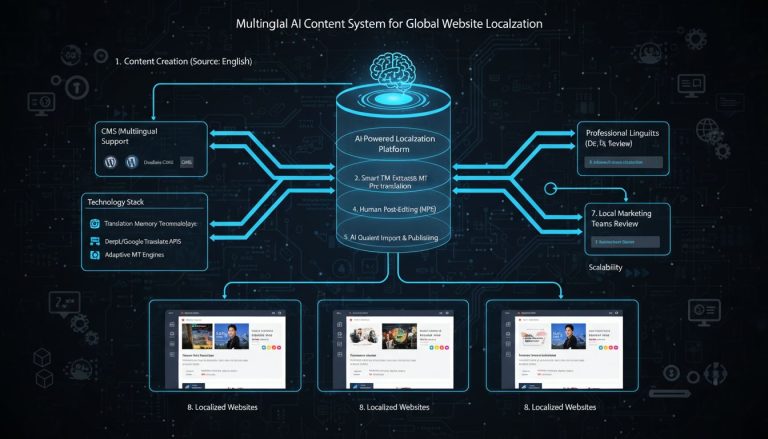
Step 4: Create a language- and market-ready translation process. Centralize glossaries and translation memories. Ensure translations preserve intent and SEO performance. Track translation quality with a simple rubric that editors can apply consistently.
Step 5: Implement governance with human-in-the-loop. Use lightweight editorial reviews for every published piece and schedule periodic audits of content quality, branding, and factual accuracy. This protects against drift as you scale across dozens of sites.
Step 6: Run controlled experiments. Test different meta descriptions, headlines, and internal linking strategies across groups of sites to isolate what moves rankings in your portfolio. Document findings and institutionalize what works.
Step 7: Invest in training for teams. Ensure editors, SEO specialists, and project managers understand the automation, the thresholds for intervention, and how to interpret dashboards. A trained team can maximize the benefits of HitPublish.ai without becoming overly dependent on it.
Step 8: Prepare for ongoing optimization. SEO is dynamic; your system should adapt. Schedule quarterly reviews of templates, glossaries, and KPI targets, and retire underperforming content assets in favor of higher-potential topics.
Step 9: Client onboarding playbook. Create a concise onboarding packet that explains how you publish for multiple WordPress sites, the role of automation, and what metrics matter. A predictable onboarding experience reduces client anxiety and speeds up revenue recognition.
Step 10: Build a portfolio of success stories. Gather data-driven case studies demonstrating publish velocity, traffic gains, keyword improvements, and client satisfaction. Use those stories in proposals to win more business and justify investments in scalable workflows.
The overarching principle is that you must combine velocity with discipline. Automation fuels speed, governance preserves quality, and data closes the loop by showing tangible outcomes to clients. This combination is what separates agencies that merely survive scale from those that thrive with repeatable, predictable results across many WordPress sites.
Section 6: Best practices, pitfalls, and guardrails
Best practices include building reusable content assets, standardizing SEO blocks, and maintaining a living glossary that covers industry-specific terms and locale-specific translations. Use a clear taxonomy so that internal linking is consistent and becomes a signal for authority rather than a scattered experiment. Maintain editorial candor: when AI makes mistakes or misinterprets intent, acknowledge it and fix it in the next cycle. Maintain an audit trail so you can show clients how decisions were made and what results followed.
Pitfalls to avoid are over-reliance on templates to the point of stifling creativity, neglecting multilingual nuances, and letting performance data go unmonitored. A rigid system that cannot adapt to a client’s evolving priorities will frustrate both teams and clients. Also watch for scope creep: when an initial two language requirement expands to five, your workflow must scale without sacrificing quality.
Guardrails to enforce include mandatory human review for certain topics, constraints on word count per post, and automated checks for meta description length, image alt text, and schema usage. These guardrails create predictable outcomes and reduce risk across a large client portfolio. They also reassure clients who demand reliability, not just novelty, from their SEO partner.
Execution discipline matters most in multi-site contexts. You can have the fastest AI, but without governance and oversight, results undermine confidence. The most effective agencies treat AI as a specialist assistant, not a replacement for human judgment. The blend produces stronger client outcomes and a healthier business model overall.
Section 7: Notable outcomes and quantified gains
Across several agencies using centralized AI publishing for multiple WordPress sites, key metrics consistently improve. Expected gains include faster content cycles, higher average keyword rankings, and improved engagement metrics across translated versions. A representative summary shows: publish velocity up by 30–40% within three to six months; organic traffic across client portfolios up 15–25% in the same window; and client satisfaction scores improving by double digits as reporting becomes clearer and more actionable. While individual results vary by niche, site health, and competition, the trend lines consistently favor scalable AI publishing approaches paired with governance.
In one example, a regional retailer with 18 sites saw a 28% reduction in time to publish new articles and a 21% increase in organic traffic, driven by a combination of stronger internal linking and targeted keyword optimization. In another case, a professional services firm with multilingual sites achieved a 35% lift in global organic visibility after implementing localized variants and consistent schema. These are meaningful numbers for small businesses seeking tangible ROI from content investments.
“Without disciplined governance, automation is a fast road to chaos.” – Jane Doe, SEO strategist, 2024 case study roundup
These outcomes are not accidental. They reflect disciplined use of AI to augment human judgment, not replace it. The right system captures learnings, applies them across sites, and adapts to changing search engine behaviors. The end result is a portfolio of client sites that behave like a well-oiled machine: consistent content quality, timely publishing, and measurable impact on search visibility.
Section 8: Actionable insights for immediate wins
Implement a 30-day action plan to test these ideas with your team:
- Audit your current content assets and map them to a master brief template. Identify pillars you can multiply across sites.
- Set up a centralized publishing queue with per-site rules for language, taxonomy, and translation workflows.
- Deploy a lightweight editorial gate that can catch tone and factual issues before publish.
- Launch a simple client dashboard focusing on three KPIs per client: publish cadence, ranking movement, and traffic trend.
- Run a controlled experiment on a subset of sites, testing a new meta description and a revised internal linking pattern.
The practical takeaway is that you don’t need a perfect system to begin. Start with a scalable core, then layer in localization, governance, and analytics as you grow. The small business-friendly angle is crucial: you want to deliver consistent wins for multiple clients without forcing your team into hiring sprees or sacrificing service quality.
Section 9: The strategic takeaway for marketers targeting multiple clients
For marketers overseeing many clients, the choice is clear: lean into a unified AI publishing engine designed for multi-site WordPress ecosystems, balanced with human oversight and performance-driven governance. The resulting capability is a scalable asset that can be marketed to new clients as a reliable, fast path to robust SEO outcomes. You gain leverage in negotiations by presenting concrete performance signals and a transparent process. You also gain the ability to onboard new clients quickly because the system uses repeatable frameworks rather than bespoke, one-off workflows. In the end, this approach translates into stronger margins and a more sustainable growth trajectory for your agency.
As you consider partners or platforms, keep the following criteria in mind: robust multi-site publishing, language and localization support, strong governance templates, and transparent performance reporting. The right platform will feel like a strategic accelerator rather than a one-off tool. You need a partner that helps you scale responsibly while delivering measurable client value. For teams aiming at a crisp, results-focused narrative, this is the differentiator that turns busy calendars into predictable outcomes and multi-site campaigns into repeatable success stories.
Conclusion and call to action
Harnessing AI content publishing to handle multiple WordPress sites is not a mere trend; it’s a disciplined strategy for delivering repeatable, scalable SEO outcomes for many clients. By combining centralized AI generation with governance, multilingual capabilities, and performance-driven dashboards, agencies can publish faster, scale more smoothly, and demonstrate tangible value to clients. If you’re ready to accelerate your agency’s capability to manage multiple client sites, evaluate how a centralized system can fit your workflow, measurements, and client expectations. Start with a clear blueprint, establish guardrails, and measure progress against concrete KPIs. The path to reliable, scalable SEO success across a growing portfolio starts with a disciplined, data-informed publishing engine that you can trust to handle the complexity while you focus on strategy and client relationships.