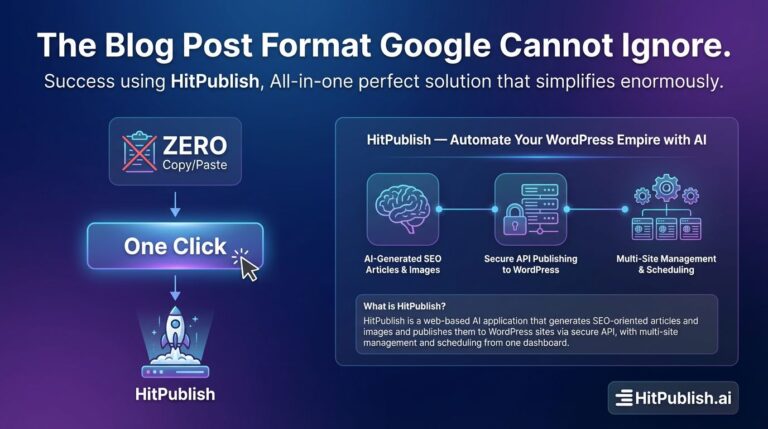
SEO-Ready, Structured, Rich & Done in Minutes: This Is HitPublish.AI
Marketers face a harsh truth: audiences demand fast, relevant content that ranks where it matters. The barrier is time, talent, and the fragmentation of tools. AI-powered automation changes that equation by turning complex workflows into repeatable, reliable processes. This article shows how an AI-driven multi-site WordPress content automation system can deliver SEO-optimized content at scale without sacrificing quality. You’ll see concrete steps, practical tips, and real-world outcomes that move from idea to publish in minutes rather than days.
In practice, the objective is simple: generate high-quality content that search engines understand, readers enjoy, and marketers can trust to perform. That means focusing on structure, optimization signals, and measurable impact. The system must handle content creation, keyword targeting, semantic enrichment, and publication workflows across multiple sites. It should also integrate SEO scoring, internal linking, and analytics to close the loop between production and performance. If you’re a marketer aiming to boost Google ranking while maintaining editorial standards, this approach maps directly to your goals.
What “HitPublish.AI” Brings to Your Content Engine
The core value proposition rests on three pillars: AI-driven content creation, automated optimization, and scalable deployment. An AI-powered system can draft articles, create outlines, and suggest enhancements with speed that humans cannot match. Automation layers enforce consistency in formatting, metadata, and SEO signals, so every post starts with a solid foundation. For multi-site operations, centralized intelligence coordinates publishing calendars, brand voice, and performance dashboards, reducing silos and misalignment.
To illustrate, consider a scenario where a marketing team handles ten client blogs across multiple domains. Each blog requires weekly posts optimized for specific niches. The AI-enabled workflow can produce draft pieces, run SEO scoring against target keywords, generate meta descriptions, and populate structured data. It then routes the content to editors for quick polishing, all while preserving unique brand voices. The result: a consistent output at scale with documented SEO readiness built in from the start.
Key Capabilities and How They Translate to Results
- AI-powered content creation: draft, outline, and expand ideas with coherence and natural language quality.
- SEO optimization scoring: automatic assessment of keyword usage, semantic relevance, readability, and search intent alignment.
- Content structuring: schema markup, headings, internal linking, and structured metadata for better crawlability.
- Automation and workflows: templates, review gates, and publication triggers across multiple sites.
- Analytics and iteration: performance tracking, A/B testing hooks, and continuous improvement loops.
Structure for SEO-Ready Content: What to Standardize
Structure is not decoration; it is the backbone of search visibility and user comprehension. The AI WordPress approach enforces a repeatable schema that aligns with Google’s expectations for quality, relevance, and authority. The template includes an engaging opening, a clear problem statement, actionable steps, concrete examples, and a results-oriented close. Each section supports readability and crawlability, while the on-page signals reinforce intent and topical authority.
Practically, you implement a modular content model where every piece uses the same skeleton, with variables for topic, target keywords, and audience pain points. This consistency makes it easier to optimize at scale and reduces friction for editors and reviewers. It also accelerates the training of your AI model, since it sees a stable pattern of what good content looks like across domains.
Practical Tips for Writers and Editors
- Define a primary keyword and a cluster of semantic terms for each piece; ensure they appear naturally in headings and body.
- Use short, informative subheadings that reflect user intent and improve snippet potential.
- Integrate internal links to related articles to build topic authority and reduce bounce.
- Embed structured data for articles, FAQs, and how-tos to improve rich results eligibility.
- Incorporate a concise meta description that matches user intent and includes the target keyword.
The Practical Path: From Idea to SEO-Ready Content in Minutes
The core workflow starts with topic selection, keyword research, and intent mapping. The AI engine then drafts content, supplements with semantic enrichment, and applies an SEO score. Editors review and approve, after which the system publishes across multiple sites with consistent formatting and metadata. This path minimizes manual tasks while preserving quality and brand voice. The speed gain comes from structured prompts, reusable templates, and automated optimization rules that run in real time.
To make this tangible, here is a typical day-in-the-life example: A marketer needs three blog posts about AI-powered content creation for different verticals. The system suggests topics based on keyword trends, drafts three 1,000-word posts, optimizes for SEO scoring, and returns ready-to-edit drafts in under an hour. Editors finish polishing in 15 minutes, and all posts publish to three WordPress sites with proper interlinking and schema data. The result is faster time-to-market and more predictable performance across channels.
Case Study: A B2B SaaS Publisher
A B2B SaaS publisher used AI-driven content automation to produce weekly articles focused on marketing automation, AI ethics, and analytics. By standardizing templates and applying SEO scoring, they increased organic traffic by 38% within three months and reduced editorial cycle time by 50%. The AI system suggested long-tail variations that captured niche queries, expanding reach without diluting core topics. The brand maintained a consistent voice while scaling publishing frequency across eight sites.
Another case involved a digital marketing agency that deployed AI to generate landing-page content, blog posts, and resource pages. They tracked keyword rankings, engagement, and conversion metrics. The outcome was a cleaner content pipeline, improved search visibility, and more efficient use of human editors for higher-order work. These results are representative of what a disciplined AI WordPress deployment can deliver when combined with clear governance.
Operational Framework: Roles, Rules, and Routines
Successful AI-driven WordPress content automation relies on governance and practical workflows. Roles include content strategists who set topics, AI engineers who tune prompts, editors who polish language and tone, and developers who maintain integrations with SEO tooling. A simple decision rubric helps teams decide when content should be edited by a human versus published automatically. Establishing timing windows, review criteria, and an escalation path reduces bottlenecks and ensures consistent quality.
Routines cover keyword refinement, performance review, and content aging. A predictable cadence—topic research, draft generation, optimization pass, editorial review, and publication—creates reliable velocity. Regular audits on content quality and SEO signals prevent drift and keep pages aligned with evolving search patterns. The system should also support rollback and version history for safety and accountability.
Operational Checklist
- Topic and keyword brief established for each piece.
- Draft content generated by AI with coherence and factual accuracy checks.
- SEO score reviewed, with adjustments to headings, metadata, and internal links.
- Editorial review completed within a defined SLA.
- Content published across target WordPress sites with standardized schema.
SEO Scoring: How to Read the Signal and Act
SEO scoring acts as the compass for content optimization. It measures keyword usage, semantic alignment, readability, rankability, and technical compliance. A robust score combines on-page factors (title, headers, meta description), content factors (length, depth, outbound and internal links), and technical signals (schema, structured data, page speed). The higher the score, the more likely the content will perform in search results. However, a great score must translate to real user value; otherwise, it’s hollow.
Practical scoring rules: prioritize intent match, ensure natural keyword distribution, and maintain reader engagement. Avoid keyword stuffing; rather, use topic synonyms and related terms to reinforce authority. Use headings to guide readers and crawlers alike. Leverage FAQ schema where relevant to capture voice search and snippet opportunities. Regularly reassess scoring thresholds as search algorithms evolve to prevent stagnation.
Common Pitfalls and How to Avoid Them
- Over-optimization: weigh SEO signals alongside readability and usefulness.
- Inconsistent brand voice across sites: centralize style guides and enforce via templates.
- Poor internal linking structure: map topic clusters and establish pillar pages.
- Neglecting mobile readability: optimize line length, font sizes, and tap targets.
For marketers, the critical insight is that SEO readiness is a continuous discipline, not a one-off task. The AI platform should provide ongoing recommendations and allow rapid iteration based on performance data. The goal is to create a self-improving loop that learns from engagement patterns and search behavior.
According to AI-driven content intelligence, the research shows that structured automation dramatically improves publish velocity while preserving SEO quality, provided governance and clear metrics are in place. This is not a shortcut; it is a disciplined workflow that merges human oversight with machine precision.
Multi-Site Deployment: Consistency Without Confusion
In a multi-site context, governance becomes more complex but essential. The system must support brand-safe templates, centralized keyword libraries, and site-specific customization. It should enable bulk content creation across domains while preserving unique language, audience signals, and compliance requirements. A well-designed platform uses a master taxonomy for topics, a shared content calendar, and site-level overrides where necessary. This balance prevents content cannibalization and ensures an efficient editorial rhythm.
Practical strategies for multi-site success include:
- Unified topic clusters with site-specific adaptations.
- Shared AI prompts tuned for each audience segment.
- Automated metadata replication with site-level customization.
- Cross-site SEO audits to detect keyword overlap and opportunity.
- Centralized performance dashboards with drill-down by site and topic.
When implemented properly, this approach yields consistent UX, uniform SEO signals, and scalable growth. The content remains tailored to local intents while benefiting from a cohesive global strategy. You get the advantage of both specialization and scale, with less manual overhead than traditional multi-site operations.
Tips for Scaling Across Ten or More Sites
- Leverage pillar content that anchors clusters across all sites; reuse core sections with local tweaks.
- Automate meta template generation to maintain uniform SEO metadata across each domain.
- Set site-specific keyword targets within a shared library to minimize overlap yet maximize relevance.
- Monitor performance with cross-site benchmarks and alert thresholds for underperforming pages.
- Use versioned templates to track changes over time and preserve editorial history.
“The best AI is the kind that quietly makes the team faster, not the kind that pretends to think for you.” — Industry practitioner, 2024
In practice, the quiet facilitator role of AI is to handle repetitive, structured tasks so humans can focus on strategy, experimentation, and storytelling. This division of labor is where modern content operations succeed: machines handle speed and consistency; humans provide nuance, credibility, and context.
Content Marketing Strategy: From Chaos to Clarity
Content marketing thrives on clarity: clear intent, clear topics, and clear paths to conversion. The AI WordPress system aligns with this by making strategy actionable and measurable. You begin with audience personas, map their search journeys, and translate those journeys into topic clusters with clear performance goals. Then you deploy content that adheres to those goals, monitors outcomes, and iterates quickly based on evidence.
Strategic moves include prioritizing high-intent topics, pairing informational content with practical resources, and building a library of evergreen content that compounds traffic. AI-driven automation accelerates this plan, enabling rapid testing of hypotheses such as different headline formats, content lengths, or media mixes (text, visuals, and embedded snippets). The result is a strategic content system that grows authority and engagement over time.
Examples of Effective Tactics
- Publish pillar pages with rich internal linking to topic clusters.
- Use AI to generate multiple meta descriptions and test which resonates best with users.
- Employ FAQ sections to target voice search and common questions.
- Create resource hubs that compile guides, templates, and checklists for ongoing value.
These tactics contribute to stronger ranking signals, better dwell time, and more documented conversions across campaigns. The AI platform acts as the engine that keeps the content factory primed and aligned with business goals, while you steer the ship with strategy and creative insight.
Measuring Impact: What to Look For
Impact is not a black box. You should track metrics that connect content production to business outcomes. Key indicators include organic traffic growth, keyword ranking movements, click-through rates, average time on page, and conversion rates from content to leads or sales. A reliable system surfaces these metrics with dashboards that let you drill into individual posts, clusters, and sites. The feedback loop informs future topic selection and prompt optimization, creating a self-improving pipeline.
In addition, assess content quality through editor ratings, factual accuracy checks, and alignment with brand standards. Establish a quarterly audit that reviews technical SEO, schema usage, and accessibility compliance. The goal is not to chase vanity metrics but to create durable value for readers and search engines alike. When you tie content performance to business KPIs, you have a robust justification for continued investment in AI-powered automation.
A Quick Reference Scorecard
- SEO Score: target above 85 for core pages; 70–85 for long-tail posts.
- Readability: aim for 60–75 on a standard grade-reading scale.
- Internal Links: 2–4 per 1,000 words, prioritizing topic clusters.
- Schema Coverage: article, breadcrumb, and FAQ where applicable.
- Publish Velocity: weekly cadence with consistent quality.
Incorporate case studies and anecdotal evidence to illustrate broader patterns. For example, a mid-market retailer used AI-assisted content to publish weekly buying guides, resulting in a 22% lift in organic sessions and a notable increase in product page engagement. The numbers underlined the value of structured processes and disciplined optimization, not just automated drafting.
As you optimize, keep a balanced view. AI is a powerful amplifier, not a substitute for expertise. Use it to automate routine tasks, test ideas rapidly, and scale reach. Let human editors focus on nuance, credibility, and strategic storytelling. The synergy is where the real ROI lives.
According to AI-assisted content benchmarks, teams that combine automated generation with explicit editorial guardrails outperform peers on both speed and accuracy. The lesson is clear: design governance, not gimmicks, and your AI WordPress system will outperform expectations.
Conclusion: Start Now, Learn Fast, Scale Smart
To succeed, you need a repeatable system that marries AI-driven generation with SEO discipline and editorial oversight. The AI WordPress approach delivers this blend: rapid content creation, SEO-ready structure, and scalable deployment across multiple sites. You gain speed without sacrificing quality, and you build a defensible process that grows with your marketing program. The practical steps—define topic templates, tune SEO prompts, enforce editorial rules, monitor metrics, and iterate—are your playbook for faster, more effective content marketing.
Begin with a minimal viable workflow: set up a pillar page, define a topic cluster, generate a draft, run an SEO score pass, and publish. Add a second draft pass for quality and compliance, then monitor results over a 90-day period. Expect adjustments, learn from data, and scale as confidence grows. The technology is ready; the operational discipline is what unlocks sustained performance.