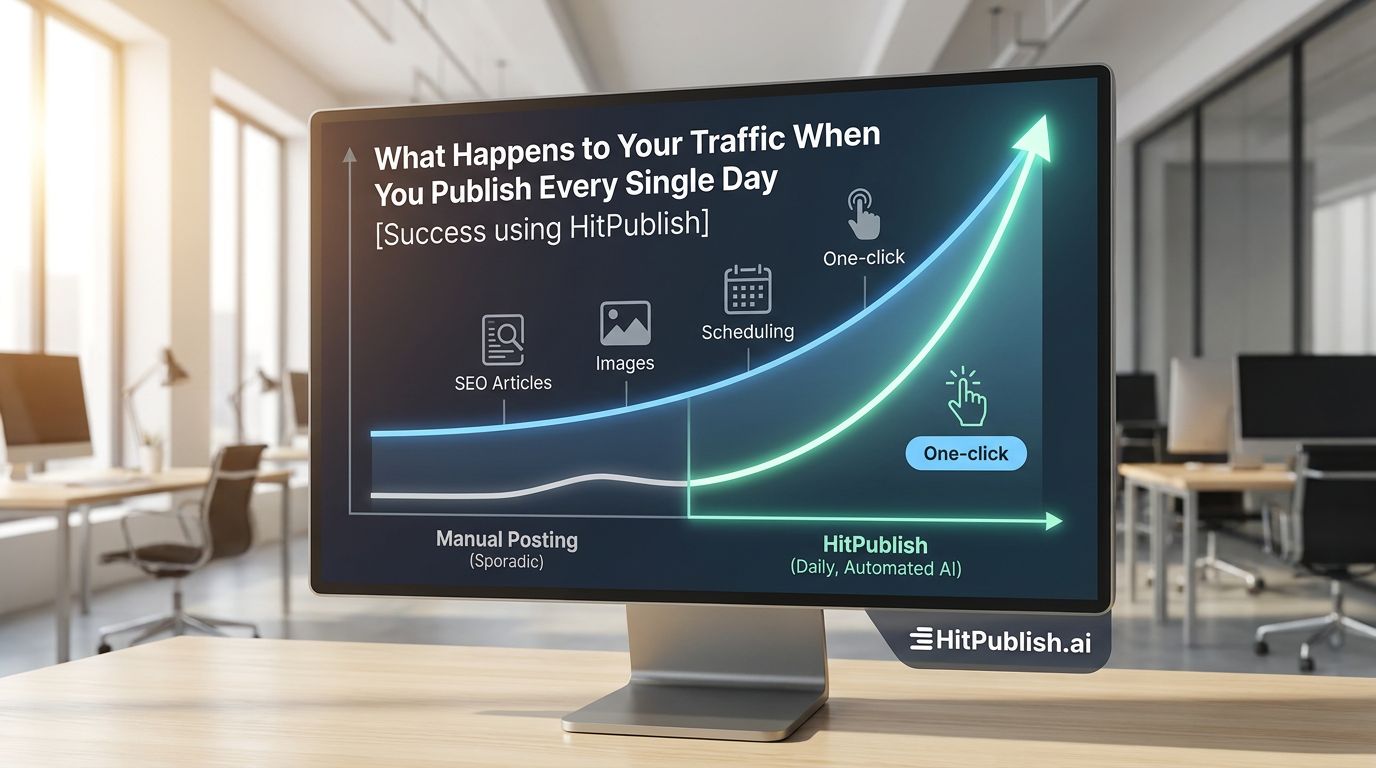
What Happens to Your Traffic When You Publish Every Single Day
Publishing every single day isn’t a vanity metric. It’s a measurable experiment that tests your topics, your processes, and your audience’s appetite in real time. The daily cadence forces you to tighten workflows, improve SEO habits, and accelerate learning. If you want traffic growth that sticks, daily publishing isn’t magic; it’s discipline, systems, and honest iteration. This article breaks down what happens to your traffic when you publish daily, with actionable steps, practical examples, and a pragmatic path to sustainable gains.
Introduction to the daily publishing mindset
The first week matters more than you expect. Daily publication creates a compounding effect only when you have clarity on goals and audiences. You’ll typically see a bump in indexability, a wider spread of long tail keywords, and a broader footprint on search engines. The catch is consistency. If you skip days, you reset momentum and slow the learning loop. When you publish daily, you build a library of content that serves different intents and stages of the buyer journey, from awareness to decision. In practical terms, expect consistent, incremental traffic growth rather than overnight miracles. This approach suits teams using AI-assisted content creation, SEO planning, and multi-site publishing to scale without sacrificing quality.
What happens to traffic on day one and the weeks that follow
Day one delivery feels like a spike in cognitive load. You publish, search engines crawl, and early visitors test relevance. If your topic aligns with current questions, you’ll see a small uptick in impressions and a handful of visitors from niche queries. The more accurate your on-page signals—titles, headers, internal links, and schema—the faster you move from impression to click. In week two, you begin to notice interlinking effects: internal navigation routes user journeys, boosting dwell time and reducing bounce. You may see initial referral traffic from social shares if your headlines resonate. The most critical metric at this stage is consistency: your daily publication habit should translate into predictable weekly increments, not wild fluctuations. Case studies show domains that maintain a steady cadence outperform sporadic publishers over a 90-day window.
Content breadth and keyword expansion
Publishing daily expands topic coverage and keyword universes. Each new post adds potential semantic signals to your site, enabling word variety and topic clusters. Over time, you’ll rank for more long tail terms and niche queries. This is where ai-assisted content generation tools shine: they speed up draft production, enable rapid keyword mapping, and help maintain a consistent voice across sites. The risk is content fatigue—low quality slipping through because volume outpaced editing. Mitigate this by enforcing editorial standards and using optimization checks before publication.
Internal linking and site structure
Daily publishing naturally improves internal linking maps. A robust set of articles provides more opportunities to connect related topics. Strategic interlinks lift page authority and help search engines discover deeper content layers. You should choreograph weekly link goals: link from newer posts to cornerstone guides, rotate anchor text, and audit orphaned pages monthly. Expect improved crawl efficiency and better distribution of link equity as your library grows.
Key mechanisms driving traffic growth with daily publishing
- Indexing velocity: more pages mean faster discovery by search engines, provided quality signals remain strong.
- Topic breadth: broader coverage reduces competition friction and captures more diverse search intents.
- Authority distribution: consistent output builds perceived expertise, boosting click-throughs from search and social.
- Content freshness signals: frequent updates signal relevance to search engines, particularly for time-sensitive topics.
- Audience learning loops: daily experiments reveal what resonates, guiding future topics and formats.
Practical tracking plan
Track these anchors weekly: organic impressions, organic clicks, average position, and bounce rate per post. Monitor topic clusters and which posts drift in ranking. Review performance every Friday and adjust next week’s editorial calendar accordingly. Establish a baseline by publishing for 4 weeks before judging efficacy. This discipline prevents chasing vanity metrics and preserves signal quality.
Strategies for sustainable daily publishing
Daily publishing is not a free-for-all. It requires a disciplined system. The following strategies help you scale without burning out or degrading content quality.
1) Content planning that aligns with intent
Start with a quarterly intent map: audience pains, questions, and decisions. Translate these into weekly topics and daily post ideas. Use a keyword map to assign posts to audience stages: awareness, comparison, decision. Maintain a lightweight editorial calendar to keep volumes manageable while preserving quality. When you publish with intent alignment, your content ladder becomes a tool, not a race to publish.
2) AI-assisted workflow that preserves human judgment
Leverage ai to draft, ideate, and summarize, but insert human review for accuracy, tone, and trust cues. Use ai to generate outlines, meta descriptions, and internal linking suggestions. Maintain a strong editorial hand: every post should pass a defined three-stage check—relevance, accuracy, and originality. AI should accelerate creation, not replace critical thinking or factual verification. The best teams combine AI speed with human refinement to keep quality high while publishing daily.
3) SEO optimization as a built-in process
Integrate SEO into every publish: keyword targets, semantic variations, schema, and internal linking. Use short, descriptive URLs; craft compelling title tags; add H1s that match intent. Add schema where relevant and ensure mobile usability. Create evergreen core pages and use daily posts to push traffic toward those assets. If you automate SEO checks, you’ll preserve consistency without grinding to a halt.
4) Multi-site publishing and content orchestration
In an AI-driven multi-site setup, standardize templates, styles, and formats. Centralize topic ideation and reuse successful formats across sites to amplify reach. Coordinate posting schedules so that different sites cover complementary angles without cannibalizing each other’s keywords. The orchestration layer becomes the engine of growth, not a bottleneck.
5) Quality guardrails and audit cadence
Set minimum quality thresholds: factual accuracy, originality, readability, and accessibility. Run quarterly audits for technical SEO, on-page optimization, and content gaps. Use automated checks for broken links, outdated stats, and duplicate content. A light touch audit preserves momentum while catching issues early.
Case studies and real-world examples
Example A shows a mid-sized marketing site that published daily for 12 weeks. Traffic rose 38% overall, with a notable uptick in long-tail keyword rankings. The team used AI to generate drafts, but editors refined every post for accuracy and voice. Within three months, the site owned several topic clusters, and internal links guided readers to a core guide, expanding session duration.
Example B focuses on a WordPress-based network. Each site followed a shared publishing blueprint: publish cadence, meta optimization, and interlinking rules. Traffic grew by 22% in two months, with strong gains on lower-competition queries. The network avoided keyword cannibalization by rotating focus areas and routing pages to central pillars. The improvement wasn’t dramatic overnight, but the stability and predictability of traffic rose noticeably.
As detailed by the AI-driven publishing resource network, daily content strategies achieve compound growth when you balance speed with diligence and ai-assisted optimization. The key is to treat daily publishing as an operating system for your content business, not a random sprint. The systems become the differentiator, not the topics alone.
Actionable tips to implement today
Build a starter playbook you can execute without delay. Below are concrete steps you can implement this week to begin daily publishing with confidence.
- Develop a 4-week topic map: five core themes, ten subtopics per week, and three post ideas per subtopic.
- Set up a lightweight editorial template covering title, meta, headings, schema, internal links, and accessibility notes.
- Utilize ai to draft outlines and first-pass drafts; reserve human review for factual checks and tone tuning.
- Create a pillar page for each core theme and map daily posts to support sections of those pillars.
- Automate basic SEO checks: readability, keyword density, alt text for images, and structured data presence.
- Monitor weekly metrics: impressions, clicks, CTR, average position, and time on page; adjust topics based on data.
- Schedule cross-site publication to balance topics and avoid keyword competition between sites.
Tools and tactics for ai-powered content creation
Choose tools that integrate with your CMS, support batch processing, and offer reliability. Use ai for idea generation, drafting, and translation, but always run human checks for accuracy, tone, and compliance. When you combine human oversight with automation, you can publish daily without sacrificing trust or quality. The resulting content ecosystem is more resilient and scalable than manual-only workflows.
Common pitfalls and how to avoid them
- Quality degradation: enforce a minimum standard and perform quick revisions before publishing.
- Content fatigue: rotate formats (how-to, list, case study, interview) to keep readers engaged.
- Topic overlap: maintain a master keyword map to prevent cannibalization across posts.
- Operational burnout: distribute load across team members and automate repetitive tasks where safe.
Measuring success and defining the trajectory
Concrete metrics matter more than vibes. Track weekly: impressions, clicks, click-through rate, average position, dwell time, and return visitors. Build dashboards that show topic clusters, pillar page performance, and internal linking flow. The aim is to reveal patterns: which topics drive sustainable traffic, which formats convert, and how the site’s authority grows over time.
“Consistency compounds. Daily publishing turns tiny wins into a measurable growth curve that lasts.” — Research and field observations across multiple marketing networks
Quotes and citation
Industry observers emphasize that disciplined, AI-supported publishing improves content velocity while protecting quality. The practical takeaway: commit to a cadence, not a vanity metric, and let data guide you toward repeatable wins.
Final considerations and a call to action
Daily publishing is a deliberate strategy, not a reckless sprint. It requires a reliable process, clear goals, and a willingness to refine. If your organization can sustain the effort, you’ll generate a larger, more engaged audience, improve SEO visibility, and build a content catalog that fuels long-term traffic growth. Start with a 4-week pilot, establish guardrails, and measure the signal you actually need: steady, incremental gains that compound over time. Then decide whether to scale to a multi-site publishing engine that leverages AI, automates routine tasks, and keeps the human touch intact.
Implementation checklist
- Define topic clusters and pillar pages for your site network.
- Set up editorial templates and automated checks for SEO signals.
- Integrate ai-assisted drafting with mandatory human review gates.
- Publish a set number of posts per week, tracking the impact on traffic and engagement.
- Review data weekly and adjust the calendar to optimize for sustainable growth.
In our AI-driven multi-site publishing world, daily content can be a powerful engine. It rewards discipline, smart automation, and relentless iteration. The path to more traffic is not flashy; it’s a steady climb built on consistent output, thoughtful optimization, and a deep understanding of your audience’s questions. Start tomorrow, and let the data tell you where to go next.