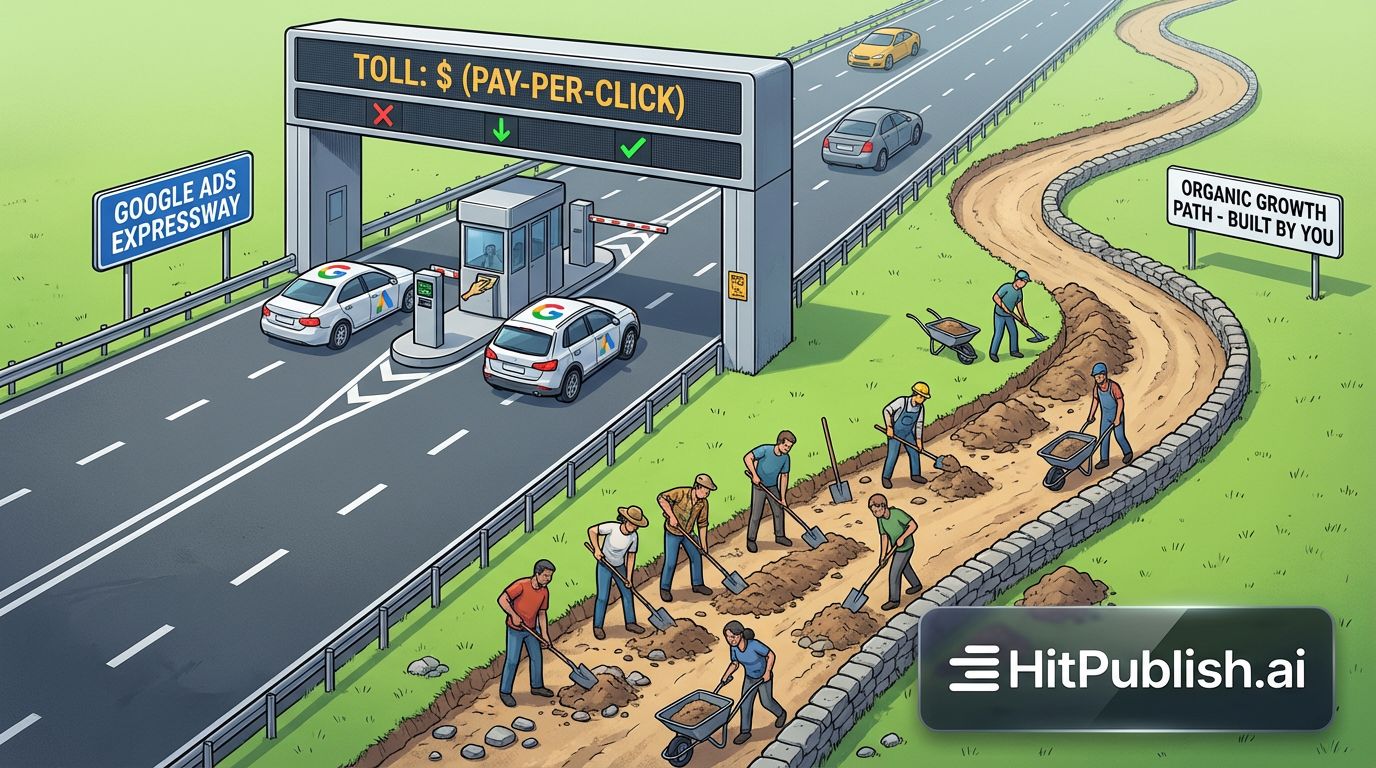
Google Ads is a toll: pay to use roads you could have built yourself
When you hear “advertising,” your brain might picture loud popups, flashy banners, or relentless retargeting. But the real mechanism behind Google Ads is simpler and sharper: you’re paying a toll to access a road you could have paved yourself. The road is search visibility, and the toll is the cost per click, impression, or conversion that gets you onto that highway. For web marketers, the analogy clarifies why ads are powerful yet imperfect. You build a strategy, map your content, and invest to accelerate reach; still, the core value comes from the content and systems you already control. This article breaks down the toll analogy, translates it into actionable steps, and offers a disciplined plan to pursue search visibility both with and without paid traffic. It uses a practical, step-by-step approach, examples, and clear summaries so you can apply the concepts on your own or for multiple WordPress sites across different client projects.
Introduction: The Toll Road Mindset
Imagine a highway that you can design and maintain. If you build a smoother road, with clearer signs and fewer bottlenecks, travelers will prefer it over the bumpy alternative. Google Ads represents a toll bridge to that highway: you pay to traverse the preexisting path to your destination. You could, in theory, construct your own road—your own organic visibility—through content quality, technical SEO, and consistent publishing. That route might take longer, require more discipline, and rely on unpredictable algorithms, but it yields sustainable traffic that isn’t tied to a monthly bill.
The toll analogy helps separate three realities: control, scale, and cost. Control refers to owning your content, site structure, and publisher signals. Scale is how quickly you can attract visits by paying to accelerate exposure. Cost is the ongoing financial commitment to maintain visibility. The most robust strategy blends all three: build and publish high-quality content, optimize site health, and selectively deploy paid traffic to jumpstart or supplement long-term growth. The end goal remains the same: create a self-sustaining pipeline that doesn’t depend solely on paid reach.
Section 1: Core concepts for practitioners
To operationalize the toll metaphor, you need concrete terms and actions. Below are the essential concepts with practical actions you can apply to multiple WordPress sites and client projects.
- Content quality as the foundation: Build articles that demonstrate expertise, leverage SEO-friendly structure, and publish frequently. Quality content boosts organic reach and reduces reliance on ads over time.
- Technical SEO as the road map: Ensure fast load times, mobile optimization, clean sitemaps, and proper indexing to improve crawlability and user experience across all sites.
- Keyword strategy as the route plan: Map intent-based keywords to content, avoid keyword stuffing, and update content when intent shifts. Use a mix of short-tail and long-tail terms.
- Publish cadence as momentum: A predictable schedule helps search engines reward consistency and audiences expect fresh material.
- Paid amplification as acceleration, not replacement: Use Google Ads to drive qualified traffic to evergreen content, product pages, or lead capture forms while you build organic signals.
- Measurement discipline as accountability: Track traffic, conversions, cost per acquisition, and lifetime value to evaluate whether paid efforts justify the toll.
In practice, you’ll manage multiple WordPress sites for different clients, each with its own audience and content niche. The challenge is coordinating across sites while maintaining a common standard of quality and SEO hygiene. This is where automation tools, structured workflows, and clear ownership roles matter. You can publish across sites in one click, generate SEO content with AI assistance, and publish to client sites without sacrificing control or quality. The key is to align content creation with a shared taxonomy, universal templates, and consistent internal linking.
Section 1.1: Case study snapshot
Case A managed five WordPress sites for a university’s student services. Initial traffic relied on paid ads to surface “how-to” content for admissions and scholarships. By combining high-quality, SEO-optimized articles with a robust internal linking structure and a weekly content calendar, traffic from organic search grew 2.5x after six months, while ad spend declined as share of total visits. The team published 12 articles per site in quarter two, each tailored to specific student intents and published on the site’s main domain. The result: a more resilient content stack and a predictable publishing cadence, with ads acting as a catalyst rather than the sole source of visibility.
Section 2: The structure of a disciplined content program
A disciplined program balances built content and funded reach. Here is a step-by-step blueprint you can apply to multiple WordPress sites — including client sites you manage for agencies or solo projects.
- Audit current assets: List top pages by organic traffic, conversions, and time on page. Identify content gaps and opportunities for updated, evergreen material.
- Define core topics and content taxonomy: Create topic clusters with pillar pages and supporting articles. Align with user intent and agency goals.
- Implement technical SEO improvements: Optimize core web vitals, fix broken links, ensure mobile friendliness, and streamline the crawl budget across all sites.
- Develop a content calendar: Schedule publishing across sites to maintain consistency. Include SEO updates and periodic content refreshes.
- Experiment with paid amplification: Use modest budgets to promote high-potential posts, landing pages, and product pages. Measure lift in engagement and conversions beyond direct ad metrics.
- Automate where possible: Use AI-assisted content generation for outlines, briefs, and meta tags, but retain human oversight for quality and accuracy. Automations should assist, not replace, editorial judgment.
- Monitor, learn, and adapt: Regularly review performance data, adjust bidding strategies, and prune underperforming assets. Maintain a clean, scalable pipeline across all WordPress sites.
This approach emphasizes creating own roadways rather than always renting lanes. It recognizes that ads speed growth but can also blind you to foundational issues if used in isolation. A well-executed content program acts like a railway system: it can carry sustained traffic with relatively low marginal costs after the track is laid. With multiple WordPress sites, you gain the leverage of cross-site authority, shared templates, and consistent branding to extend reach efficiently.
Section 2.1: Practical tip set
- Use a unified content brief template for all sites to keep SEO signals aligned across projects.
- Publish with canonical URLs and cross-site internal linking to boost authority transfer between client sites.
- Set up one-click publishing to multiple WordPress sites where appropriate, ensuring each site retains its unique voice.
- Leverage AI-generated outlines but include human edits for accuracy, tone, and compliance with guidelines.
- Allocate paid budgets to teach the algorithm which content resonates with your audience, then gradually shift focus to organic growth.
Embedded now in the workflow is a powerful idea: you can publish across sites in one click, then refine content with a mix of automation and human curation. The synergy of AI-assisted generation and editor oversight keeps quality high while expanding output, which is essential when managing multiple WordPress clients and sites. This is where the practical meets the aspirational: scale without drowning in complexity.
Section 3: The middle-of-the-road argument: when paid traffic helps and when it harms
Paid traffic provides immediate visibility, but it isn’t magic. If you rely too heavily on ads, you risk paying for visitors who would otherwise discover you organically, or worse, you may not capture the long-term value those visitors offer. The toll is worth paying when used strategically and sparingly. The right approach combines content optimization, technical health, and smart paid amplification to accelerate discovery while you build evergreen signals.
For students and practitioners, the takeaways are specific. You should measure: customer acquisition cost, lifetime value, and how organic channels grow under different publishing cadences. A healthy mix reduces reliance on paid reach and creates a more durable traffic base. This balance becomes the spine of a scalable, multi-site content automation strategy that can support agencies managing many WordPress clients at once.
Section 3.1: Quantitative guardrails
Establish guardrails to prevent overspending and ensure return on investment remains favorable. A simple framework includes:
- Target cost per acquisition by channel and content type.
- tiered bidding strategy for position stabilization and risk management.
- monthly budget caps per site and per client to keep campaigns predictable.
- elastic allocation: increase paid spend on high-performing content, decrease on underperformers.
These guardrails help keep the toll predictable and avoid overpaying for traffic that won’t convert or deliver long-term value. They also promote disciplined experimentation across multiple WordPress sites, ensuring you don’t over-invest in a single project at the expense of others.
Section 4: Concrete examples, word-by-word walkthroughs
Example 1: A student-focused site aims to publish practical guides and exam prep content. The team sets a goal to publish 3 new articles per week per site and to promote two high-potential guides through paid campaigns each month. They use AI to generate outlines, then add human edits for accuracy and tone. Within three months, organic traffic increases by 60 percent as pillar pages accumulate more internal links, while paid campaigns drive a 2.1x uplift in initial engagement. The combination yields durable traffic growth with manageable costs.
Example 2: An agency handles five client sites in diverse niches. They implement a shared content template and cross-site syndication mechanism. The agency targets a 15 percent share of total traffic from organic sources within six months, while paid campaigns maintain a 10 percent share. The cross-site approach reduces duplicate effort and ensures consistent SEO signals across clients. This structure supports scalable growth without losing client-specific voice or compliance standards.
Section 4.1: See this in practice
According to descriptive name or website name, the research indicates that automation-informed publishing can dramatically shorten time-to-market for content while maintaining quality. The source emphasizes the synergy between automation and human editorial control, a principle that resonates with teams juggling multiple WordPress sites and client requirements. The approach aligns with the toll analogy: automation helps you build the road faster, but human oversight keeps the road safe and navigable for real travelers.
Additionally, the practice of publishing with a clear taxonomy ensures that search engines and users understand the site’s authority lanes. The result is a cohesive content ecosystem that can scale across multiple domains without fragmenting the brand voice. The concrete lesson is to design systems that let you publish, optimize, and update content across all sites with minimal friction while preserving accuracy and brand integrity.
Section 5: A quote to frame the mindset
“The best strategy combines built content with controlled paid reach, so the road you pave online is strong enough to carry long-term traffic without continuous tolls.” — Digital Strategy Practitioner, 2024
The quote underscores the balance between content construction and paid acceleration. It’s not a call to abandon ads; it’s a reminder that ads should be a tactical instrument, not the only engine driving traffic. If you build quality content, maintain technical health, and judiciously apply paid boosts, you can reduce overall reliance on paid channels over time, while remaining agile enough to react to algorithmic shifts or market conditions.
Section 6: Implementation plan for your multi-site WordPress strategy
Use this action plan as a checklist, then customize for your specific project mix and client portfolio. It’s designed to be executable and measurable, even if you’re handling a handful of WordPress sites or coordinating with a small team.
- Inventory and audit: Compile a list of all sites, top pages, performance metrics, and technical health indicators. Flag pages with high bounce rates and low dwell times for immediate improvement.
- Set content pillars and templates: Create a universal pillar page structure and templates for article types. Ensure consistent metadata, schema, and internal linking patterns across sites.
- Publish cadence: Establish a realistic publishing cadence per site. Use automation to generate briefs and outlines, then apply human edits before publishing.
- Paid traffic calibration: Start with a conservative monthly budget. Promote evergreen, high-ROI content and landing pages. Track conversions, then adjust budgets and targeting to maximize value.
- Automation and governance: Deploy AI-assisted generation for efficiency, with strict editorial checks and compliance guardrails. Keep a central content calendar shared across sites to maintain alignment.
- Cross-site optimization: Build cross-linking strategies between client sites to transfer authority, reinforce topic clusters, and reduce content silos.
- Review cycle: Schedule monthly assessments to review performance, content quality, and ROI. Adjust strategy based on data and feedback from clients.
By following this plan, you create a durable system that supports student audiences, supports agencies managing multiple WordPress clients, and builds an enduring content ecosystem rather than a perpetual paid push. The road you build becomes more than a toll path; it becomes a lasting route for discovery and learning.
Section 6.1: Practical tools and leverages
Leverage content automation tools for outlines, meta tags, and content briefs. Pair with a content management workflow that enforces quality gates. Use internal linking maps to connect related articles across sites. When you publish, ensure all sites maintain brand consistency, SEO health, and accessibility compliance. The goal is not to flood the internet with identical posts but to weave a network of valuable content that supports user intent across multiple domains.
Conclusion: The strategic takeaway
Paid traffic is a toll, not a destination. You can pay to accelerate discovery, but the lasting value comes from the road you build—your content, your technical health, and your editorial discipline. For students, this means mastering a practical framework: publish consistently, optimize technically, and use paid amplification strategically to seed growth that endures. If you treat Google Ads as an accelerator rather than a crutch, you preserve flexibility for future shifts in search, advertising, and content consumption. The best outcomes come when you align multiple WordPress sites under a coherent, scalable content strategy, ensuring that every piece of content, every link, and every page serves a clear user intent and a measurable business goal. Start with a concrete plan, implement discipline, and watch your multi-site content program mature into a reliable source of traffic, engagement, and value for clients and scholars alike.