The Hidden Time Cost of Manual WordPress Article Publishing
The Hidden Time Cost of Publishing Articles Manually on WordPress
In the modern digital landscape, content is king. Businesses, bloggers, and academic institutions alike rely heavily on publishing articles to engage audiences, boost SEO, and establish authority. WordPress, with its user-friendly interface and vast ecosystem, remains the dominant platform for content publishing. However, beneath its approachable facade lies a hidden challenge—namely, the significant time investment required for manual article publication. While many assume that publishing on WordPress is straightforward, the reality involves a complex interplay of tasks that, over time, can drain resources and hamper productivity. This article explores the often-overlooked time costs associated with manual publishing, examines how automation and AI tools can mitigate these challenges, and provides practical insights for scaling content operations effectively.
Understanding the Time Investment in Manual WordPress Publishing
The Multi-Faceted Process of Manual Publishing
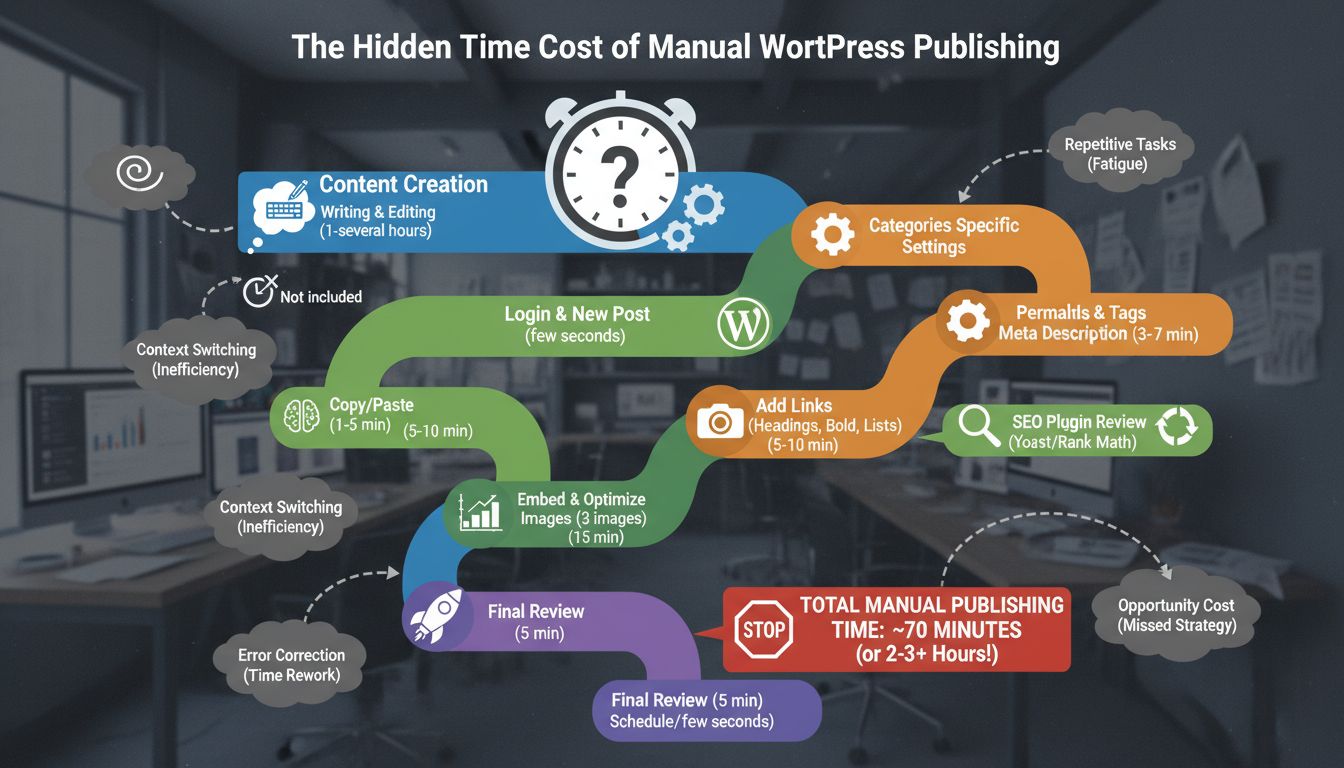
Publishing an article manually on WordPress is not merely clicking the “publish” button. It involves several interconnected steps—content creation, formatting, SEO optimization, image management, scheduling, and post-publication promotion. Each stage consumes a considerable chunk of time. For instance, content creation alone can take hours, especially if the writer is aiming for quality and SEO relevance. After that, formatting the post with headings, images, and internal links demands meticulous attention to detail.
SEO optimization is another critical component. Incorporating keywords, crafting meta descriptions, and ensuring mobile responsiveness all require additional effort. These tasks, while essential, are often underestimated in terms of their time consumption. In some cases, the process of manually inserting internal links or adjusting media can take up as much time as writing the content itself. This cumulative effort becomes a bottleneck, especially when publishing frequency is high or when managing multiple sites.
Impact of Multi-site Management
For agencies or content marketers managing multiple sites—say, a network of niche blogs or corporate portals—the time costs multiply exponentially. Each site might have unique formatting standards, SEO strategies, or branding requirements. Manually repeating the same process across several platforms leads to redundant work, increasing the risk of errors, inconsistencies, and delays. Managing a multi-site setup effectively demands a robust process, yet many still rely on manual publishing, which is inherently inefficient.
The Hidden Costs: More Than Just Time
Opportunity Cost and Productivity Loss
Time spent on manual publishing isn’t just about the clock ticking. It directly affects a team’s overall productivity. When hours are allocated to routine publishing tasks, fewer resources remain for strategic activities like content planning, audience engagement, or data analysis. For content teams aiming for rapid scaling, this bottleneck can hinder growth and innovation. The opportunity cost becomes especially evident when considering the potential gains from automating repetitive tasks, freeing up human capital for higher-value work.
Quality and Consistency Challenges
Manual processes are prone to inconsistencies—missed SEO optimizations, formatting errors, or overlooked internal links. These issues, while seemingly minor, cumulatively degrade site quality and SEO performance. For example, neglecting to add alt text to images or failing to update meta descriptions can negatively impact search rankings. Ensuring consistency across multiple articles and sites requires rigorous oversight, which adds further to the time burden.
Technical Hurdles and Learning Curves
WordPress’s flexibility is one of its strengths but also a source of complexity. New users often spend considerable time troubleshooting plugin conflicts, updating themes, or fixing broken links. For teams without dedicated technical staff, this translates into wasted hours that could be better spent on content development. Moreover, frequent platform updates can introduce new challenges, necessitating ongoing training and adaptation.
Leveraging AI and Automation to Cut Down Publishing Time
The Promise of AI in Content Creation and Optimization
Artificial intelligence has revolutionized content marketing, particularly in automating content creation and SEO optimization. AI-powered tools can generate drafts, suggest keywords, and even write entire articles based on minimal input. For WordPress users, integrating AI tools streamlines the content pipeline, reducing the time from conception to publication. For example, AI content generators can produce initial drafts that require only editing, saving hours of writing time.
Moreover, AI can assist with SEO by analyzing keyword density, readability, and site structure, ensuring content is optimized for search engines without manual effort. Automating SEO tasks—such as meta tag insertion, internal linking, and image alt text—further accelerates the publishing process. As detailed in the AI content and SEO automation platform HitPublish, these tools are increasingly capable of handling multiple facets of publishing, allowing teams to scale efficiently.
Automating Routine Tasks: From Formatting to Scheduling
Beyond content creation, automation can handle formatting, media insertion, and scheduling. WordPress plugins and third-party tools enable scheduled publishing, batch uploading, and even content redistribution across multiple sites. This is especially valuable for agencies managing multi-site portfolios, where uniformity and timing are critical. Automating these steps minimizes human error and frees time for strategic activities like audience engagement or analytics.
Case Study: Scaling Content Production with AI
Consider a digital marketing agency managing 20 niche blogs. Before adopting automation, their team spent approximately 30 minutes per article on formatting and SEO. Implementing AI-driven content generation and automation tools cut this down to under 10 minutes per article. Over a month, this change allowed them to publish three times as many articles, significantly boosting traffic and lead generation. The key takeaway is that integrating AI tools like those found on HitPublish enables agencies to scale without proportionally increasing resource allocation.
Practical Strategies for Reducing Publishing Time
Adopt a Content Workflow Framework
Establishing a clear workflow reduces confusion and saves time. Use project management tools to assign tasks, set deadlines, and track progress. Define steps such as content drafting, editing, SEO review, formatting, and scheduling. Automate repetitive steps where possible, like image resizing or internal linking, through plugins or scripts.
Leverage AI Content and SEO Tools
Utilize AI-powered platforms that offer AI content generators and SEO optimization. These tools can produce first drafts, suggest keywords, and automatically generate meta descriptions. Regularly updating your toolkit with the latest AI innovations ensures you stay ahead of the curve and maximize productivity.
Implement Batch Publishing and Scheduling
Batch content creation and scheduling reduce context switching. Instead of publishing articles individually, prepare multiple posts in one session and schedule them over the week or month. This approach minimizes disruptions and ensures a steady flow of content without constant manual intervention.
Train and Delegate
Invest in training team members on automation tools and best practices. Delegating routine tasks to less specialized staff frees up senior writers and strategists for high-level planning. As a result, the overall efficiency of the content operation improves.
Embracing Automation for Sustainable Content Growth
Manual publishing on WordPress, while seemingly straightforward, entails a hidden time cost that can hamper scalability and productivity. Recognizing these costs is the first step toward adopting smarter workflows. By leveraging AI and automation tools—like those highlighted by HitPublish—teams can dramatically reduce the time spent on routine tasks. This not only accelerates content delivery but also allows for more strategic focus on content quality, SEO, and audience engagement.
In an era where content marketing and SEO are more competitive than ever, embracing automation is no longer optional but essential. The key lies in integrating these technologies seamlessly into your publishing process, thereby transforming a traditionally time-consuming activity into a streamlined, scalable operation. Doing so will boost your site traffic, improve SEO rankings, and ultimately, support sustained growth in a crowded digital marketplace.
Careful planning, strategic use of AI tools, and continuous process refinement can turn the hidden time costs of manual publishing into a thing of the past. The future belongs to those who adapt quickly and leverage technology to their advantage. The path to more efficient content creation and publication begins now.